
EMDR Intensives for Mothers: When You Know You Need Help But Can't Make Weekly Therapy Work
You've thought about going back to therapy. Maybe more than once. Maybe you've even started, and then a sick kid, a scheduling conflict, a season of too much took over and you let it drop. Or you're in therapy now and something about it feels like it's not getting to the thing that actually needs attention.
The desire is there. The time and the logistics are not cooperating.
This is one of the most common things I hear from mothers who reach out to me. Not "I don't think I need help," but "I can't figure out how to make help actually work with my life."
EMDR Intensives exist for exactly this situation.
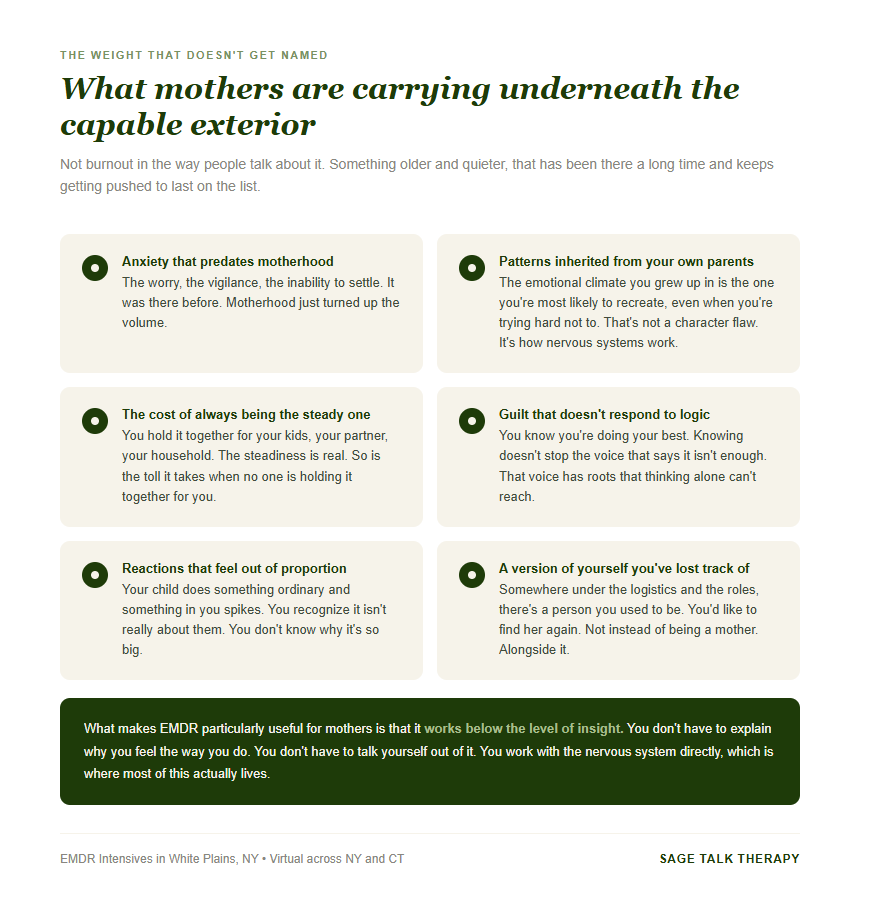
What Mothers Are Actually Carrying
The anxiety and burnout that brings mothers to therapy is often described in terms of the role. The mental load, the invisible labor, the depletion of always being the one who holds it together.
All of that is real. But underneath it, in my experience, there's usually something older.
Anxiety that was there before the children. Patterns inherited from your own parents that are now showing up in how you parent, even when you're actively trying not to repeat them. The cost of having been the capable one, the steady one, the one who managed, for most of your life. Old experiences that never fully processed because you were too busy managing to stop and feel them.
Motherhood turns up the volume on all of it. The vigilance that felt functional before now operates at a higher frequency. The self-criticism that you could compartmentalize before now has more material to work with. The guilt that you could push aside before now has a face and a name attached to it.
Why This Keeps Getting Pushed to Last
Mothers are extraordinarily good at identifying what everyone else needs and chronically underqualified at applying the same standard to themselves. That's not a personality flaw. It's a combination of cultural conditioning, nervous system patterning, and the practical reality that someone actually has to hold everything together.
But there's also a structural problem, which is that the standard model of therapy asks a lot of you before it gives anything back.
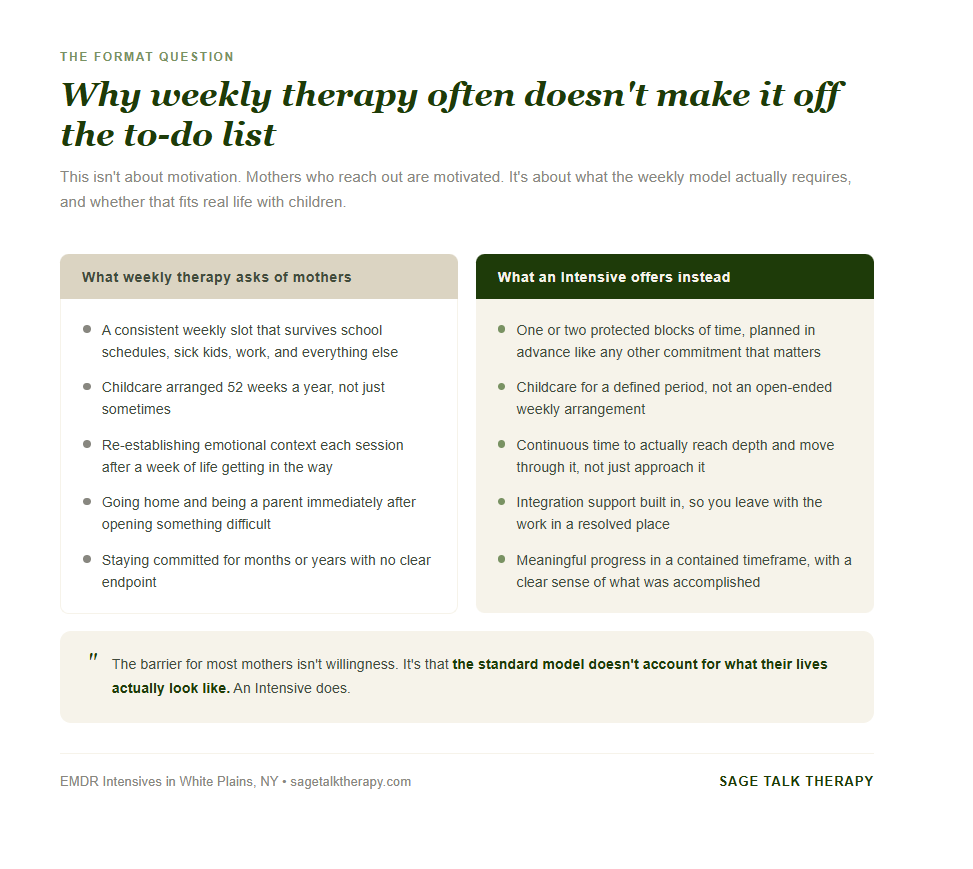
Weekly sessions require a protected time slot, ideally the same time every week, that survives school schedules, sick children, work demands, seasonal chaos, and everything else. They require childcare arranged not once but as an ongoing commitment. They ask you to open something difficult in fifty minutes and then go directly from the therapist's office back into the role.
For many mothers, this isn't a motivation problem. It's a logistics problem. The format doesn't fit the life.
What the Intensive Format Offers Instead
An EMDR Intensive is a concentrated block of therapy time, planned in advance like any other commitment that matters, that does not require you to protect a weekly slot indefinitely.
For a mother, that distinction is significant.
Instead of fifty minutes once a week for months, the Intensive condenses the work into extended sessions over a defined period. You arrange childcare once. You block the time intentionally. You show up with focus. And because the sessions are longer, we can actually reach the depth of the work rather than spending most of the hour getting there.
There is also something practically meaningful about having a clear beginning and end to a piece of work. You know what you're doing, you know the timeframe, you do it, and you have something to show for it. That structure often feels more manageable than an open-ended weekly commitment with no defined horizon.
This doesn't mean the work is rushed. Intensive formats include a preparation session before the processing begins and an integration session after. The work is held carefully. You're not left with things unresolved and nowhere to put them.
The EMDR Piece: Why It Matters for What Mothers Carry
Mothers dealing with anxiety, inherited patterns, and the accumulated cost of always being the capable one often find that traditional talk therapy moves slowly because it stays in the realm of insight.
You understand why you get triggered by certain things. You understand where the self-criticism comes from. You understand the connection between how you were parented and how you parent. Knowing these things is real and valuable. But it doesn't always translate into change at the level of the nervous system, which is where most of this actually lives.
EMDR works differently. It doesn't require you to explain or narrate or analyze. It works with the nervous system directly, helping the brain reprocess stored experiences so they stop generating the same automatic response. The anxiety that spikes when your child ignores you, the guilt that descends when you lose your patience, the chronic sense that you're failing even when the evidence says otherwise, these things have roots. EMDR addresses the roots.
This is also why EMDR is particularly relevant for mothers thinking about intergenerational trauma. The patterns you inherited don't have to be the ones you pass on. One of the most meaningful things this work can do is interrupt that transmission at the level of the nervous system, which is where it actually lives.
What Changes When a Mother Does This Work
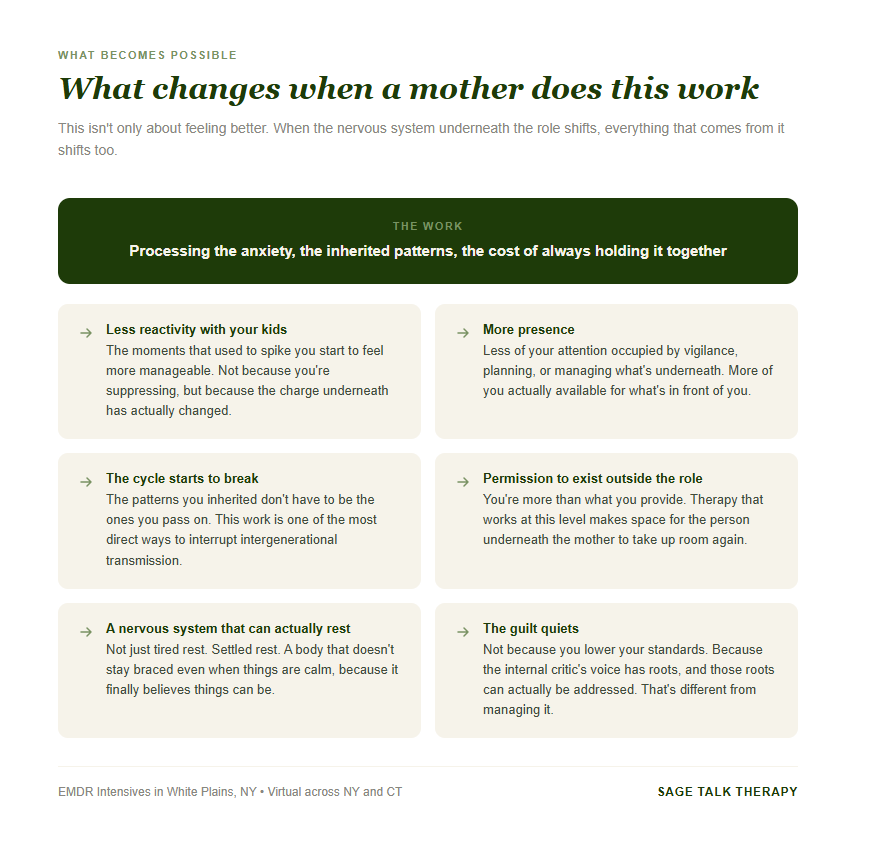
The goal of this work isn't to make you a calmer mother. That's a side effect, and it's a meaningful one. But the goal is bigger than the role.
When the underlying patterns shift, several things tend to follow:
Reactions that used to spike you start to feel more manageable. Not because you're suppressing them, but because the charge underneath has actually changed. The moments that felt intolerable become difficult but workable.
More of you becomes available for what's in front of you. Less attention occupied by vigilance, by the internal critic, by the residue of things that haven't finished processing. More actual presence with your kids, your partner, yourself.
The guilt quiets. Not because you've lowered your standards, but because the voice that tells you you're failing has roots, and those roots can actually be addressed. That's different from managing it or arguing with it.
The cycle has a chance to break. You don't have to pass on what you received. That's not guaranteed by wanting it to be different. It requires the kind of work that goes below the level of intention.
What You deserve That Isn’t About The Kids
There's a version of this conversation that frames everything in terms of what's better for your children. If you take care of yourself, you'll be a better mother. That's true. But it's not the only reason this matters.
You deserve this for yourself. Not as a means to something else. Not because it makes you more functional in your role. Because you're a person, and what you carry matters, and you've been carrying it long enough.
The Intensive format exists partly because it respects that your time is limited and your life is full. But it also exists because some things deserve more than fifty minutes a week spread across a year.
A Note on Westchester Specifically
Many of the mothers I work with from White Plains, Scarsdale, Bronxville, Pleasantville, and Eastchester are managing a particular combination: high professional demands, high expectations for themselves as parents, and very little structure in their lives that is just for them.
The pressure to do motherhood well in communities that value achievement and appearance is its own layer. The comparison. The feeling that everyone else is handling it better. The sense that asking for help, or admitting that the inside doesn't match the outside, is something you're supposed to have figured out by now.
You haven't failed at managing this. You've been carrying something that deserves more than management.
if This Resonates
I work with mothers who are high-functioning on the outside and quietly exhausted underneath. Many have been thinking about therapy for a long time. Many have tried it and found the format didn't stick. They're looking for something that takes their actual lives into account, goes to the root of what they're carrying, and produces something they can feel.
EMDR Intensives are available on a limited basis each month. If you've been putting this off, this might be the format that finally makes it possible.

Dadiana Lopez
LCSW · Anxiety & Trauma Therapist · EMDR Specialist
Dadiana Lopez is a Licensed Clinical Social Worker and EMDR therapist based in White Plains, NY. She specializes in anxiety, trauma, PTSD, and the patterns that form in the wake of both — including people-pleasing, perfectionism, and burnout. She sees clients in person in Westchester and online throughout New York and Connecticut.
Seeing clients in-person in White Plains, NY and online throughout New York and Connecticut.