
You Didn’t Choose What You Inherited. Here’s How To Start Changing It.
There is a particular kind of confusion that comes with patterns you can't explain.
The anxiety that doesn't match your circumstances. The reflexive way you shut down in conflict. The guilt that floods in whenever you try to prioritize yourself. The relationship dynamics that keep repeating no matter how clearly you can see them. The rules — about what you're allowed to want, how much space you're allowed to take up, what love is supposed to feel like — that seem to live somewhere beneath logic, immune to insight.
You didn't invent these. You inherited them.
Not in the way you inherit furniture or a last name. In the way you inherit a nervous system that was shaped by people who were shaped by people who were shaped by experiences that may have happened before you were born. The patterns that feel most stubbornly yours — the ones that make the least sense, that resist the most work — are often the ones that traveled the farthest to reach you.
This post is about understanding how that happens, and more importantly, how it can change.
what INTERGENERATIONAL TRAUMA ACTUALLY IS
Intergenerational trauma — also called generational trauma or transgenerational trauma — refers to the way trauma's effects move through families across generations. It is not simply a metaphor for difficult family patterns. Research shows that trauma can actually affect gene expression and be passed down through generations — not just through stories or behaviors, but biologically. This is called epigenetics.
Intergenerational trauma refers to trauma-related effects observed in children of exposed parents, while transgenerational trauma describes effects observed in later generations without direct exposure. Proposed mechanisms involve interacting biological and psychosocial processes, including stress-responsive regulatory systems, epigenetic variation, and caregiving environments.
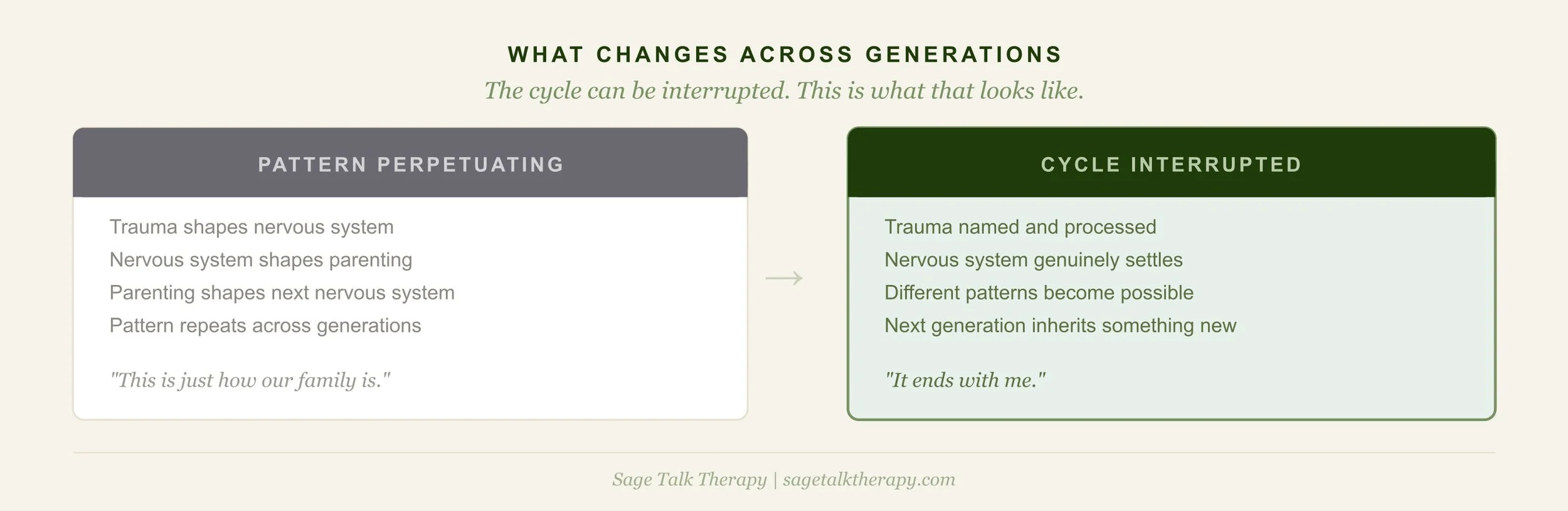
In plain language: when someone experiences significant trauma, it changes how their stress response system functions. Those changes affect how they parent, how they regulate, how they attach, what they model, and what they pass on — both through the relational environment they create and, research increasingly suggests, through biological mechanisms that alter how stress-response genes are expressed in their children.
This phenomenon was first observed in the 1960s when psychiatrists treating children of Holocaust survivors noticed these children exhibited symptoms similar to their parents despite living in safe environments — symptoms including anxiety, hypervigilance, and distrust, which seemed inherited rather than acquired.
This isn't destiny. But it is real. And recognizing it as real — not as weakness, not as drama, not as making excuses — is where the work begins.
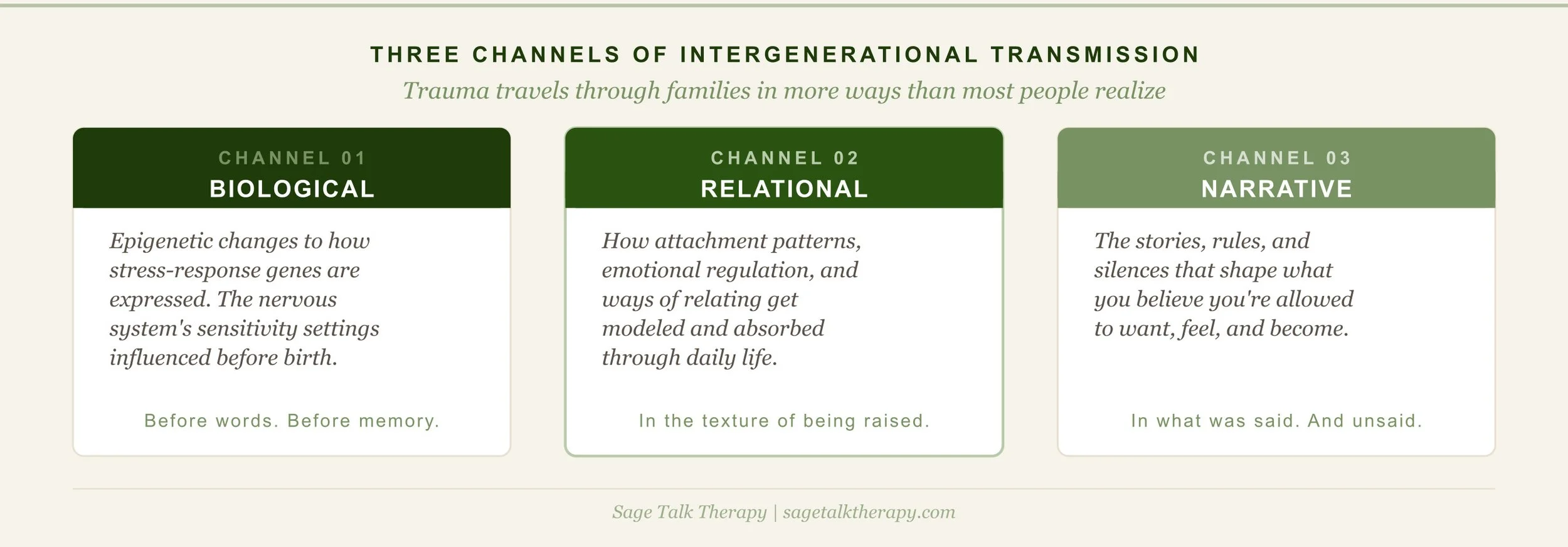
The three channels it travels through
Intergenerational trauma doesn't travel through one pathway. It moves through families in at least three distinct ways, often simultaneously.
The biological channel
The stress response system — the nervous system's threat-detection and activation machinery — is partly shaped by experience, and partly transmitted through the biological environment of pregnancy and early development. A parent whose own stress system is chronically activated creates a physiological environment that influences how their child's stress system calibrates.
This doesn't mean trauma is hereditary in the way eye color is. It means the nervous system's sensitivity settings are influenced by what came before. A child born to a parent carrying unresolved trauma may arrive in the world with a threat-detection system already oriented toward vigilance — not because of anything they've experienced personally, but because of what their parent's body carried.
This helps explain why anxiety, hypervigilance, and stress sensitivity can show up so early in life, before the child has had the experiences that are typically assumed to produce them.
The relational channel
This is the channel most people intuitively understand, though they often underestimate its depth.
How a parent was parented shapes how they parent. Not through conscious choice — often in spite of conscious choice. The parent who swore they would never be like their own parent, and finds themselves doing exactly the same thing in moments of stress, is experiencing the relational transmission of pattern in real time.
This moves through attachment — how available, attuned, and consistent caregiving is. Through emotional regulation modeling — what the child learns about how to manage difficult feelings by watching the adults around them. Through the explicit and implicit messages about what is safe, what is dangerous, who can be trusted, what happens when things go wrong.
The child doesn't need to know the family history to absorb its lessons. The lessons are in the texture of daily life — in how conflict is handled, what happens when someone needs something, whether comfort is reliably available, what emotions are permissible and which ones get suppressed.
The narrative channel
Every family has a story — and the stories we inherit about who we are, what we're capable of, and what we're allowed to want shape us in ways that can be as powerful as anything that happens to us directly.
The family that doesn't talk about the loss. The legacy of shame that is passed down in how certain topics are avoided. The stories of survival that are told as pride but carry an implicit message that struggle is what this family does, that ease is suspect, that wanting more is a betrayal of those who had less.
Narrative transmission is often the most conscious level — we can hear it and recognize it — and yet it is not always the easiest to change, because the stories feel like truth rather than interpretation.
What it Actually Looks Like in Your Life
The clinical description of intergenerational trauma — stress hormone dysregulation, epigenetic transmission, attachment disruption — is accurate. It's also abstract. Here is what it tends to feel like from the inside.
The anxiety that doesn't have a clear source. You're anxious in ways that don't match your actual circumstances. You can't point to a specific reason. The vigilance feels older than your own life — because in some ways, it is.
The guilt around wanting something different. Pursuing a different kind of life — different values, different relationships, different ways of relating — feels like a betrayal. Like you're rejecting where you came from. This is one of the most painful and least discussed aspects of doing this work, particularly for first-generation children of immigrant families or for people breaking cycles of generational poverty, addiction, or abuse.
The patterns that keep repeating despite awareness.You can see the dynamic clearly. You understand intellectually where it comes from. You've read about it, talked about it, and still find yourself in the same relational territory again and again. The people-pleasing, the conflict avoidance, the way you shrink or the way you dominate — these aren't choices in any simple sense. They're embodied patterns, learned before language.
The sense of carrying something that isn't entirely yours. This one is harder to articulate but many people recognize it — a heaviness, a grief, an anxiety that feels somehow bigger than your own life. Like you're holding something that was handed to you without explanation.
The ways it shows up in your own relationships and parenting.This is often what brings people into therapy around intergenerational trauma — not the abstract concept, but the moment of recognition. The moment you hear your parent's words coming out of your mouth. The moment you realize you're creating the same dynamics you swore you'd leave behind.
What “Breaking the Cycle” Actually Means
The phrase "breaking the cycle" gets used a lot, and it's worth being precise about what it does and doesn't mean.
It does not mean rejecting your family, cutting ties with your history, or becoming an entirely different person. It does not require villainizing your parents or grandparents, most of whom were doing the best they could with what they had been given.
What it means is developing enough awareness of and freedom from the inherited patterns that you have genuine choice in how you respond — rather than automatic repetition of what was passed down.
That is a meaningful distinction. Automatic repetition doesn't require awareness — it just happens. Genuine choice requires that the pattern become visible, that its roots become understandable, and that the nervous system has enough new experience of safety that the old survival responses lose their grip.
This is the work. It is not quick, and it is not easy. It is also genuinely possible.
What Actually Helps
Effective interventions for multi-generational trauma often require addressing both individual psychiatric symptoms and the family environments through which trauma-related vulnerability is expressed and reinforced. Prevention and treatment approaches tend to span multiple levels, including trauma-focused therapy, attachment and relationship-based interventions, and broader strategies that support regulation.
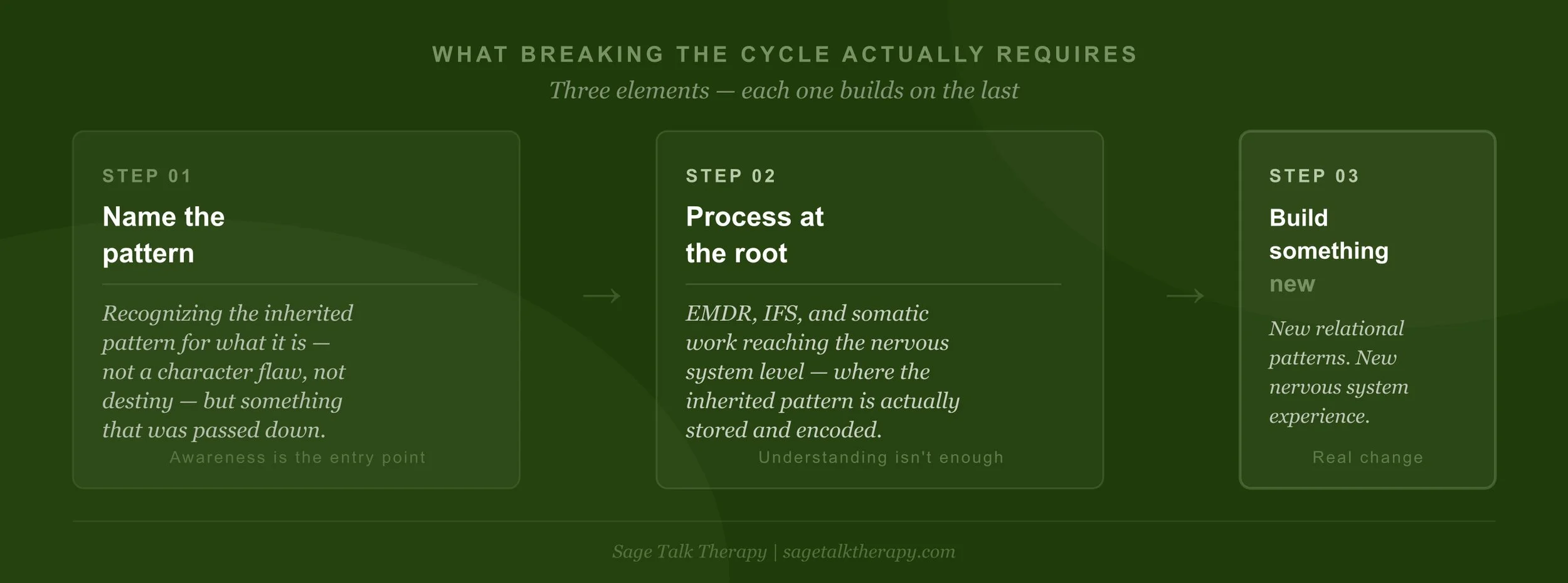
In practice, the work tends to move through a few recognizable elements:
Making the inherited visible.
Before you can change a pattern you've been living inside of, you need to be able to see it from the outside. This involves understanding your family system — not in the sense of exhaustively researching family history, but in the sense of recognizing the patterns, the rules, the emotional climate, and what they were responding to. Genograms — visual maps of family patterns across generations — are a useful tool for this. So is the kind of reflective, curious conversation that good therapy makes possible.
Processing at the nervous system level.
Understanding the pattern is necessary but not sufficient. EMDR works specifically with the experiences that trained the nervous system toward particular threat responses — including experiences that were transmitted through the relational environment rather than explicitly traumatic. By helping the brain reprocess what it has been treating as ongoing threat, EMDR allows the nervous system to update its calibration. The inherited vigilance has less to fire from.
Building new relational experience.
The nervous system also learns through new experience — through being in relationships that feel genuinely different from the ones that formed the original patterns. The therapeutic relationship is often one of the first of those. Not because the therapist replaces family, but because the consistent, attuned, boundaried quality of a good therapeutic relationship offers the nervous system new information about what relationships can be.
Developing compassion for what was passed on without blame.
One of the most important — and most frequently skipped — elements of this work is understanding the humanity of the people who passed the patterns on. Your parents were shaped by their parents. The anxiety, the rigidity, the emotional unavailability, the perfectionism — these had origins too. Understanding those origins doesn't excuse their effects on you. It frees you from carrying them as personal verdicts.
Consciously building something different.
This is the forward-facing part of the work. Not just processing the past, but actively creating new patterns — in how you relate to yourself, how you parent, how you allow yourself to be in relationships, what you model for whoever comes after you. This is what "breaking the cycle" actually looks like in daily life.
A note on the specific Experience of First-Generation Cycle-Breakers
This work carries particular weight for people doing it across cultural, economic, or immigrant family lines. If your parents or grandparents survived things you didn't — poverty, war, migration, systemic oppression, loss — the guilt of wanting something different can be enormous. It can feel like ingratitude, like disloyalty, like forgetting where you came from.
It is none of those things. Wanting to heal what was passed to you is not a rejection of your family. It is one of the most profound acts of love available to you — toward yourself and toward whatever generation comes next.
As someone who has done this work in my own life and guides clients through it professionally, I can say this with conviction: honoring where you came from and changing what it cost you are not opposites. They are the same work, done from different angles.
if this resonates
Intergenerational trauma therapy is some of the most meaningful work I do. If you recognize yourself in what you've read here — the patterns that feel older than your own life, the guilt around wanting something different, the sense of carrying something that wasn't entirely yours to begin with — that recognition deserves to be followed.
Learn more about Intergenerational Trauma Therapy.

Dadiana Lopez
LCSW · Anxiety & Trauma Therapist · EMDR Specialist
Dadiana Lopez is a Licensed Clinical Social Worker and EMDR therapist based in White Plains, NY. She specializes in anxiety, trauma, PTSD, and the patterns that form in the wake of both — including people-pleasing, perfectionism, and burnout. She sees clients in person in Westchester and online throughout New York and Connecticut.
Seeing clients in-person in White Plains, NY and online throughout New York and Connecticut.