
What Is a Nervous System Response? A Plain-Language Explainer
If you've spent any time reading about therapy, trauma, or anxiety, you've almost certainly encountered phrases like these:
Your nervous system is dysregulated. You're stuck in fight-or-flight. Your body is having a threat response. We need to work at the nervous system level.
These phrases get used constantly in mental health spaces — on social media, in therapy sessions, in books and podcasts about healing. And they're genuinely important concepts. But they're often dropped into conversation without anyone actually explaining what they mean.
This post is that explanation. Plain language, no jargon, no advanced neuroscience degree required. By the end of it, you'll have a real working understanding of what a nervous system response is, why it matters for anxiety and trauma specifically, and why so much of what happens in trauma-informed therapy is oriented around it.
Start here: what the nervous system actually is
The nervous system is the communication network of your body. It's the system through which your brain receives information from the outside world, makes sense of it, and tells your body how to respond.
It has two main branches that matter for this conversation. The first is the sympathetic nervous system, which is your activation system — the one responsible for mobilizing energy and action. The second is the parasympathetic nervous system, which is your settling system — the one responsible for rest, digestion, recovery, and connection.
In a well-regulated nervous system, these two branches work in rhythm. You get activated when activation is needed — a deadline, a difficult conversation, a genuine threat — and you settle back down when it passes. The system is flexible. It responds to what's actually happening and then returns to baseline.
The problems we're usually talking about in therapy happen when that rhythm gets disrupted. When the activation system gets stuck on, or the settling system can't do its job, or the whole system has learned to respond to non-threats as if they were real ones.
What a nervous system response actually is
A nervous system response is your body's automatic reaction to a perceived threat — or anything that has been associated with a threat in the past.
The key word is automatic. This is not a conscious process. You don't decide to have a nervous system response. Your body does it before your thinking brain has had a chance to weigh in. By the time you've registered that something just happened, your heart rate has already changed, your breathing has already shifted, hormones are already moving through your system.
This is by design. The nervous system's job is to protect you, and it does that job fast. Speed matters more than accuracy when a genuine threat is present. Which is why the system sometimes gets it wrong — responding to things that feel threatening based on learned associations rather than actual current danger.
Here is a simple way to think about it: your nervous system is constantly scanning the environment and asking a single question. Safe or not safe? Based on the answer, it selects a response state.
the three response states
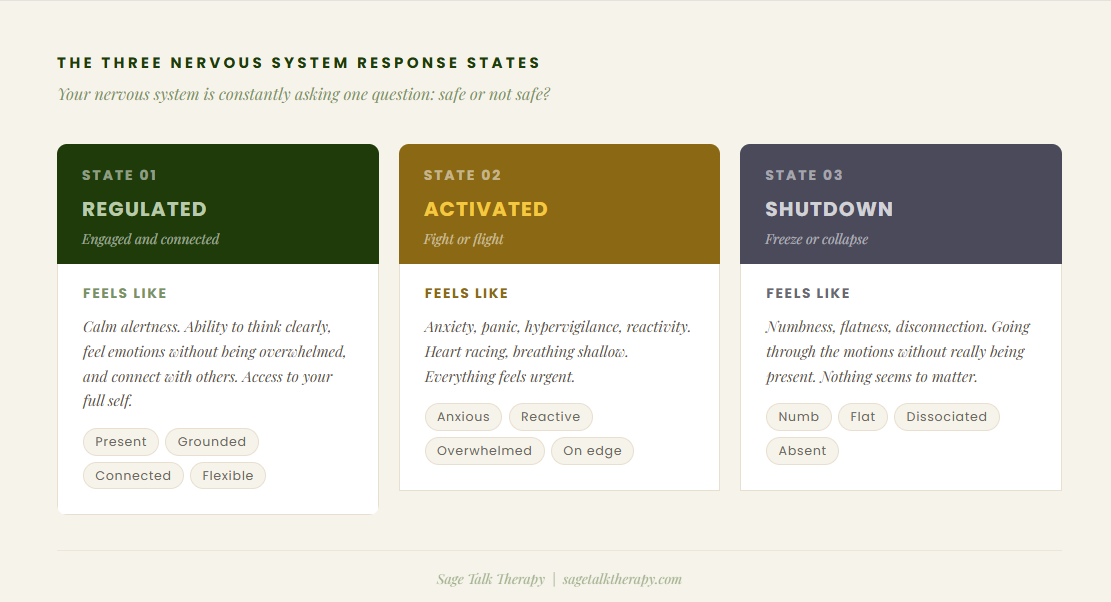
Nervous system responses generally fall into three states. You've probably heard of two of them.
State 1: Engaged and connected (safe)
This is what regulation looks and feels like. Your system has assessed the environment as safe enough. You can think clearly, connect with other people, access your emotions without being overwhelmed by them, and respond to what's actually in front of you rather than what happened in the past. You have access to your full range of capacities.
Most people who have experienced chronic stress or trauma don't spend enough time in this state. But it's there — and it's what therapy is working to expand access to.
State 2: Activated (not safe — fight or flight)
When the nervous system perceives a threat, the sympathetic branch mobilizes. Heart rate increases. Breathing gets faster and shallower. Blood moves away from digestion and toward the muscles. Stress hormones flood the system. The thinking brain partially goes offline — you don't need complex reasoning when you need to run or fight.
This state feels like anxiety, panic, hypervigilance, reactivity, the sense that everything is urgent and nothing is safe. In the short term, for a genuine threat, this is exactly the right response. The problem is that in people with chronic anxiety or trauma histories, this state can become the default — the nervous system treating ordinary situations as emergencies because it has learned to expect threat.
State 3: Shutdown (overwhelming threat — freeze or collapse)
When the threat feels too big, too inescapable, or when the activation has gone on too long without resolution, the nervous system can flip into shutdown. This is the freeze response — the possum playing dead, the human who dissociates, goes numb, or feels completely disconnected from what's happening around them.
This state feels like depression, flatness, emotional numbness, the inability to feel much of anything, the sense of going through the motions of life without really being present in it. It's the nervous system's most primitive protection — when nothing else works, go offline.
THE WINDOW OF TOLERANCE
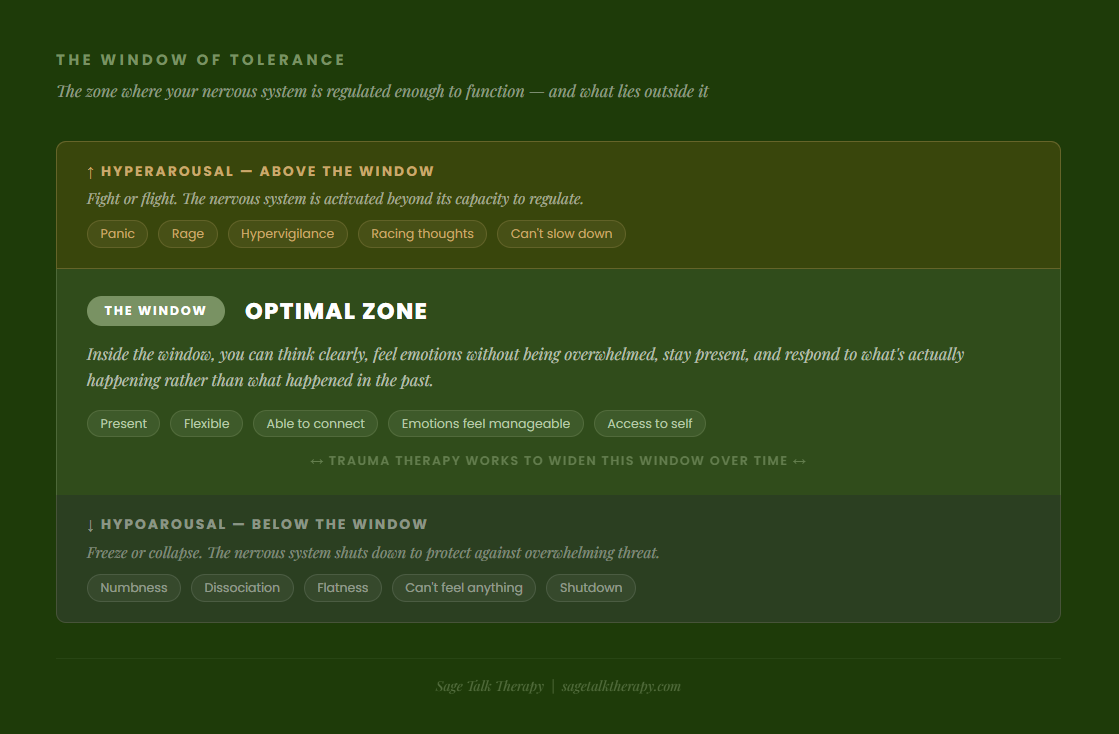
This is one of the most useful concepts in trauma therapy — and one of the most frequently referenced without explanation.
The window of tolerance is the zone in which your nervous system is regulated enough to function well. When you're inside your window, you can think, feel, connect, and respond effectively. You have access to yourself.
When something pushes you outside your window — above it into activation, or below it into shutdown — you lose access to your full capacities. The thinking brain goes partially offline. You operate from automatic responses rather than conscious choice.
Everyone has a window of tolerance, but the size of it varies significantly based on experience. People who grew up in consistently safe environments tend to have larger windows — they can tolerate more activation before tipping into crisis. People who experienced chronic stress or trauma, especially early in life, tend to have narrower windows. Their systems learned, understandably, to read more things as threatening, and the threshold for tipping out of the window is lower.
Trauma therapy is, in many ways, the process of widening that window. Not by avoiding activation — that just keeps the window narrow — but by building the capacity to move through activation and come back to center.
Why understanding this matters for anxiety
Anxiety is often understood as a thinking problem. Anxious thoughts. Catastrophizing. Cognitive distortions. And the thinking component is real — the stories we tell ourselves absolutely shape how we experience anxiety.
But anxiety is also, fundamentally, a nervous system state. The racing heart, the shallow breathing, the muscle tension, the inability to settle — these are not just symptoms of anxious thinking. They are direct expressions of a sympathetically activated nervous system.
This is why pure cognitive approaches to anxiety — identifying and challenging anxious thoughts — work well for some people and not at all for others. If the nervous system is the driver, working only at the cognitive level is like trying to calm down a racing engine by changing the dashboard display.
Approaches that work directly with the nervous system — EMDR, somatic experiencing, breath work, grounding practices — reach the anxiety where it actually lives. Not just in the thoughts, but in the body.
Why understanding this matters for trauma
Trauma is even more directly a nervous system phenomenon than anxiety.
When a traumatic experience happens — particularly one that is overwhelming, inescapable, or happens repeatedly — the nervous system stores it differently than ordinary memories. It gets encoded as a threat that is still present, not as something that happened and passed. This is why trauma survivors often describe their memories not as remembering something that happened, but as being there again — because at the nervous system level, the body is responding as if the threat is current.
This is also why trauma symptoms often feel irrational and disconnected from the present moment. A certain smell, a tone of voice, a situation that resembles something from the past — the nervous system picks up the pattern and fires the original response. Not because something is wrong with the person, but because the system is doing exactly what it learned to do.
When chronic stress or trauma keeps the sympathetic nervous system activated too long, people become stuck in fight-or-flight mode — and nervous system dysregulation means the stress response stays activated long after the actual threat has passed.
Healing trauma requires helping the nervous system update its threat assessment — learning, at a physiological level, that the threat has passed and the present moment is actually different from the past. That's what approaches like EMDR and somatic experiencing are designed to do.
What Therapy Actually Does to the Nervous System
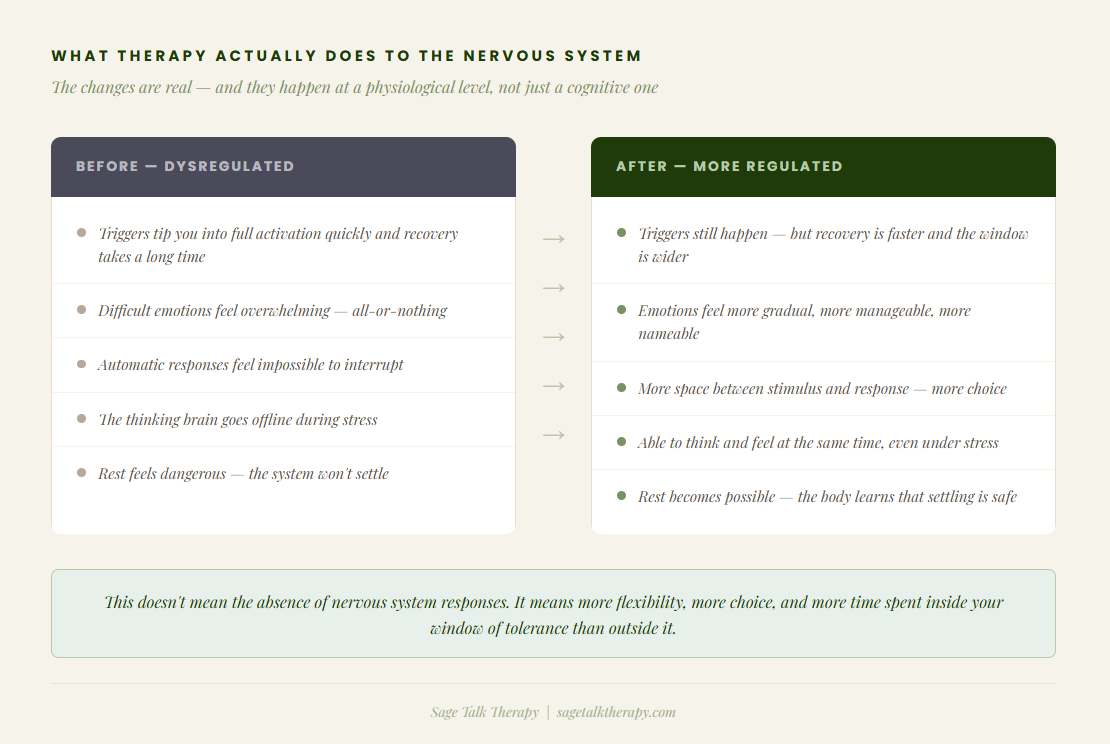
When therapy works well, it literally changes how your nervous system processes information.
This isn't metaphor. Psychotherapy creates actual changes in the brain — strengthening areas that manage emotions while quieting regions linked to fear and stress. The amygdala, which is the brain's alarm center, becomes less reactive. The prefrontal cortex, which is responsible for reasoning and regulation, becomes better connected to the emotional centers. The window of tolerance widens.
In practical terms, what this looks like is this: things that used to tip you into activation start to feel manageable. You can feel difficult emotions without being overwhelmed by them. You can be triggered without being hijacked. You can stay present in conversations that previously sent you into shutdown.
This doesn't happen through insight alone. Understanding your nervous system doesn't automatically regulate it — the same way understanding how a muscle works doesn't make it stronger. The change happens through repeated experience — through the actual practice, in therapy and in daily life, of moving through activation and returning to center.
Each time you successfully use a grounding technique or respond differently to a trigger, you are literally rewiring your nervous system's default settings — and over time, your system starts to default to calm rather than crisis.
a note on what this means for you
If you've ever been told that your reactions are too much, that you're overreacting, that you should be able to just calm down — understanding the nervous system offers a different frame.
Your nervous system is not overreacting. It's doing exactly what it learned to do based on everything it has experienced. The responses that feel out of proportion to the present moment made complete sense in the context that created them. They were protective. They were adaptive. They kept you safe.
The work — in therapy and over time — is not to shame those responses or fight them. It's to give your nervous system enough new experience of safety that it doesn't need to fire them as often, as intensely, or as automatically as it once did.
That's what it means to heal. Not the absence of nervous system responses — those are part of being human. But more choice, more flexibility, and more moments spent inside your window of tolerance than outside it.
if this resonates
Understanding the nervous system is foundational to the work I do with anxiety, trauma, and the patterns that connect them. If you're in Westchester, NY or online throughout New York or Connecticut and want to explore what nervous-system-informed therapy could look like for you, I'd welcome the conversation.
Learn more about anxiety therapy.
Learn more about trauma therapy.

Dadiana Lopez
LCSW · Anxiety & Trauma Therapist · EMDR Specialist
Dadiana Lopez is a Licensed Clinical Social Worker and EMDR therapist based in White Plains, NY. She specializes in anxiety, trauma, PTSD, and the patterns that form in the wake of both — including people-pleasing, perfectionism, and burnout. She sees clients in person in Westchester and online throughout New York and Connecticut.
Seeing clients in-person in White Plains, NY and online throughout New York and Connecticut.