
EMDR Intensives for High-Achieving Professionals in Westchester
You've probably already read about EMDR. Maybe you've thought about trying it. Maybe you've even started weekly sessions and felt something shift, then felt it stall when life got in the way. Or maybe you've been in talk therapy for years, understand your patterns completely, and still can't get them to change at the level that matters.
If any of that sounds familiar, this post is for you.
EMDR Intensives are a concentrated format of EMDR therapy designed for people who are ready to do meaningful work and don't want to spread that work across months of weekly appointments. For professionals in Westchester County, this format often fits the way nothing else does.
Here's what you need to know.
The Problem With Weekly Therapy for High-Achievers
Weekly therapy works well for a lot of people. But for professionals with demanding schedules, competing responsibilities, and a tendency to live at full capacity, the standard format creates friction that can quietly undermine the process.
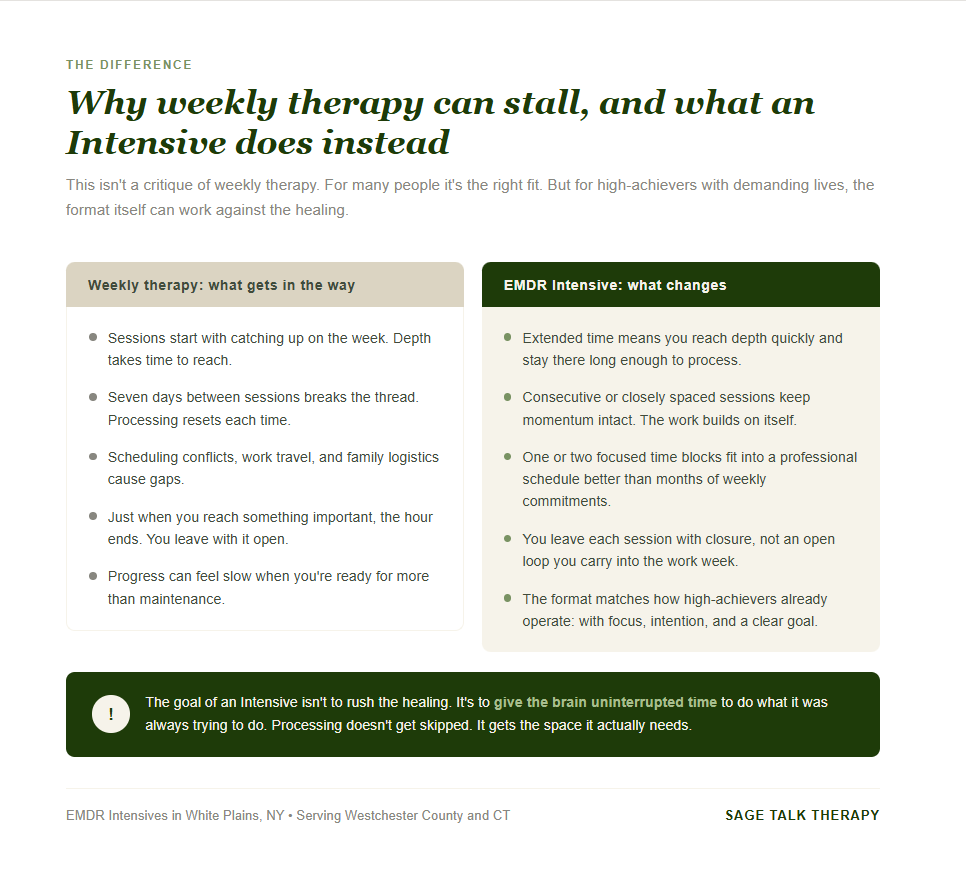
The session ends just as you're reaching something real. You spend the first ten minutes catching up on what happened since last week. You build momentum, then spend the following seven days carrying the material around before you can return to it. You miss a session because of a work trip or a school event, and the thread gets dropped.
This isn't a failure of therapy. It's a format mismatch.
Many of the professionals I work with from White Plains, Scarsdale, Eastchester, and Bronxville are not lacking in motivation. They're not avoiding the work. The weekly structure just doesn't contain the kind of sustained, uninterrupted attention that deep processing actually needs.
What an EMDR Intensive Actually Is
An EMDR Intensive is a block of extended therapy time, usually across one or more sessions, that allows for concentrated processing without the interruptions of a typical weekly schedule.
Rather than fifty minutes once a week, we work in longer, focused stretches. This changes what's possible. The nervous system has enough time to move through material, not just approach it. You reach depth faster, stay there long enough to do something with it, and leave with the work in a more resolved place than a standard session can get to.
The Intensive is also personalized before it begins. We don't start the processing work until we've mapped what you're working toward, prepared your nervous system, and made sure you feel safe doing this. There's a pre-intensive session to build that foundation. There's a post-intensive session to close and integrate. The work is bookended, not dropped.
Why This Format Works for the Professional Brain
There's something specific about how high-achieving professionals engage with work that makes the Intensive format click in a way that weekly therapy often doesn't.
You already know how to focus. When you're given a clear goal, a defined window of time, and space to go deep, you perform well. You're not afraid of intensity. You're used to doing hard things with your full attention.
The weekly therapy model asks you to do the opposite: show up for fifty minutes, scratch the surface, then stop and go back to your life. For someone who operates at the level most of my Westchester clients do, that rhythm can feel frustrating. Not because the work isn't happening, but because it keeps getting interrupted at exactly the wrong moment.
The Intensive asks something different of you. It says: set aside this time, come ready, and let's actually move through something together. That's a request that lands differently for the type of person who is used to bringing their full effort to things that matter.
Who IS A GOOD FIT
EMDR Intensives aren't the right fit for everyone, and it's worth being honest about that.
They tend to work best for people who:
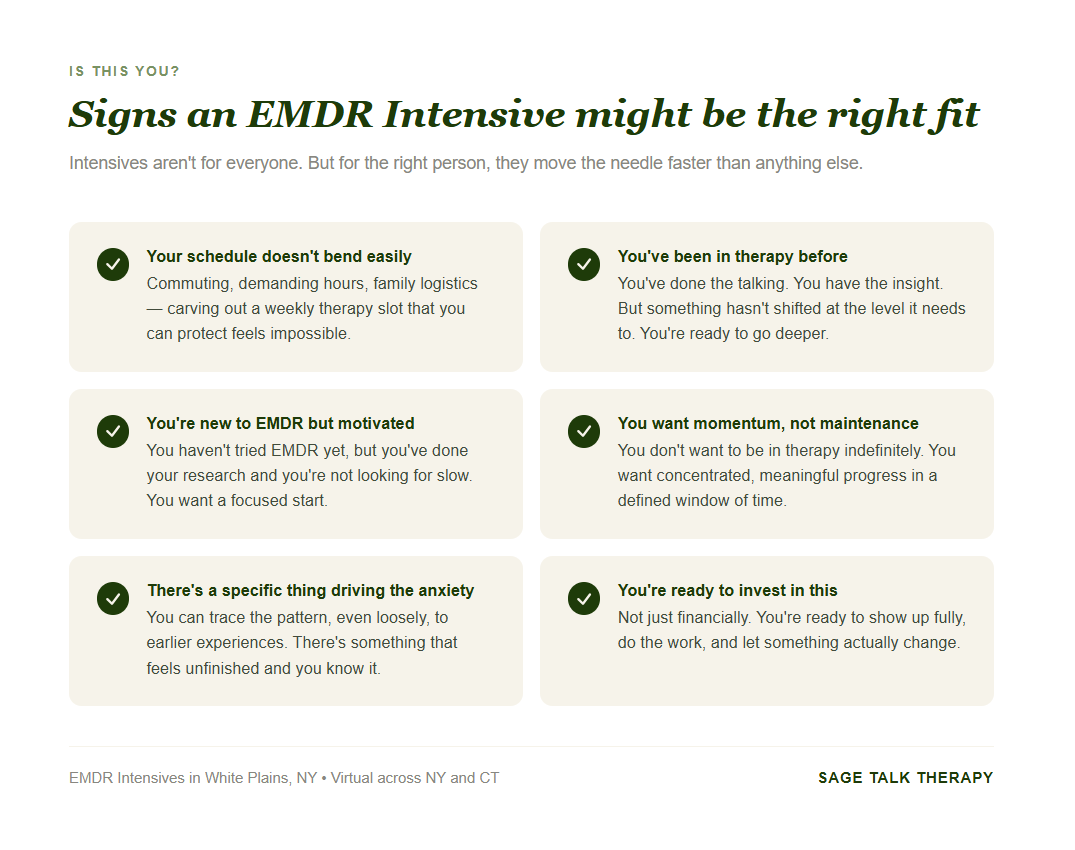
Are carrying something specific that has a felt sense of being unfinished. A period of their life. A relationship. A professional experience that left a mark. Anxiety that traces back to something earlier than work stress.
Have already been in therapy and know what it feels like to get close to something but not quite get there. They're not starting from zero. They have self-awareness and readiness. What they need is more time and a different container.
Are new to EMDR but research-oriented and motivated. They've done their reading. They understand the approach. They're not looking for a long orientation period. They want to begin.
Have schedules that don't bend easily. The commute into the city. The demanding job. The family logistics. Protecting a weekly slot indefinitely is genuinely difficult, and a concentrated block of time is actually more manageable to plan for.
Are ready to invest in this at the level it deserves. Not just financially. They're willing to prioritize this the way they prioritize other things that matter.
What This Looks Like for the Anxiety Patterns I See Most
In my work with professionals across Westchester County, the anxiety that brings people to an Intensive isn't usually about a single dramatic event. More often it's the accumulation of a particular kind of history.
Growing up in a household where performance was expected and mistakes had costs. Chronic low-level criticism that became an internal voice. Early experiences of emotional unpredictability that taught the nervous system to stay on alert. These patterns don't disappear when you become successful. In many cases they get louder, because the stakes feel higher and the evidence is now more visible.
Perfectionism that has never felt like a choice. Burnout that keeps coming back no matter how much you try to manage it. Anxiety that lives in the body, not just the mind, and that doesn't respond the way it should to insight or coping strategies. These are the patterns that EMDR was designed to address at their source.
A Note on EMDR for Anxiety Specifically
EMDR was originally developed for PTSD, and its trauma applications are well established. But its usefulness for anxiety, particularly anxiety that has roots in earlier experiences, is increasingly recognized and is central to my work.
For many professionals, the anxiety they carry is not generalized worry about the future. It's a nervous system that learned, at some point, that it needed to stay ready. That the world was unpredictable. That being enough required constant vigilance. That relaxing was a risk.
EMDR targets the stored experiences that created those beliefs. Not by talking about them endlessly, but by helping the brain reprocess how those memories were stored so they stop driving the present. The anxiety doesn't have to be traced back to one clearly definable event. Often the most meaningful work addresses patterns of experience that accumulated over time.
What the Process Looks Like
If you're considering an Intensive, here's what to expect from start to finish:
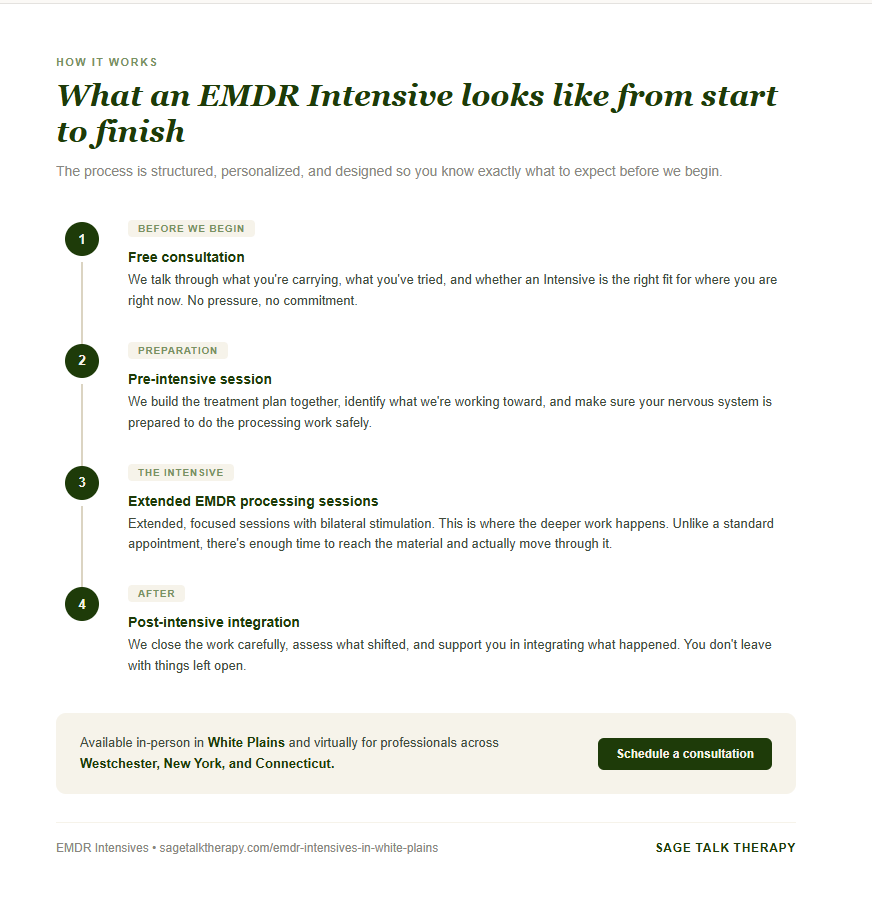
We begin with a free consultation.
We talk through what you're carrying, what you've already tried, and whether the Intensive format fits where you are right now. There's no pressure and no expectation.
If it seems like a good match, we schedule a pre-intensive session.
This is where we build the treatment plan, identify what we're targeting, and prepare your nervous system to do the processing work safely. You won't go into the Intensive unprepared.
The Intensive itself is extended EMDR processing.
This is where the deeper work happens. Unlike a standard appointment, we have enough time to reach the material and actually move through it, not just approach it.
Afterward, we close carefully.
Post-intensive integration is built into the process. You don't leave with things unresolved.
ONE MORE THING WORTH SAYING
A lot of high-achievers delay getting help because they assume they should be able to manage this on their own. That the anxiety is the price of ambition. That everyone who is performing at this level feels this way underneath.
Some of that is true. But not all of it, and not permanently.
The nervous system you're running on now is the one that learned to operate under specific conditions. It did its job. But you're allowed to want something different. A nervous system that can settle. That knows the threat isn't ongoing. That doesn't have to work this hard just to get through a regular week.
That's what this work is for. And it's available to you.
if This Resonates
I offer EMDR Intensives for adults in Westchester County and virtually for clients across New York and Connecticut.
My clients are professionals from White Plains, Scarsdale, Bronxville, Eastchester, Pleasantville, Harrison, and the surrounding area who are carrying anxiety and burnout that hasn't responded to what they've already tried. Many come in having done good prior therapy work. They're not starting from scratch. They're looking for something that goes further.
Intensives are available on a limited basis each month. If you've been thinking about this, the best first step is a conversation.

Dadiana Lopez
LCSW · Anxiety & Trauma Therapist · EMDR Specialist
Dadiana Lopez is a Licensed Clinical Social Worker and EMDR therapist based in White Plains, NY. She specializes in anxiety, trauma, PTSD, and the patterns that form in the wake of both — including people-pleasing, perfectionism, and burnout. She sees clients in person in Westchester and online throughout New York and Connecticut.
Seeing clients in-person in White Plains, NY and online throughout New York and Connecticut.