
The Anxious Overachiever: How Anxiety, Perfectionism, and Burnout Feed Each Other
You don't look like someone who's struggling.
Your work is good. Your calendar is full. You meet deadlines, show up for people, and handle whatever gets thrown at you. From the outside, you're the person everyone counts on. The capable one. The one who has it together.
And privately, you're exhausted in a way that doesn't make sense given how much you're accomplishing. Your mind doesn't stop even when your body finally stops moving. Rest feels dangerous. Doing nothing feels like falling behind. You tell yourself you'll slow down when things calm down — and things never calm down.
If that resonates, you're not dealing with a time management problem or a lack of discipline. You're dealing with something that runs much deeper: the particular exhaustion that comes from being an anxious overachiever. The place where anxiety, perfectionism, and burnout collapse into each other and make it almost impossible to get off the wheel.
This post is about understanding how those three things are connected — and why understanding that connection is the first step toward actually changing it.
tHEY ARE NOT THREE SEPARATE PROBLEMS
Most people who come to therapy with burnout don't initially identify as anxious. They come in exhausted, depleted, maybe a little flat. They've been going hard for a long time and something has finally given out.
Most people who come in with perfectionism don't initially identify as burned out. They come in frustrated — frustrated that nothing they do ever feels quite good enough, that the bar keeps moving, that they can't seem to turn the inner critic off.
And most people who identify as anxious don't connect their anxiety to perfectionism or burnout at all. They see the anxiety as a separate problem — something to manage alongside everything else.
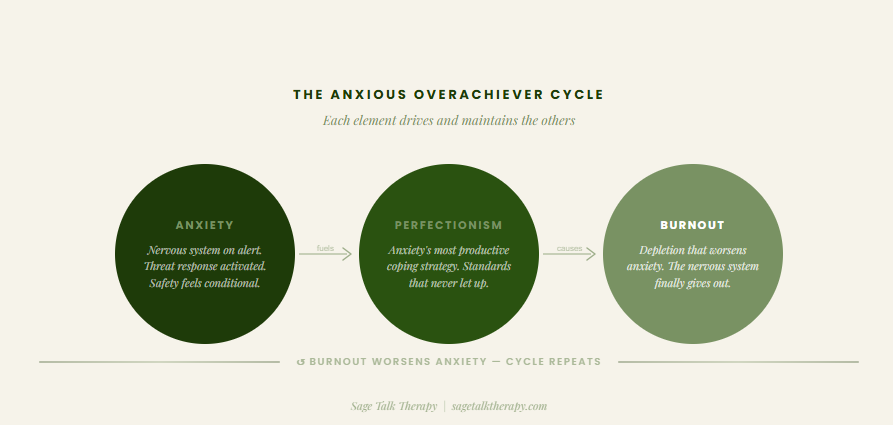
What they're often missing is that anxiety, perfectionism, and burnout are not three separate problems happening simultaneously. They're one interconnected system, each element driving and maintaining the others.
Understanding how that system works changes everything about how to address it.
HOW ANXIETY BECOMES PERFECTIONISM
Anxiety is fundamentally about threat. When your nervous system perceives something as dangerous — failure, judgment, rejection, loss of control — it mobilizes a response. In anxious overachievers, that response doesn't look like panic or avoidance. It looks like preparation.
If I prepare thoroughly enough, nothing can go wrong. If I do this perfectly, no one can criticize me. If I anticipate every possible problem, I can prevent the thing I'm afraid of.
Perfectionism is anxiety's most productive coping strategy. It gives the anxious nervous system a way to feel like it's doing something about the threat. And for a while, it works. High standards produce good results. The preparation pays off. The work is praised.
The problem is that this also trains the nervous system to believe that the perfectionism is what's keeping the threat at bay.
Not your actual competence. Not your genuine ability.
The vigilance. The standards. The control.
Which means the standards can never come down. Because if they do, something bad will happen.
HOW PERFECTIONISM DRIVES BURNOUT
Perfectionism creates a very particular kind of exhaustion — one that is invisible from the outside and relentless from the inside.
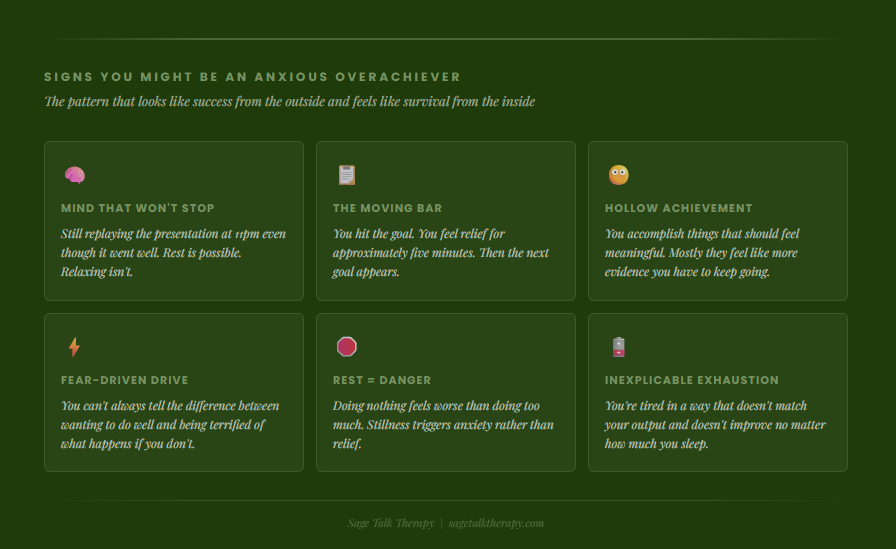
It's not just that the work is demanding. It's that the internal standard applied to the work is never satisfied. You finish something and instead of feeling done, you feel relief followed immediately by pressure. The next thing is already waiting. The bar has already moved.
High-functioning anxiety and burnout share overlapping symptoms but are distinct — anxiety drives relentless internal pressure while burnout is characterized more by depletion, disconnection, and a sense of emptiness. But in anxious overachievers, they rarely arrive separately. The perfectionism burns the fuel. The anxiety keeps the engine running past empty. And at some point, the body and mind simply cannot sustain it anymore.
Burnout in high-achieving, anxious perfectionists has a particular quality. It often doesn't announce itself with a dramatic collapse. It arrives quietly — as irritability that seems disproportionate, as a growing flatness about things that used to matter, as the sense that you're going through the motions of a life that looks successful and feels hollow.
Many clients describe it as waking up one day and realizing they've been running for so long they forgot what they were running toward.
How burnout feeds the anxiety
Here is the part that makes the cycle so hard to break: burnout doesn't resolve the anxiety. It makes it worse.
When you're depleted, your capacity to manage anxiety shrinks. The coping resources that were already stretched thin get thinner. The nervous system becomes more reactive, not less. Small things feel big. The threshold for overwhelm drops.
And for someone whose whole system has been organized around performing and achieving — whose sense of safety depends on staying on top of everything — burnout is terrifying. Because burnout means you can't perform the way you used to. Which activates exactly the fears the perfectionism was designed to prevent.
So you push harder. Or you collapse and then, when some energy returns, push harder again to make up for lost time. The cycle continues.
Anxious overachievers often need more than coping skills — they need therapy that helps them rewire the patterns keeping them stuck, because this kind of anxiety is a full-body experience that keeps the nervous system on constant high alert.
where this actually comes from
The anxious overachiever pattern rarely starts in adulthood. It usually has roots that go back much further.
For many people, the connection between performance and safety was established early. A home environment where love or approval felt conditional on being good, achieving, complying. A parent whose anxiety was soothed by your success. A school environment where being smart or capable was the primary way you found belonging or protection from something harder. A family system where problems were managed by performing rather than feeling.
When achievement becomes the mechanism for safety early in life, the nervous system wires accordingly. Doing well equals safe. Not doing well equals threat. And that equation doesn't update automatically just because you're now an adult with actual competence and actual resources.
It keeps running in the background, setting the pace, driving the perfectionism, fueling the anxiety — long after the original environment that created it is gone.
This is why addressing the anxious overachiever pattern requires more than stress management techniques. Managing the symptoms while the root keeps running is exhausting and temporary. The root is where the work needs to go.
what the work actually looks like
Treating the anxious overachiever pattern well requires addressing all three layers: the anxiety in the nervous system, the perfectionism as a coping structure, and the burnout as the physical and emotional consequence of both.
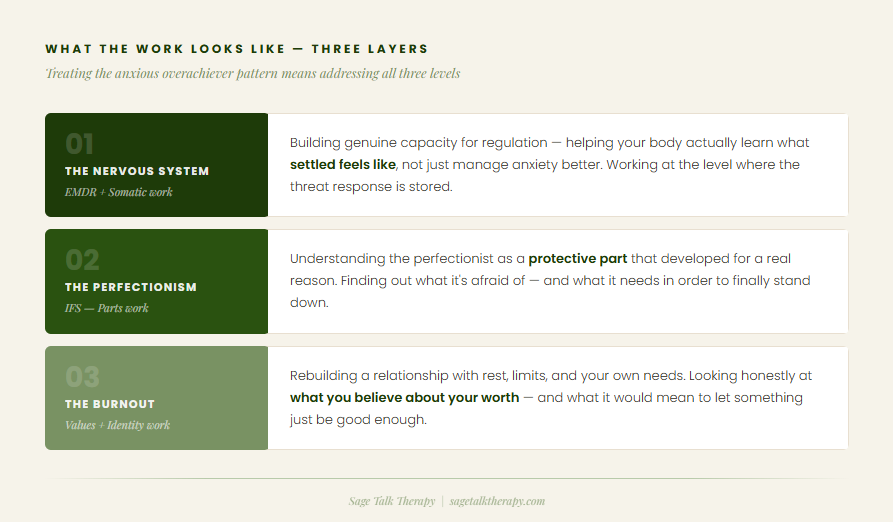
At the nervous system level, the work involves building genuine capacity for regulation — not just managing anxiety better, but helping your body actually learn what it feels like to settle. EMDR and somatic approaches are particularly effective here, because they work at the level where the threat response is stored rather than just cognitively.
At the perfectionism level, IFS is often the most useful framework. The perfectionist is a part — a manager part that developed specifically to keep you safe by keeping your performance high. Understanding what it's afraid of, what it's been protecting, and what it needs in order to stand down is fundamentally different from just trying to lower your standards. Parts don't respond well to being fought. They respond to being understood.
At the burnout level, the work involves rebuilding a relationship with rest, limits, and your own needs — not as self-care add-ons but as a genuine reorganization of how you operate. That often means looking honestly at what you believe about your worth, what you fear will happen if you slow down, and what it would actually mean to let something be good enough.
This isn't quick work. But it's the kind that changes the pattern rather than just managing its consequences.
a note on getting help as a high achiever
There is a particular irony in the anxious overachiever seeking therapy. The same perfectionism that drives the pattern also shapes how they approach the help. They want to do therapy well. They want to show progress. They feel guilty for struggling when they have so much.
If that's you — the person who picked up this post and spent the whole time thinking "yes, but I should be able to handle this" — I want to say something directly: the fact that you've been managing this alone for this long is not evidence that you should keep doing it alone. It's evidence of how hard you've been working to hold it together.
You don't have to have it completely figured out before you reach out. You don't have to be in crisis. You just have to be tired enough of the wheel to want something different.
if this is you
I work with anxious overachievers in Westchester, NY and online throughout New York and Connecticut. If what you've read here sounds familiar — the relentless drive, the standards that never let up, the exhaustion you can't quite explain to anyone around you — I'd welcome the chance to talk.
If you're in Westchester and looking for a therapist specializing in trauma treatment, I'd welcome the chance to connect. A free 15-minute consultation is the lowest-stakes way to see whether we'd be a good fit.
Learn more about anxiety therapy at Sage Talk Therapy.
Learn more about perfectionism therapy.

Dadiana Lopez
LCSW · Anxiety & Trauma Therapist · EMDR Specialist
Dadiana Lopez is a Licensed Clinical Social Worker and EMDR therapist based in White Plains, NY. She specializes in anxiety, trauma, PTSD, and the patterns that form in the wake of both — including people-pleasing, perfectionism, and burnout. She sees clients in person in Westchester and online throughout New York and Connecticut.
Seeing clients in-person in White Plains, NY and online throughout New York and Connecticut.