
What High-Functioning Anxiety Actually Looks Like (And Why It's So Easy to Miss)
High-functioning anxiety is not a formal clinical diagnosis. You won't find it in the DSM-5. What it describes is a pattern: significant internal anxiety that is effectively masked by — and in many cases directly fuels — high external performance.
High-functioning anxiety is characterized by internal worry and perfectionism while maintaining external productivity, with signs including constant overthinking, difficulty relaxing, people-pleasing behaviors, and physical symptoms like muscle tension or insomnia.
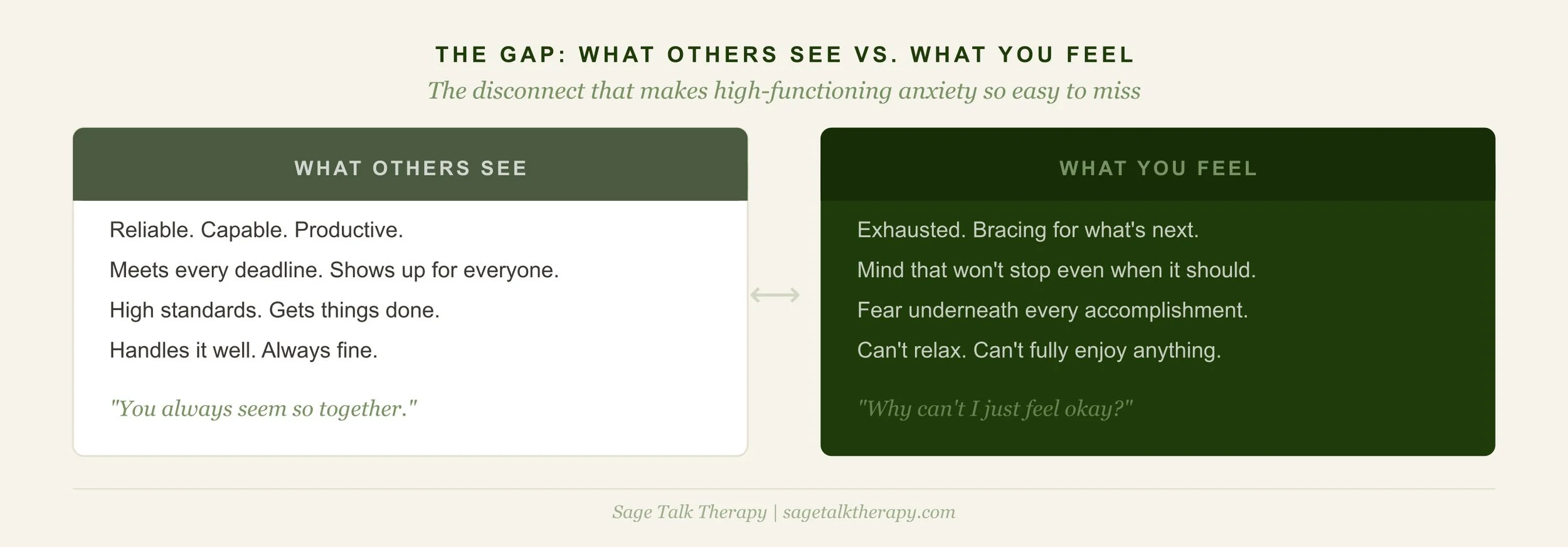
The core feature is the disconnect. The internal experience — the worry, the dread, the inability to settle, the relentless self-monitoring — is dramatically different from what the outside world sees. And that gap is maintained, often very successfully, through a set of coping strategies that happen to look a lot like admirable traits.
Productivity. Preparation. Perfectionism. Reliability. Over-functioning.
These are the anxiety's disguise. And they work so well that even the person wearing them often doesn't recognize them as symptoms.
what it looks like from the inside
This is the part that most articles on high-functioning anxiety get wrong — or at least incomplete. They list the signs from the outside. What's more useful is understanding what it feels like from the inside, because that's where recognition actually happens.
The Mind That Won’t Stop
Many signs of high-functioning anxiety involve persistent overthinking and cognitive overload — replaying conversations, worrying about how you were perceived, and overanalyzing decisions that should be simple.
But it's more specific than that. For people with high-functioning anxiety, the thinking isn't random — it's purposeful. The mind is running a constant threat-assessment program. Anticipating what could go wrong. Preparing for every contingency. Rehearsing difficult conversations in advance. Replaying them afterward to find what could have gone better.
It feels productive. It often is productive. And it never stops.
Even in moments that should be restful — the vacation, the weekend morning with nothing scheduled, the quiet evening after a good day — the mind finds something to work on. Because stopping feels more dangerous than continuing. The vigilance feels necessary. Relaxing feels like letting your guard down in a way that might cost you something.
The Performance That Runs on Fear
From the outside, high-functioning anxiety can look like ambition, drive, and high standards. And those things are real. But underneath them is often a much less comfortable truth: a significant portion of the performance is motivated by fear rather than genuine desire.
Fear of failure. Fear of disappointing people. Fear of being seen as less capable than you appear. Fear that if you stop achieving, something important will be taken away — love, respect, belonging, safety.
The perfectionism that comes with high-functioning anxiety is not about wanting things to be excellent. It's about the anxiety that arises when they aren't. The standard isn't chosen — it's imposed by the nervous system's threat-detection program, which has learned to equate falling short with something genuinely dangerous.
This is one of the reasons high-functioning anxiety is so exhausting. The output is real. The accomplishments are real. But they don't produce satisfaction — only temporary relief before the next thing requires the same level of performance.
The Exhaustion Nobody Sees
High-functioning anxiety can lead to insomnia, burnout, digestive issues, and an increased risk of depression — and this is often the first place where the hidden cost becomes impossible to ignore.
The exhaustion of high-functioning anxiety is specific. It's not the exhaustion of having done too much. It's the exhaustion of having run a constant background program while doing everything else. The threat-monitoring, the self-editing, the performance maintenance, the people-pleasing, the anticipatory worry — all of that requires energy. And it runs 24 hours a day, including in sleep, which is why sleep often doesn't feel restorative.
Many people with high-functioning anxiety describe a particular quality to their tiredness — not just physical fatigue but a sense of being depleted at a deeper level. The tank has been running on fumes for so long that the concept of full doesn't really feel real anymore.
The inability to enjoy what you've earned
This is one of the most quietly painful aspects of high-functioning anxiety. You work hard. You achieve real things. And when the achievement arrives — the promotion, the milestone, the good outcome — there is a brief moment of relief followed almost immediately by the next thing that needs to be addressed.
The accomplishments don't land. Not the way they should. Because the anxiety isn't actually about achieving the goal — it's about managing the threat of not achieving it. When the goal is met, the threat recedes temporarily. But the threat-management system keeps running, looking for the next thing to prepare for.
Over time this produces a particular kind of hollowness. A life that looks, from the outside, like one of genuine success and engagement — and feels, from the inside, like running on a treadmill that never stops.
The people-pleasing underneath
High-functioning anxiety and people-pleasing are close companions. When the nervous system has learned that other people's responses — their approval, their disappointment, their anger — are threats to be managed, being genuinely agreeable becomes a survival strategy.
Those with high-functioning anxiety often become chronic people-pleasers — agreeing to things they don't want or can't manage, fearing that saying no will upset others.
What this looks like from the outside: being helpful, accommodating, easy to work with, reliable, never causing problems. What it feels like from the inside: a constant low-level monitoring of everyone else's emotional state, a reflexive yes when your actual answer is no, and a resentment that builds quietly over time because no one seems to notice what it costs you.
The physical signals being ignored
The body keeps score even when the mind is excellent at managing the presentation. Jaw clenching. Shoulder tension that never fully releases. Disrupted sleep. Stomach issues that don't have a clear medical explanation. A low-level fatigue that doesn't respond to rest.
Chronic anxiety keeps the body's stress response activated even when no real danger is present — leading to persistent physical symptoms including muscle tension, headaches, fatigue, and digestive disruption.
For people with high-functioning anxiety, these physical signals are often the last thing to be addressed — because addressing them would require slowing down enough to acknowledge how much the whole system has been carrying.
Where it Comes From
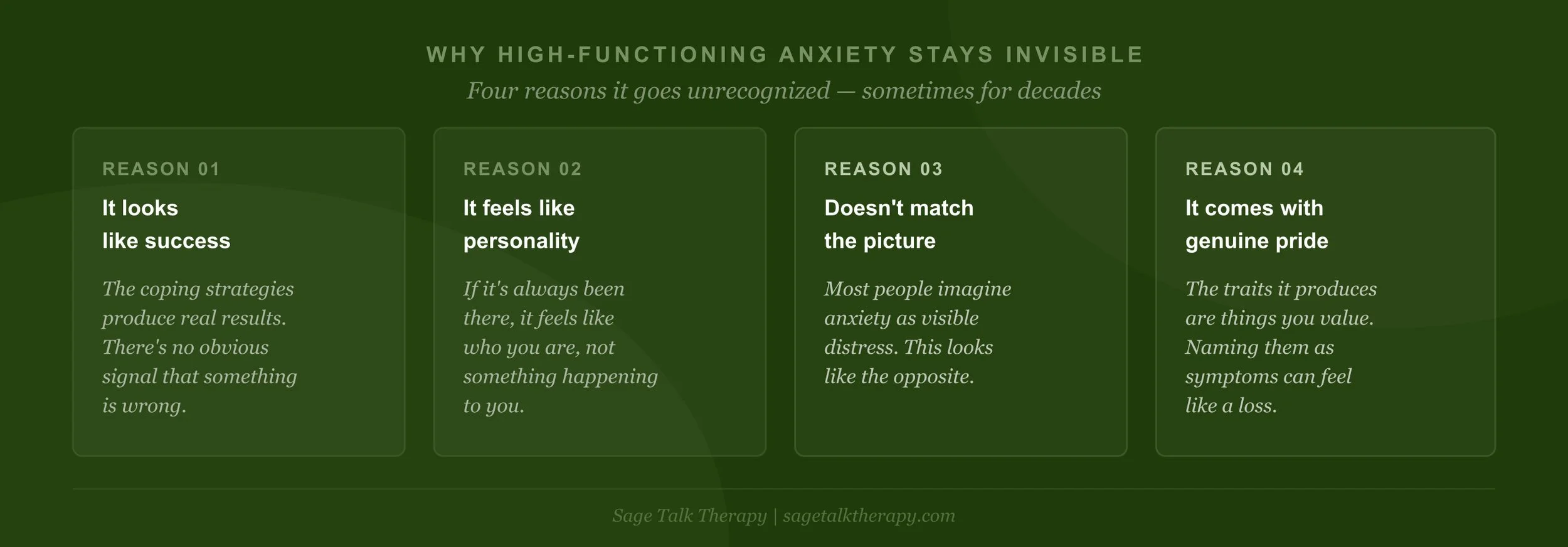
High-functioning anxiety rarely arrives without context. For many people, the roots go back to early experiences that taught the nervous system to stay ready — to read rooms, manage others' responses, perform consistently, and never quite let the guard down.
A home environment where approval was conditional on achievement. A parent whose moods were unpredictable, making constant vigilance a survival tool. Early experiences of being praised specifically for being capable, reliable, and not-needing-things. A family system where emotions were managed through doing rather than feeling.
When these patterns develop early, they become indistinguishable from personality by the time adulthood arrives. The anxiety isn't experienced as anxiety — it's experienced as motivation, conscientiousness, drive. The cost of it goes unnoticed because it has always been there.
Understanding the roots doesn't mean you're broken or that your achievements aren't real. It means the pattern has an explanation — and that explanation points toward what actually needs to change.
What Treating It Well Actually Requires
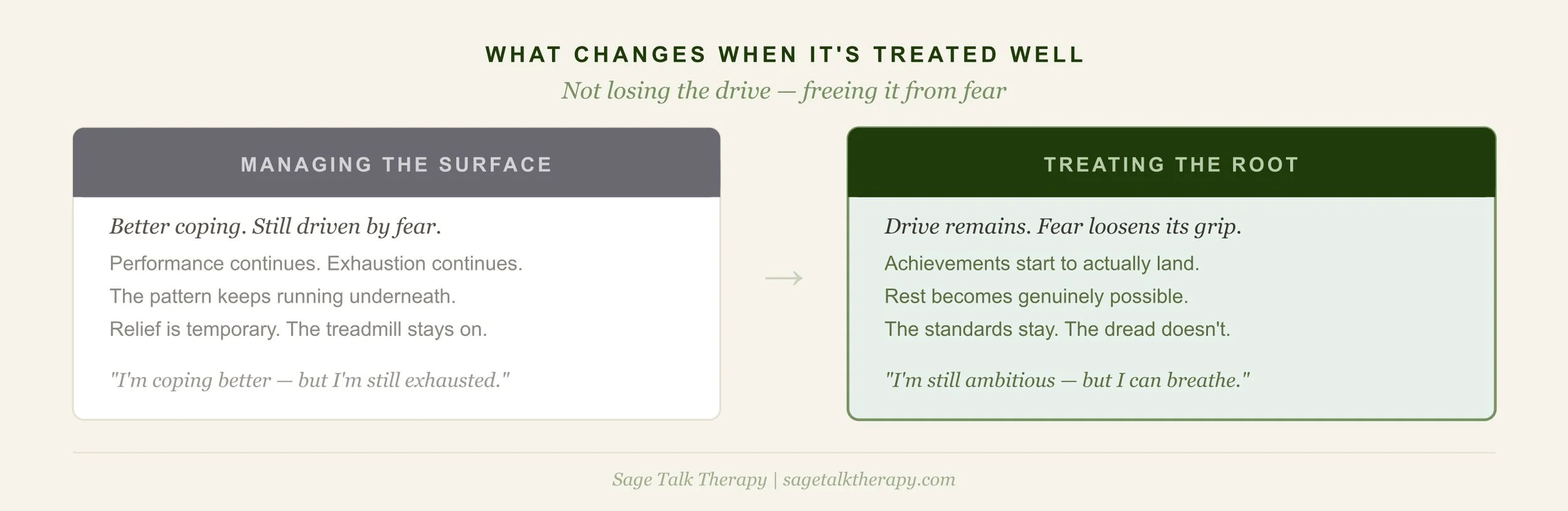
The most common approach to high-functioning anxiety — stress management, better self-care, learning to set limits, mindfulness — addresses the surface without touching the root. These tools have genuine value as daily support. But they don't change the underlying nervous system calibration that is generating the anxiety in the first place.
Effective treatment for high-functioning anxiety reaches two levels that symptom management alone doesn't.
The first is the nervous system level — the actual threat-response calibration that keeps the alarm running even in safe circumstances. EMDR is particularly well-suited for this because it works with the experiences that trained the nervous system toward hypervigilance, helping the system update its assessment of what actually constitutes a threat in the present.
The second is the identity level — the deep entanglement between anxiety and self-concept. For people with high-functioning anxiety, "being the capable, reliable, high-achieving person" is not just a behavior. It's a core part of how they understand themselves and feel safe in the world. Therapy that addresses this level — IFS work on the parts that have organized around performance as protection — creates genuine internal change rather than just behavioral adjustment.
The goal is not to dismantle the drive or the high standards. It's to free those things from fear — so they're chosen rather than compelled.
A note on being the person who has it all together
There is a particular loneliness to high-functioning anxiety. Because you look fine, people treat you as fine. There is no obvious signal for others to respond to — no visible distress to prompt concern or support. You get to carry this quietly, which you have become very good at, while privately wondering why it never gets easier.
If that resonates — the capable person who is tired of being capable, who has been managing this alone for a long time and is starting to wonder if there is something underneath it worth looking at — that recognition matters. You don't have to be in crisis to deserve support. You don't have to stop functioning to qualify for help.
The fact that you're still functioning is not evidence that everything is fine. It's evidence of how hard you've been working.
if this resonates
I work with high-functioning adults in Westchester, NY and online throughout New York and Connecticut who are ready to address the anxiety underneath the performance — not just manage it better.
Learn more about anxiety therapy.

Dadiana Lopez
LCSW · Anxiety & Trauma Therapist · EMDR Specialist
Dadiana Lopez is a Licensed Clinical Social Worker and EMDR therapist based in White Plains, NY. She specializes in anxiety, trauma, PTSD, and the patterns that form in the wake of both — including people-pleasing, perfectionism, and burnout. She sees clients in person in Westchester and online throughout New York and Connecticut.
Seeing clients in-person in White Plains, NY and online throughout New York and Connecticut.