
When Something Happened and You Haven't Been the Same: EMDR Intensives for a Specific Experience
There's a particular kind of stuck that doesn't look like falling apart.
You're functioning. Going to work, handling your life, showing up for other people. But somewhere underneath, you're aware that something shifted after a specific thing happened, and it hasn't fully shifted back.
You might be able to name it exactly:
A loss…
A betrayal…
A medical experience...
A relationship that ended in a way that still doesn't feel finished...
A period of your life that was too much for too long...
Or something that happened at work that touched something much deeper than your career…
You've processed it with your mind. You understand what happened, maybe even why. But understanding hasn't been enough to move it. It still lives somewhere that thinking can't reach.
If that's where you are, this post is for you.
What It Means for Something to Be Unresolved
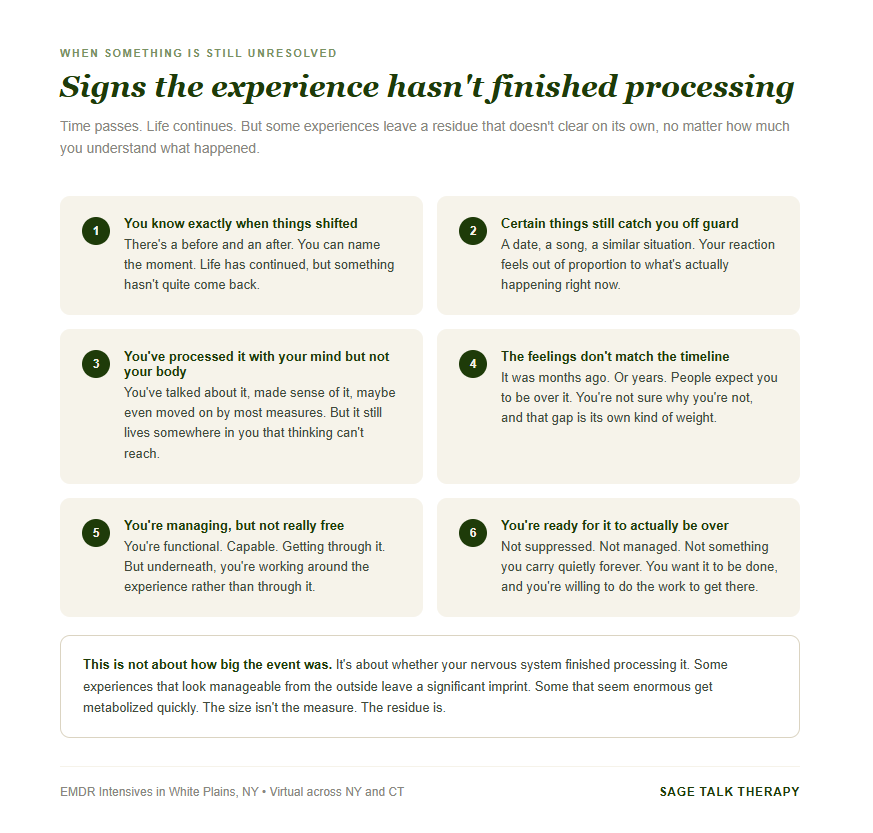
The nervous system doesn't process experiences on a timeline that matches our expectations or anyone else's. Some things get metabolized quickly. Others get stored in a way that keeps them feeling present, active, ongoing, even when objectively they're in the past.
This isn't about the size of the event. It's not a measure of how strong you are or how well you've coped. It's about whether the brain had what it needed, in the moment and afterward, to complete the processing. When it didn't, the experience stays stored in a way that keeps generating a response.
That response might look like:
Reactions that feel out of proportion to what's actually happening now.
Certain things catching you off guard months or years later.
The memory still carrying an emotional charge that doesn't match how much time has passed.
A before and an after you can feel clearly, even if you can't always explain it.
Managing around the experience rather than having actually moved through it.
None of this is weakness. It's how unprocessed material behaves in a nervous system that is doing exactly what it was designed to do.
Why This Is Exactly What EMDR Was Designed For
EMDR was developed specifically to help the brain complete what it started. Not by talking through the experience repeatedly, but by helping the nervous system reprocess how the memory is stored so it stops generating the same response.
The experience doesn't disappear. The memory stays. What changes is the charge attached to it. Most people describe it as the event still being there but no longer having the same grip. The body stops responding to it as if it's still happening.
This matters particularly for experiences that have a defined quality to them. When you can say "this is the thing, this is when it happened, this is what hasn't settled," the work has a clear target. That clarity is actually a clinical advantage.
Why the Intensive Format Works Particularly Well Here
Standard weekly EMDR sessions are effective. But when there's a specific experience at the center of the work, the Intensive format has particular advantages.
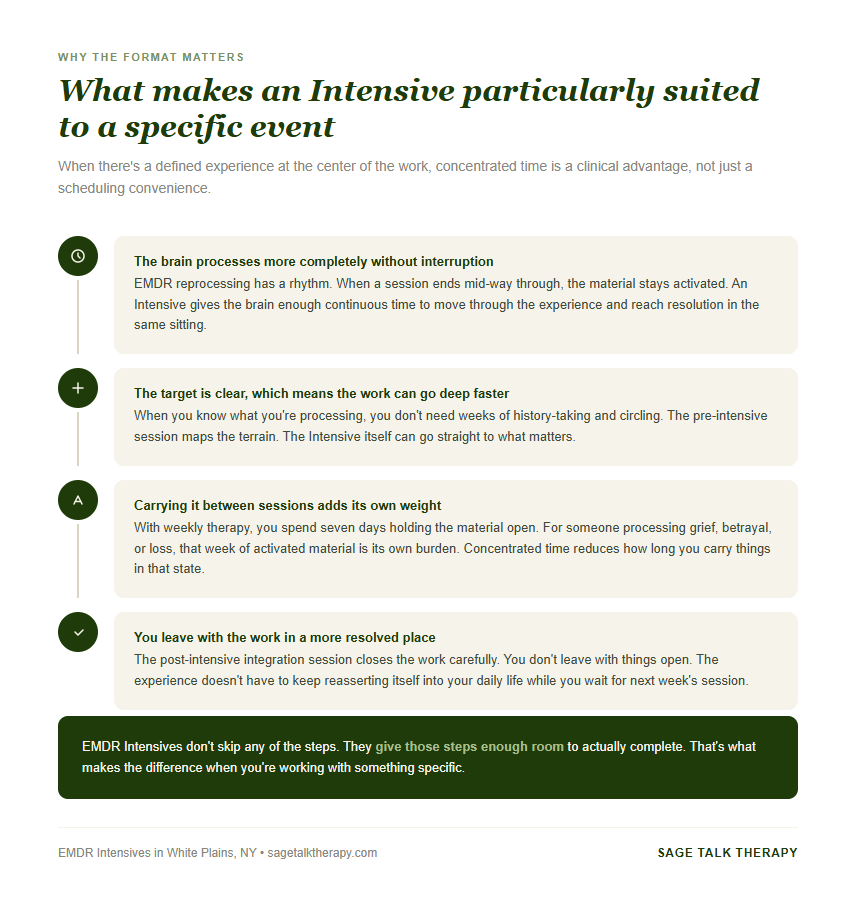
EMDR reprocessing has a rhythm. The brain activates the material, begins to process, and when it has enough time, reaches resolution within the same sitting. When a fifty-minute session ends mid-way through that process, the material stays activated. You leave with it open and carry it through the week until the next appointment.
For someone processing grief, betrayal, a medical experience, or loss, that week of activated material is its own burden. It means the healing process is stretched across months of weekly appointments, with the hardest parts of the work spread across a timeline that doesn't serve the nervous system.
An Intensive changes that. Extended, focused sessions give the brain uninterrupted time to actually move through the material rather than just approach it. When the target is specific and clear, we can go deep faster. And because the work is bookended with a preparation session before and an integration session after, you don't leave with things unresolved.
What Kinds of Experiences This Addresses
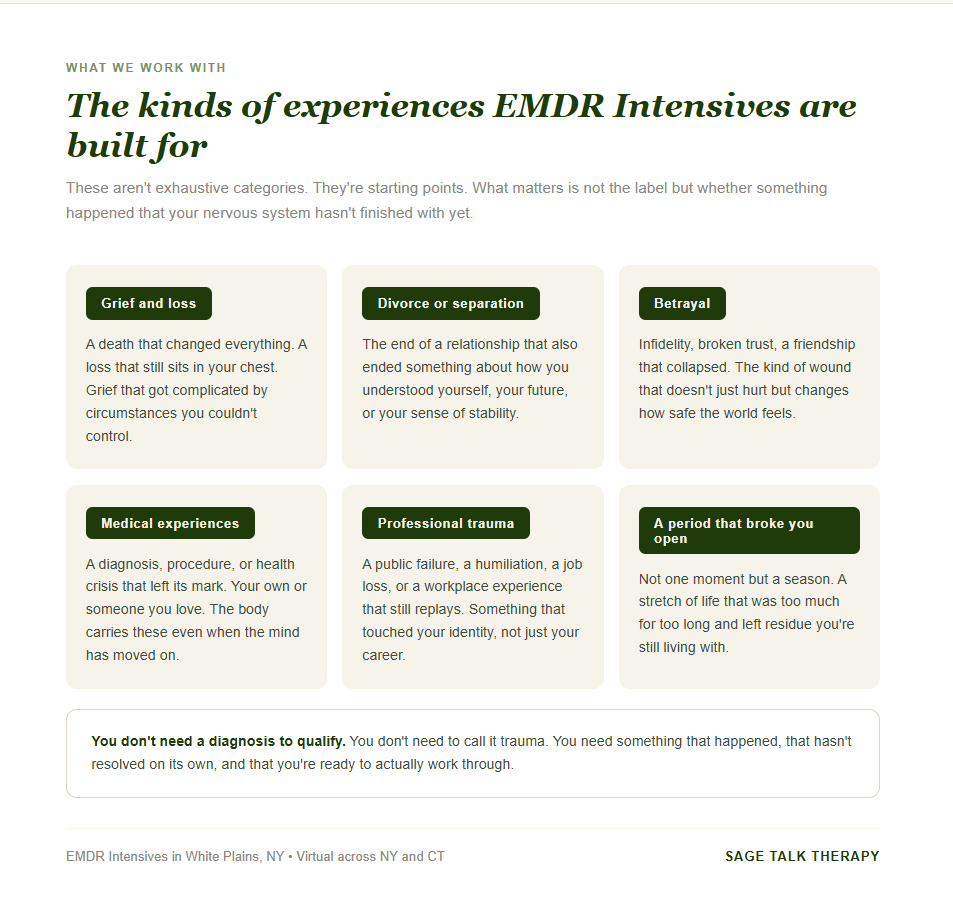
EMDR Intensives are well-suited to a wide range of defined experiences. You don't need a diagnosis. You don't need to call it trauma. What you need is something that happened, that hasn't resolved, and that you're ready to work through.
That might include:
Grief and loss: A death that changed everything. A loss that never fully processed because life required you to keep moving. Grief that got complicated by circumstances surrounding how someone died, or by a relationship with them that was itself complicated.
Divorce or separation: The end of a relationship that also ended a version of your life, your future, your understanding of yourself. The legal process ends. The emotional residue often doesn't.
Betrayal: Infidelity, broken trust, a friendship that collapsed in a way that still doesn't make sense. The kind of wound that doesn't just hurt but shifts how safe connection feels going forward.
Medical experiences: A diagnosis, a procedure, a health crisis, a pregnancy loss. Your own body doing something that frightened you. Or watching someone you love go through something you couldn't stop. The body carries these in particular ways.
Professional trauma: A public failure, a humiliation, a job loss or termination, a workplace experience that touched your identity rather than just your career. The kind of thing that replays.
A period that was too much: Not one event but a season. A stretch of time that accumulated in a way your nervous system couldn't fully metabolize. Sometimes there's no single moment to point to, just the residue of a time that broke you open.
What the Research Says About Concentrated Treatment
The evidence base for EMDR is strong, and there is growing research specifically supporting concentrated or Intensive formats for certain presentations.
Studies on Intensive EMDR programs have found that concentrated treatment can achieve comparable or greater symptom reduction in less total treatment time than weekly sessions. For presentations involving a specific traumatic experience, concentrated formats reduce the burden of repeatedly activating material between sessions and support more complete processing within each treatment period.
The nervous system benefits from being able to stay with the work long enough to reach resolution rather than stopping and starting. This is not a new clinical insight. It's why Intensive formats exist.
A Word on Timing
People often wait longer than they need to before reaching out. They assume they should be further along by now. They wonder whether what they experienced was significant enough to warrant this kind of focused attention. They tell themselves other people have been through worse.
None of that reasoning serves you.
The question isn't whether the experience was big enough. The question is whether it's still affecting you in ways that you're ready to be done with. If the answer is yes, that's reason enough.
There's also no right amount of time to have passed. Some people reach out shortly after something happens because they want to address it before it takes deeper root. Others come years later, carrying something that never quite resolved. Both are valid. Both are workable.
One Last Thing
The experience you're carrying has been there long enough. You've been managing around it, living with it, giving it room in your nervous system that it's been occupying rent-free.
You don't have to keep doing that.
EMDR doesn't erase what happened. It helps the brain store it differently, so it stops generating the same response every time something brushes up against it. The memory becomes one you have rather than one that has you.
That's available to you. And it doesn't have to take as long as you think.
WORKING WITH ME
I'm Dadiana Lopez, a Licensed Clinical Social Worker and EMDR therapist in White Plains, NY. I offer EMDR Intensives for adults in Westchester County and virtually for clients across New York and Connecticut.
My clients include professionals and individuals from White Plains, Scarsdale, Bronxville, Eastchester, Pleasantville, Chappaqua, and the surrounding area who are carrying something specific that hasn't resolved, and who are ready for a focused, structured approach to finally moving through it.
Intensives are available on a limited basis each month. If you've been holding something and you're ready to be on the other side of it, the best first step is a conversation.

Dadiana Lopez
LCSW · Anxiety & Trauma Therapist · EMDR Specialist
Dadiana Lopez is a Licensed Clinical Social Worker and EMDR therapist based in White Plains, NY. She specializes in anxiety, trauma, PTSD, and the patterns that form in the wake of both — including people-pleasing, perfectionism, and burnout. She sees clients in person in Westchester and online throughout New York and Connecticut.
Seeing clients in-person in White Plains, NY and online throughout New York and Connecticut.