
Signs Your Nervous System is Dysregulated (and What to do About It)
You've probably heard the phrase "nervous system dysregulation" more times than you can count lately. It's all over wellness spaces, therapy Instagram, and mental health podcasts. And like a lot of concepts that go viral, it's often dropped into conversation without anyone explaining what it actually means or — more importantly — how to know if it applies to you.
This post is that explanation.
Nervous system dysregulation is real, it's common, and it's one of the most significant but least discussed drivers of the chronic anxiety, emotional reactivity, and exhaustion that bring people into therapy. Understanding what it looks like in real life — not in theory — is often the first genuinely useful step toward doing something about it.
What dysregulation Actually Means
A regulated nervous system is a flexible one. It activates when activation is genuinely needed — a real threat, a real demand — and settles back down when the situation has passed. It moves between states of engagement, alertness, and rest with reasonable ease. You have access to yourself across a range of circumstances.
A dysregulated nervous system has lost that flexibility. It's stuck — either running too hot, in a state of chronic activation that never fully quiets, or running too cold, in a state of shutdown or numbness that disconnects you from your own experience. Sometimes it oscillates between both, tipping from one extreme to the other without spending much time in the regulated middle.
Dysregulation is not a character flaw or a weakness. It is a learned state. The nervous system adapts to its environment — and when the environment has been chronically stressful, unpredictable, or unsafe, the nervous system learns to stay ready. That readiness made sense at some point. The problem is that it keeps running long after the original circumstances are gone.
the signs: what dysregulations looks like in real life
These are the patterns I see most consistently in clients who are living with chronic nervous system dysregulation. Not all of them will apply, and they won't all look the same — dysregulation shows up differently depending on your history, your nervous system's particular learned patterns, and whether you tend more toward hyperactivation or shutdown.
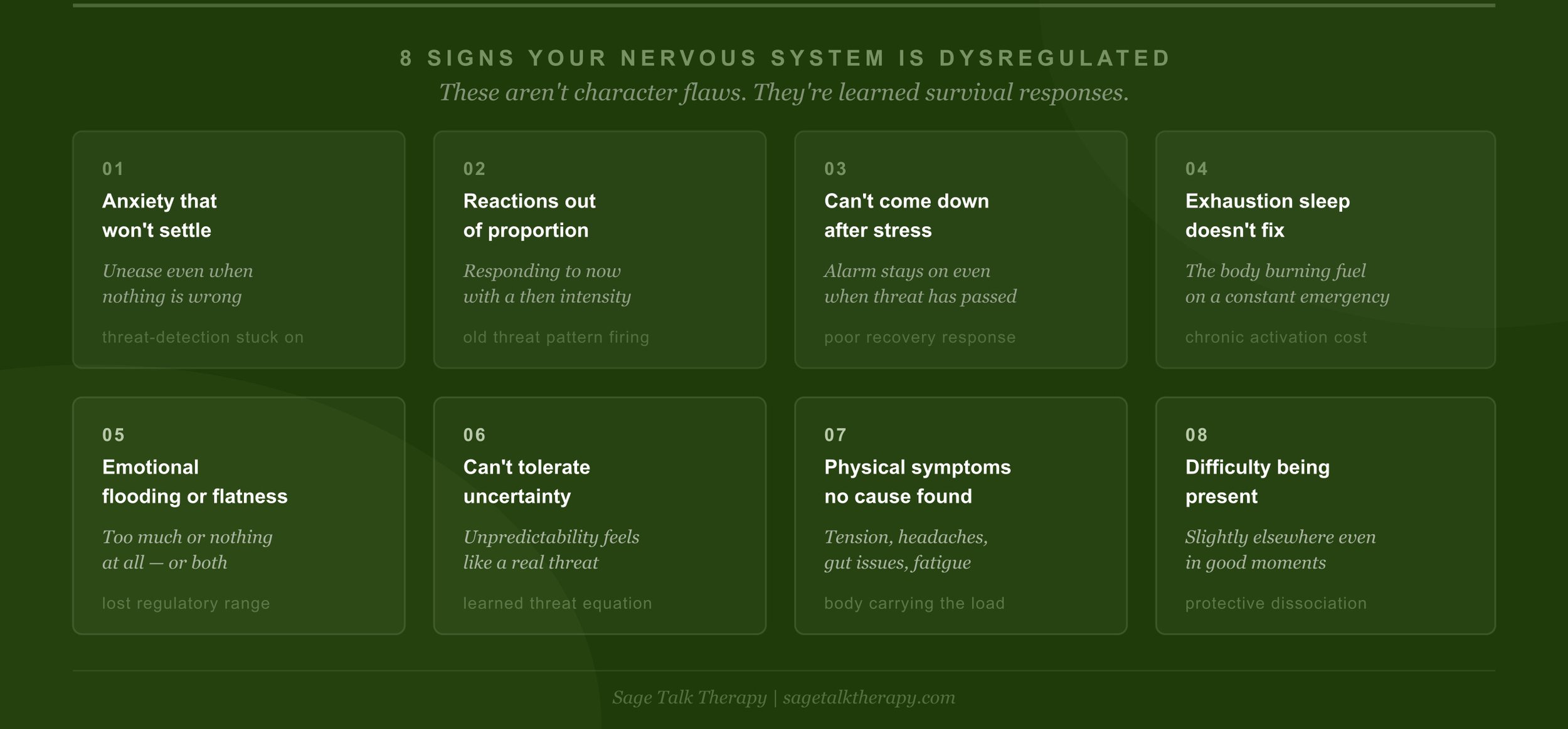
Anxiety That Won’t Fully Settle
The most common and recognizable sign. You feel anxious even when there is no clear current threat. You can identify no pressing emergency, and yet the background hum of unease doesn't go away. It might spike in response to specific triggers, but even between those spikes, something never quite settles.
This is the nervous system running its threat-detection program regardless of whether the current circumstances warrant it. For many people this pattern has roots that go back much further than anything happening right now — the nervous system learned early that vigilance was necessary, and it hasn't received enough evidence to update that learning.
Reactions That Feel Out of Proportion
Someone uses a particular tone of voice. A plan changes unexpectedly. Someone is upset with you, or you sense they might be. And the reaction — the spike of anxiety, the surge of anger, the sudden urge to shut down completely — is much bigger than the situation seems to warrant.
This is one of the most disorienting aspects of nervous system dysregulation, because the reactions feel entirely real and appropriate from the inside while looking disproportionate from the outside. What's happening is that the current situation has activated a threat response that belongs to a different moment — an older, more dangerous one. The nervous system is responding to the pattern, not the present.
Difficulty Coming Down After Stress
The meeting ends. The conflict resolves. The hard conversation is over. And you still can't settle. The cortisol and adrenaline keep running. You lie awake rehashing it. You feel keyed up for hours after the stressor has passed.
A regulated nervous system has what's called good recovery — the ability to return to baseline relatively quickly after activation. Dysregulation disrupts recovery. The alarm system stays on even when the alarm is over, because it has learned not to trust that the coast is truly clear.
Chronic Exhaustion that Sleep Doesn’t Fix
You sleep a reasonable amount and still wake up tired. The exhaustion is not just physical — it has a particular quality of depletion, as if something is running in the background that you can't turn off. Which, in a sense, there is.
Running a chronic threat response is physiologically expensive. The stress hormones that mobilize the body for action have metabolic costs. When the nervous system is in a sustained state of activation, the body is essentially burning fuel on a constant low-level emergency response. The exhaustion is the bill for that.
Emotional Flooding or Emotional Flatness
Either everything feels too much — emotions arrive fast, intensely, and seem difficult to contain — or nothing seems to feel like anything at all. Some people with dysregulation experience primarily the flooding version. Others primarily the flatness. Many oscillate between the two, which is particularly disorienting.
Both are expressions of a nervous system that has lost its regulatory range. Flooding is the hyperactivated state breaking through. Flatness is the shutdown state — the nervous system's most primitive protection, going offline to prevent overwhelm.
Difficulty tolerating uncertainty
The need to know. The compulsive checking. The inability to leave things open-ended without anxiety climbing. The sense that if you don't have a plan, a backup plan, and a plan for the backup plan, something bad will happen.
Intolerance of uncertainty is one of the clearest expressions of a nervous system that has learned to equate unpredictability with threat. When early environments were genuinely unpredictable, the nervous system learned that certainty was a survival tool. That learning persists long past its usefulness.
Physical Symptoms Without Clear Cause
Chronic muscle tension — particularly in the jaw, shoulders, and neck. Digestive disruption. Headaches. A constant low-level fatigue. Disrupted sleep. These are not imagined and they are not random. They are the body expressing what the nervous system is carrying.
The stress response is a full-body event. When it runs chronically, the body bears the cost. Many people spend years treating these physical symptoms without ever addressing the dysregulated nervous system underneath them.
Difficulty Being Present
The lights are on but something is slightly elsewhere. Even in good moments — moments that should feel meaningful or enjoyable — there is a quality of not quite being there. Conversations happen but you're slightly monitoring rather than fully inhabiting them. Rest is technically occurring but doesn't actually feel restful.
This is often a milder form of dissociation — the nervous system managing activation by creating a degree of distance from immediate experience. It's protective. It's also profoundly disconnecting over time.
why dysregulation persists (and why willpower doesn’t fix it)
Understanding why these patterns are so persistent is important, because most people who are living with dysregulation have already tried to address it through will and effort. They've told themselves to calm down, to stop overreacting, to not let things get to them. They've tried breathing exercises, journaling, and various coping strategies. Some of it has helped, temporarily. And then something gets triggered and the whole system fires again.
That's not a failure of discipline. It's a mismatch between the approach and the nature of the problem.
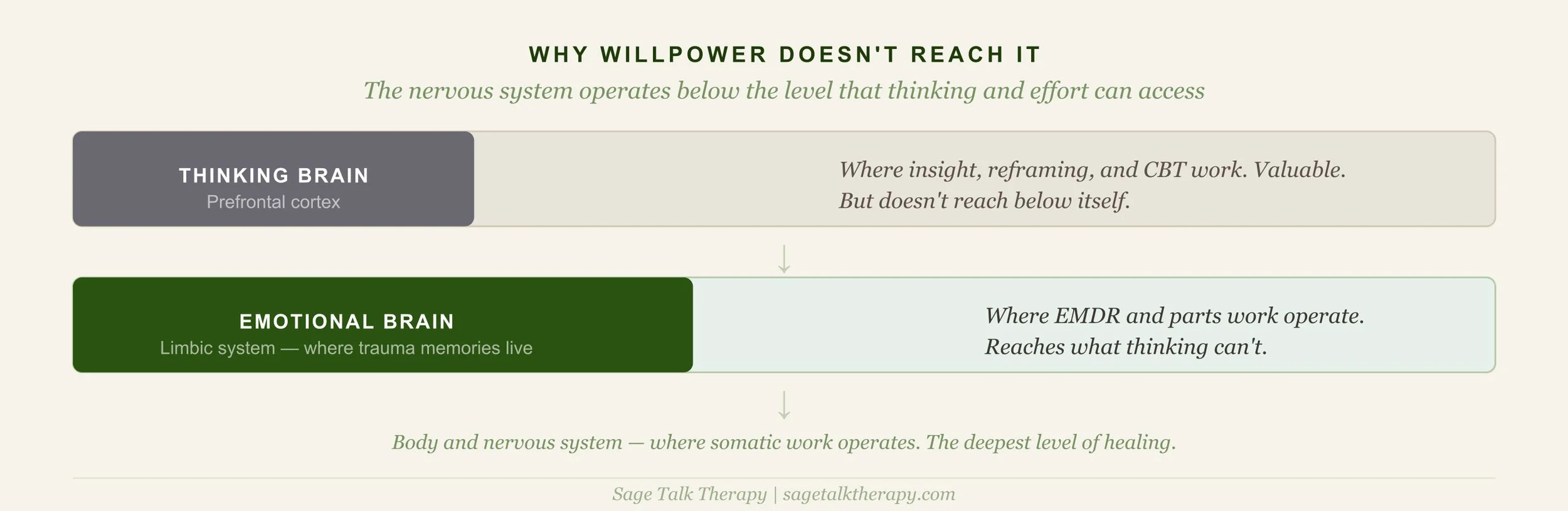
Nervous system dysregulation is not primarily a cognitive problem. It lives at a physiological level — in the calibration of the threat-detection system, in the stress hormone patterns, in the automatic responses that fire before the thinking brain has a chance to intervene. Addressing it through thinking and willpower is asking the prefrontal cortex to override a system that is fundamentally operating below the prefrontal cortex's jurisdiction.
This is why approaches that work directly with the nervous system — rather than just the thoughts about what's happening — tend to produce more durable change.
what actually helps
None of the following is a quick fix. Nervous system dysregulation that has developed over years doesn't resolve in a weekend. But these are the approaches with the strongest evidence and the most consistent clinical results.
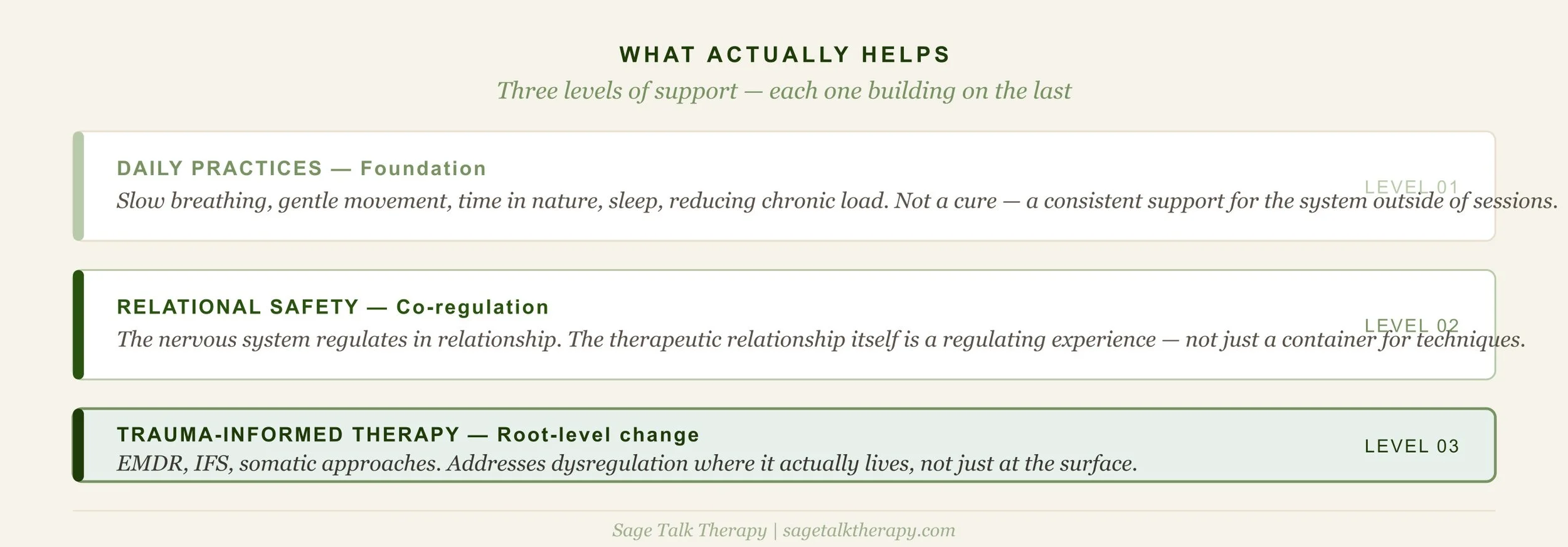
Trauma-informed therapy: specifically approaches that work at the nervous system level rather than purely through insight and conversation. EMDR, somatic experiencing, and IFS all address dysregulation where it actually lives rather than just working on the surface of it.
EMDR: is particularly effective for dysregulation that has roots in specific experiences — whether overtly traumatic or the more subtle accumulated experiences of a chronically stressful early environment. By helping the brain reprocess what it has been treating as ongoing threat, EMDR allows the nervous system's threat-detection calibration to update. The alarm stops firing for situations that no longer warrant it.
Somatic and body-based practices: not as a replacement for therapy, but as consistent daily support for the nervous system outside of sessions. This includes practices that activate the parasympathetic nervous system specifically: slow diaphragmatic breathing, gentle movement, time in nature, cold water exposure (brief, not extreme), and any activity that creates a felt sense of physical safety and settling in the body.
Reducing chronic load: the nervous system's capacity for regulation is finite. When chronic stressors are high — overwork, relationship conflict, financial pressure, poor sleep, inadequate nutrition — the threshold for dysregulation drops. This doesn't mean eliminating all stress, which is both impossible and not the goal. It means honestly assessing what is consistently keeping the load too high, and making changes where possible.
Relational safety: the nervous system regulates in relationship. Co-regulation — the physiological settling that happens in the presence of a calm, attuned other — is not just a nice concept. It is one of the primary mechanisms through which the nervous system learns to settle. This is why the therapeutic relationship is not just a vehicle for techniques. It is itself a regulating experience.
a note on timelines
People often ask how long it takes to regulate a chronically dysregulated nervous system. The honest answer is: longer than most people want, and less long than most people fear.
Meaningful shifts in nervous system regulation typically happen within months of consistent trauma-informed work — not years. But the shifts are gradual and cumulative rather than sudden. Clients often describe noticing the change retrospectively — realizing at some point that they have been recovering from triggers faster, that the baseline anxiety is quieter, that they have been more present in their daily life without consciously trying.
The work is not dramatic. It is steady. And it compounds over time in ways that are genuinely significant.
if this resonates
Nervous system dysregulation is one of the underlying patterns I work with most consistently, across anxiety, trauma, burnout, and the other concerns that bring people into my practice. If several of the signs in this post felt familiar, that's worth paying attention to.
I work with adults in Westchester, NY and online throughout New York and Connecticut. If you want to understand more about what your nervous system has been carrying — and what a trauma-informed approach could look like for you — I'd welcome the conversation.
Learn more about anxiety therapy.
Learn more about trauma therapy.

Dadiana Lopez
LCSW · Anxiety & Trauma Therapist · EMDR Specialist
Dadiana Lopez is a Licensed Clinical Social Worker and EMDR therapist based in White Plains, NY. She specializes in anxiety, trauma, PTSD, and the patterns that form in the wake of both — including people-pleasing, perfectionism, and burnout. She sees clients in person in Westchester and online throughout New York and Connecticut.
Seeing clients in-person in White Plains, NY and online throughout New York and Connecticut.