
The Link Between Childhood Experiences and Adult Anxiety Nobody Talks About
Most people treat anxiety as a present-tense problem.
Something to manage, something to cope with, something to work around. They focus on the current stressor — the relationship, the job, the endless list of things that could go wrong — and try to find ways to quiet the noise. They might try therapy, medication, mindfulness, exercise. Some of it helps. Some of it helps temporarily.
What rarely gets asked is the question that actually matters most: where did this anxiety come from?
For a significant number of adults living with chronic anxiety, the honest answer has roots that go back much further than anything happening right now. It goes back to childhood — not necessarily to dramatic, obvious trauma, but to the accumulated experiences of growing up in an environment that shaped how your nervous system learned to read the world.
This is the link that most anxiety treatment addresses only superficially, if at all. And it's the link that, when understood clearly, changes everything about how healing becomes possible.
what the research actually says
There is a substantial and growing body of research on Adverse Childhood Experiences — ACEs — and their relationship to adult mental health. The original ACE Study, conducted in the 1990s, surveyed over 17,000 adults about their childhood experiences and health outcomes. What it found was striking: higher ACE scores were associated with significantly increased risk of lifetime depressive disorders, poor mental health, and psychological distress in general.
More recent research has deepened that picture considerably. Higher ACEs were associated with increased risk of anxiety-related disorders, substance use, and depression — with specific brain regions identified as potential mediators between adverse childhood experiences and adult psychiatric diagnoses.
A 2026 study confirmed what clinicians working with trauma have observed for years: childhood trauma may dysregulate the stress response system, resulting in an exaggerated and prolonged stress reaction — thereby increasing stress sensitivity in ways that persist into adulthood.
In plain language: what happened to you as a child changed how your nervous system responds to the world. Not temporarily. Biologically. And that change doesn't resolve on its own just because the childhood is over.
but I didn’t have a “bad” childhood
This is where most people stop reading, or start mentally exempting themselves.
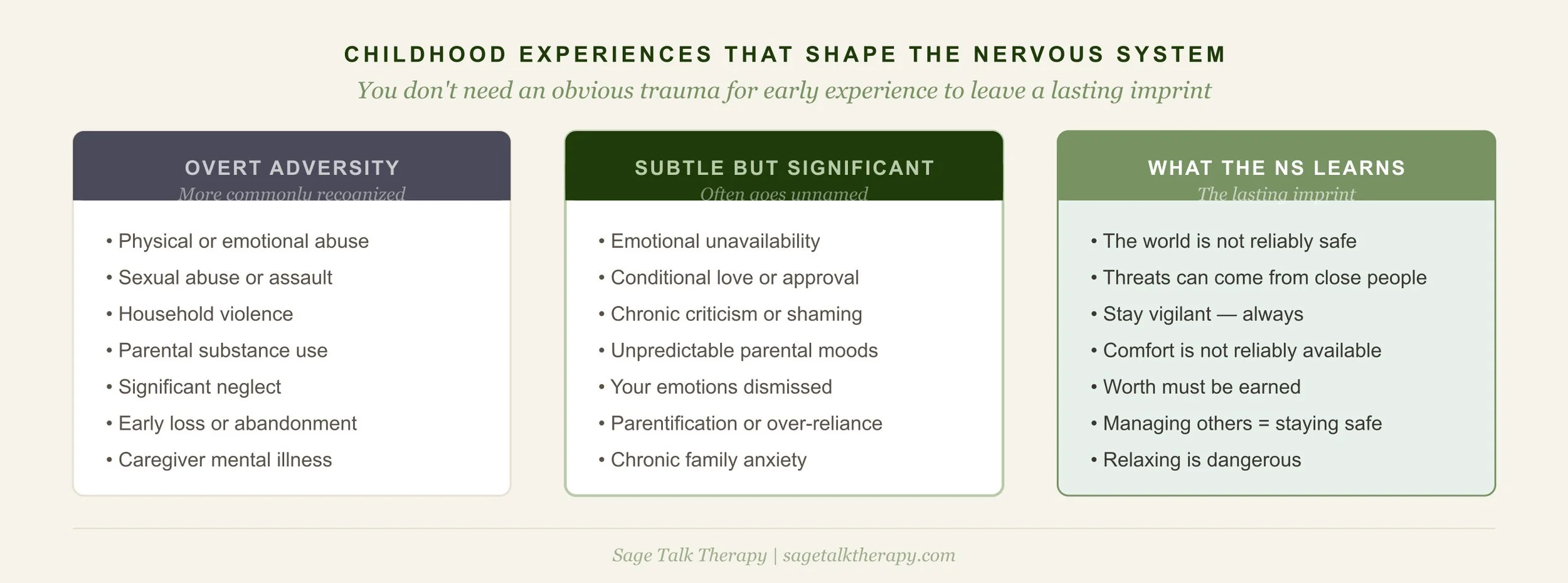
The ACE research originally focused on the most obvious forms of adversity — physical abuse, sexual abuse, household violence, parental substance use. And those experiences absolutely matter and have profound effects.
But the clinical picture is broader than that. Many adults carrying childhood-rooted anxiety grew up in homes that looked, from the outside, completely fine. No dramatic crises. No obvious abuse. Just the slower, subtler forms of difficulty that are much harder to name.
A parent whose own anxiety was pervasive and unspoken, leaving you with a chronic low-level sense that the world was not quite safe. Emotional unavailability — a parent who was physically present but never really there, leaving you with an unmet need for attunement that your nervous system interpreted as abandonment. A home where conflict was explosive and unpredictable, training you to read every room for signs of what was coming. Chronic criticism delivered as love. Conditional approval that taught you your worth was earned, not given.
None of these require a label to have left a mark. The nervous system doesn't require an identifiable trauma event to learn that hypervigilance is necessary. It learns from the accumulated texture of everyday experience — from what was predictable and what wasn't, from whether comfort was reliably available, from whether your emotional reality was seen and responded to or dismissed and minimized.
how childhood experiences get wired into the nervous system
Here is the mechanism that makes this connection so durable — and so hard to address with conventional anxiety management approaches alone.
The human nervous system is most plastic — most shaped by experience — in the earliest years of life. During childhood, and especially in the first years, the brain is building its foundational architecture based on what it encounters. The attachment relationship with primary caregivers is not just emotionally important. It is literally neurobiological. How your caregivers responded to you — consistently or unpredictably, warmly or coldly, safely or threateningly — shaped the developing stress response system at a cellular level.
For a plan-language explanation of how the nervous system works, click here.When the early environment is safe enough — not perfect, just safe enough — the nervous system learns a foundational lesson: threats pass, discomfort is survivable, comfort is available, the world is basically manageable. This becomes the default operating state.
When the early environment is unsafe, unpredictable, or chronically stressful, the nervous system learns a different lesson: threats are frequent, comfort is unreliable, staying vigilant is necessary for survival. The alarm system calibrates toward sensitivity rather than safety. And that calibration persists.
This is not a choice. It is not a personality trait. It is the nervous system doing exactly what it was designed to do — adapting to its environment to maximize survival. The problem is that the environment changes and the nervous system doesn't update automatically. The alarm stays sensitive long after the original environment is gone.
What This Looks Like in Adult Life
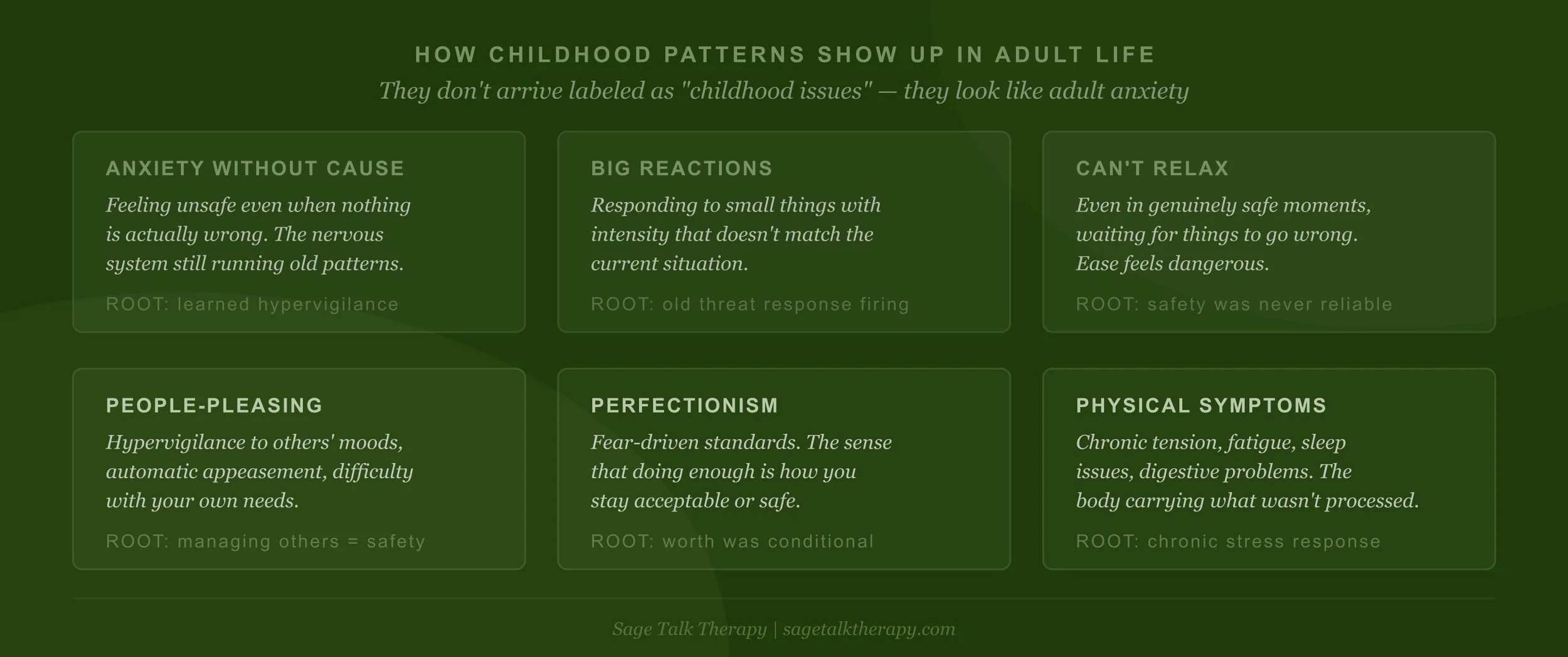
The nervous system patterns shaped by childhood experience don't announce themselves as "childhood issues." They show up as adult symptoms that feel entirely disconnected from the past.
Chronic anxiety with no clear cause. You're anxious even when nothing is actually wrong. You can identify no current threat, and yet the sense of unease is constant. This is often the nervous system running the threat-detection program it learned early, regardless of whether current circumstances warrant it.
Disproportionate reactions. Something small happens — a tone of voice, a perceived slight, a moment of uncertainty — and the reaction is much bigger than the situation seems to call for. The current event has triggered the nervous system's memory of something older, and the response belongs to then as much as it belongs to now.
Difficulty trusting that things are okay. Even when life is genuinely going well, there's an underlying inability to relax into it. A waiting for the other shoe to drop. An inability to fully inhabit moments of ease or joy without bracing.
People-pleasing and hypervigilance to others' emotions. When early safety depended on accurately reading and managing a caregiver's emotional state, that vigilance becomes automatic. In adulthood it looks like being exquisitely attuned to everyone else's feelings at the expense of your own — and feeling anxious when someone around you is upset, even when it has nothing to do with you.
Perfectionism and the inability to rest. When worth was conditional on performance in childhood, the adult nervous system keeps running the same equation. Doing enough equals safety. Not doing enough equals threat. The anxious drive to achieve is the nervous system trying to stay safe the only way it learned how.
Physical symptoms with no clear medical cause. Adverse childhood experiences generate a chemical stress response that affects physical health throughout the body — chronic tension, digestive issues, fatigue, headaches, sleep disruption. These are not imagined. They are the body carrying what the mind has never fully processed.
Why This Matters for Treatment
Understanding the childhood roots of adult anxiety is not an academic exercise. It has direct implications for what kind of treatment will actually work.
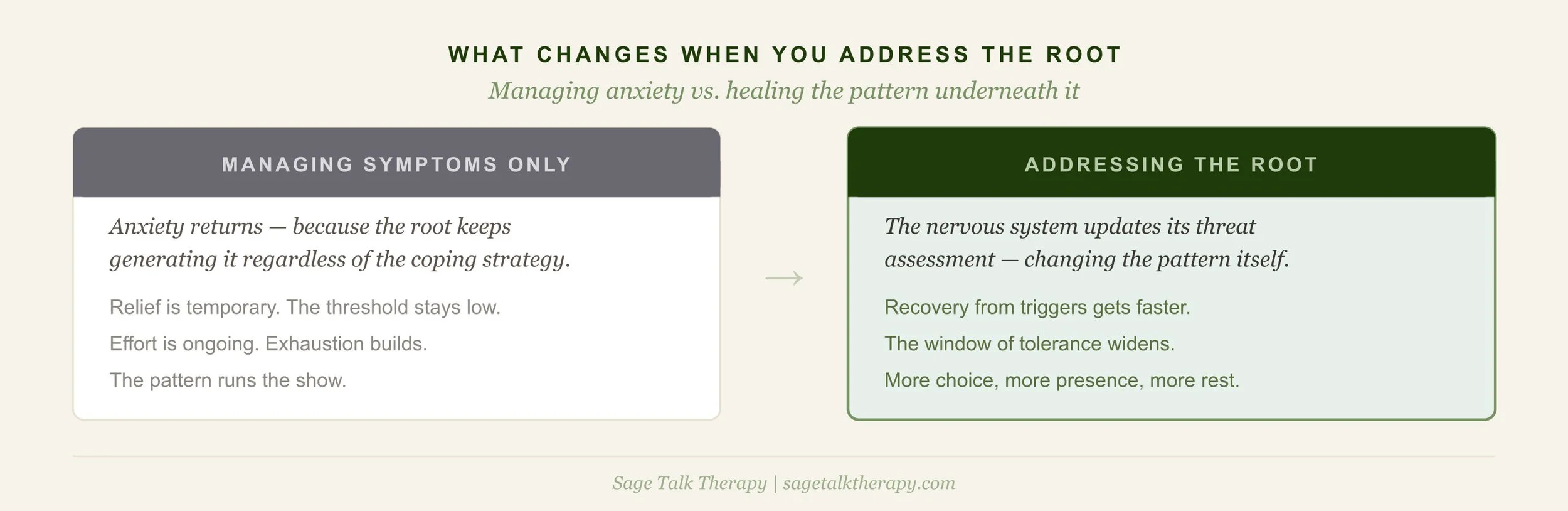
If chronic anxiety is primarily a nervous system pattern shaped by early experience, then approaches that work only at the level of current thoughts and behaviors are working on the surface while the root keeps running underneath.
This is why so many intelligent, self-aware people can do significant amounts of talk therapy and cognitive work — genuinely understanding their anxiety, its origins, its patterns — and still not feel fundamentally different. The understanding is real. It just hasn't reached the level where the pattern is encoded.
Approaches like EMDR work directly with the nervous system's stored threat responses — helping the brain reprocess experiences that are still being read as current threats and update its assessment of the present moment. Somatic approaches work with how early experience is held in the body. Internal Family Systems works with the protective parts that formed in response to early relational wounds. These approaches reach the level where childhood experience actually lives — not just in memory and narrative, but in the automatic, physiological responses that run below conscious thought.
This doesn't mean the work is endless or that childhood experiences are a life sentence. Positive adult experiences can serve as meaningful turning points for mental health even in the presence of significant adverse childhood experiences. The nervous system remains plastic throughout life — capable of learning, updating, and building new patterns. But that updating requires the right conditions and the right approach.
A Word on Self-Compassion and This Kind of Understanding
Knowing that your anxiety has childhood roots can be a genuinely liberating reframe — or it can become another source of self-blame or grief. A few things worth holding:
Understanding where anxiety came from is not the same as being defined by it. The nervous system patterns shaped by childhood experience are not your identity. They are learned responses. And learned responses can change.
This isn't about assigning blame to your parents or your childhood. Most parents doing the things that shape anxious nervous systems were doing the best they could with what they had — often carrying their own unprocessed histories. Understanding the mechanism doesn't require vilifying anyone.
And it isn't about excavating every painful memory. Effective trauma-informed work doesn't require narrating your entire childhood in detail. It requires working with what your nervous system learned — and that can happen without reliving everything that taught it.
What it does require is acknowledging that the present-tense anxiety management strategies alone are often not enough — and being open to the possibility that the root deserves attention.
What This Work Looks Like
When therapy addresses the childhood roots of adult anxiety, it tends to move through a few recognizable phases.
First, making the connection. Understanding — at a felt level, not just an intellectual one — how the current patterns connect to early experience. This is often genuinely revelatory for clients who have spent years treating anxiety as a present-tense problem.
Then, working with what the nervous system learned. Using approaches that work at the level where the learning happened — somatic, EMDR-based, parts-based — to help the system update its threat assessment and build new patterns of response.
And finally, integration. The anxiety doesn't disappear entirely. But it loses the quality of being unavoidable and all-consuming. Triggers still happen — but recovery is faster. The window of tolerance widens. The relationship with the internal experience of anxiety becomes more workable. The pattern is no longer running the show.
if this resonates
If you've been managing anxiety for years without ever asking where it came from — or if you've suspected the roots go deeper than your current circumstances — that instinct is worth following.
I work with adults in Westchester, NY and online throughout New York and Connecticut who are ready to address anxiety at the root rather than just managing its surface. The work is slower than a coping strategy and more meaningful than any symptom management approach alone.
Learn more about anxiety therapy.
Learn more about trauma therapy.

Dadiana Lopez
LCSW · Anxiety & Trauma Therapist · EMDR Specialist
Dadiana Lopez is a Licensed Clinical Social Worker and EMDR therapist based in White Plains, NY. She specializes in anxiety, trauma, PTSD, and the patterns that form in the wake of both — including people-pleasing, perfectionism, and burnout. She sees clients in person in Westchester and online throughout New York and Connecticut.
Seeing clients in-person in White Plains, NY and online throughout New York and Connecticut.