
If you have been researching EMDR therapy and come across the term EMDR Intensive, you may have found yourself more confused than before you started looking.
The marketing language around intensives often makes them sound like simply faster therapy — the same thing as weekly sessions, just compressed. That framing misses what actually makes intensives different. It also overstates the case in ways that set the wrong expectations.
The honest reality is that EMDR Intensives and weekly EMDR sessions are both effective, evidence-based formats. The research supports both. They produce similar outcomes. The difference is structural — and that structural difference makes each one a better fit for specific situations, specific people, and specific kinds of work.
This post is a genuinely honest comparison. Including what weekly therapy does better, what intensives are not suited for, and how to actually think through which format fits what you are carrying.
What weekly EMDR looks like
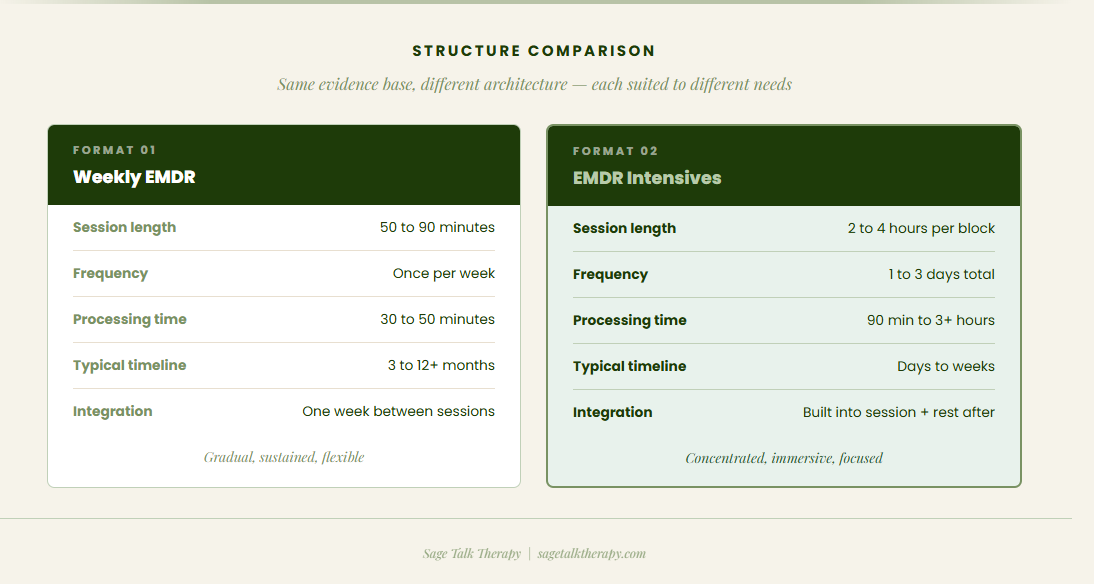
Standard weekly EMDR sessions run 50 to 90 minutes, once a week. Within that structure, a session typically includes a brief check-in, resourcing or stabilization as needed, a processing set with bilateral stimulation, and a closing phase that ensures the client leaves the session settled rather than activated.
The weekly format has several things working in its favor.
Integration time: One of the underappreciated advantages of the weekly format is the week between sessions. The brain continues processing after a session ends. Dreams change. Associations surface. Insights arrive. The week provides space for that integration to happen naturally, and the next session can build on what has shifted rather than pushing immediately forward.
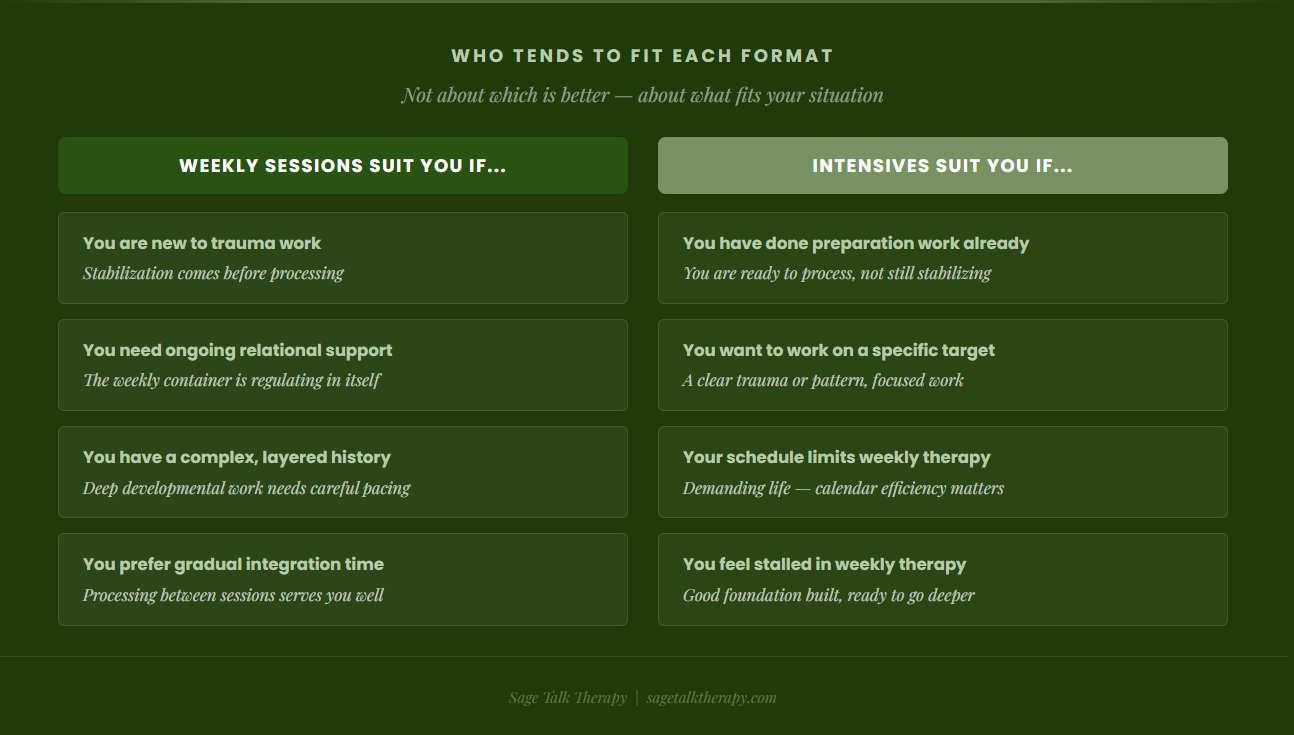
Gradual pacing for complex histories: For clients with extensive developmental trauma, significant dissociation, or very narrow windows of tolerance, the weekly format allows the work to be carefully paced. There is time to build resources, to let the nervous system develop capacity incrementally, and to ensure that processing never moves faster than the client's system can handle.
Ongoing relationship and support: The consistent therapeutic relationship built over weekly sessions provides its own regulatory function. The predictability of the container — same therapist, same time, same structure, every week — is itself a form of safety that supports deeper work over time.
Flexibility for what emerges: Life happens between sessions. Sometimes the most important thing to address in a given week is not the original treatment target but what has surfaced in the client's life. Weekly therapy has the flexibility to meet people where they are.
Weekly EMDR works well. For many people, it is the right format from beginning to end. Most patients need fewer than ten sessions to return to a stable mental state using the standard weekly format, with complex or childhood trauma typically requiring twelve or more sessions.
What an EMDR intensive looks like
An EMDR Intensive concentrates treatment into extended blocks rather than weekly increments. At Sage Talk Therapy, intensives are structured as a 5-hour package of clinical work, including 3-hours of reprocessing, designed around specific treatment targets identified during a preparation consultation.
The structural difference is significant. Instead of 50 minutes of processing time that includes check-in, setup, and closure, an intensive provides three hours of actual processing time in a single container. The work can go deeper, move further, and complete more fully without the artificial stopping point that the end of a standard session imposes.
Instead of seeing your therapist for 50 minutes once a week and stopping mid-process, you get extended time to go deeper, stay in the flow, and actually complete trauma processing in fewer sessions. Many clients choose intensives when they're dealing with a specific trauma, want quicker results, or feel like weekly therapy just isn't cutting it anymore.
The research supports this format. A peer-reviewed study found that intensive daily EMDR treatment — two sessions a day over ten days — produced statistically significant treatment effects equivalent to weekly treatment across 18 to 20 sessions, with outcomes maintained at one-year follow-up. The intensive format produces the same results in a fraction of the calendar time.
What this means practically is that what might take three to six months of weekly sessions can often be addressed in one to three days of intensive work.
The specific advantages of intensives
No mid-processing interruption
This is the clinical advantage that matters most. In a 50-minute session, when the processing is moving and something important is shifting, the clock runs out. The therapist has to bring the client back to a settled baseline and close the session before the work is complete. The following week, the client has to re-enter that material from a colder start. Intensives allow processing to continue until natural completion rather than stopping at an arbitrary time boundary.
Momentum builds
In extended processing, associations surface more freely, connections become clearer, and the work moves with a momentum that interrupted weekly sessions cannot replicate. Clients frequently describe intensive processing as feeling more thorough and complete than the same number of hours of weekly processing.
Calendar efficiency
For clients with demanding professional lives, caregiving responsibilities, or geographical distance from their therapist, the intensive format provides access to a substantial amount of clinical work without requiring months of weekly appointments. Three days of intensive work can accomplish what six months of weekly sessions might reach.
Travel access
Intensives make high-quality specialized EMDR accessible to people who are not local to the therapist. Rather than commuting weekly, a client can make one trip and accomplish significant work in a concentrated period. At Sage Talk Therapy, intensives are also available online for clients throughout New York and Connecticut who cannot travel to White Plains.
Crossing a threshold
Some clients reach a point in weekly therapy where they feel stalled — where they have built good stabilization and understand their patterns but are not moving through the processing phase as efficiently as they need to. An intensive can provide the concentrated depth that breaks through that plateau.
What intensives are not suited for
Honesty requires naming this clearly:
Intensives are not the right starting point for everyone: Before intensive processing can happen safely, adequate preparation is required: a stable therapeutic relationship, sufficient stabilization resources, a nervous system that can tolerate extended activation without being overwhelmed. Clients with very narrow windows of tolerance, significant dissociation, or significant current life crisis are generally not good candidates for an intensive format until those things are addressed.
Intensives are not a shortcut around the work: Intensive processing is not easier than weekly processing. It is more concentrated. The depth and efficiency of the intensive format requires that the client is genuinely ready for processing — prepared, resourced, and stable enough to stay in the work for extended periods. For someone who is not yet ready, the same extended time that produces depth in a prepared client can produce overwhelm in an unprepared one.
Intensives do not replace ongoing support for some clients: For people who benefit significantly from the ongoing relational container of weekly therapy — who use the weekly structure for life management as well as trauma processing, or who have limited capacity for self-support between sessions — weekly therapy remains the more appropriate format. Intensives work best when the client has adequate daily functioning and is using therapy primarily for targeted processing work.
Intensives are not appropriate for active crisis: Current significant life instability, active suicidality, or acute mental health crisis are contraindications for intensive processing. The nervous system needs to be stable enough to enter and exit extended activation safely.
How to think about which format fits
The decision between weekly sessions and an intensive is not about which is better. It is about what fits your particular situation.
Here are the questions worth sitting with:
What is your readiness for processing?
Have you done enough stabilization work that your nervous system can hold extended activation? If you are just beginning trauma work, weekly therapy may be the right starting point regardless of your interest in intensives. If you have done significant previous work and are prepared to process, an intensive may be appropriate sooner.
What is your life capacity?
Do you have the bandwidth to take at least one day away from your regular life for intensive work? Can you plan appropriate rest and self-care around that days? The days following an intensive typically require some quieter space for integration — not crisis management, but genuine rest. If your life does not allow for that, the weekly format may be more practical.
What are you trying to accomplish?
If you are working on a specific, identifiable experience — a discrete trauma, a specific pattern with clear roots, a phobia or particular trigger — the intensive format is often very well suited. If you are working on broad developmental trauma, highly diffuse anxiety, or relational patterns that require the ongoing relational container of weekly therapy, the weekly format or a combination of both may serve you better.
Have you tried weekly therapy and felt stalled?
Many clients start with weekly sessions and eventually choose an EMDR intensive when they're ready to focus more deeply on a specific experience. If you have done good preparation work in weekly therapy and are ready to move into deeper processing, an intensive can provide the concentrated depth that breaks through the plateau.
What does your therapist recommend?
A good EMDR therapist will help you assess readiness honestly. The recommendation should be based on clinical judgment about your nervous system's capacity, your stabilization level, and the nature of your treatment targets — not on which format is more expensive or more efficient for the schedule.
What a Sage Talk Therapy intensive looks like
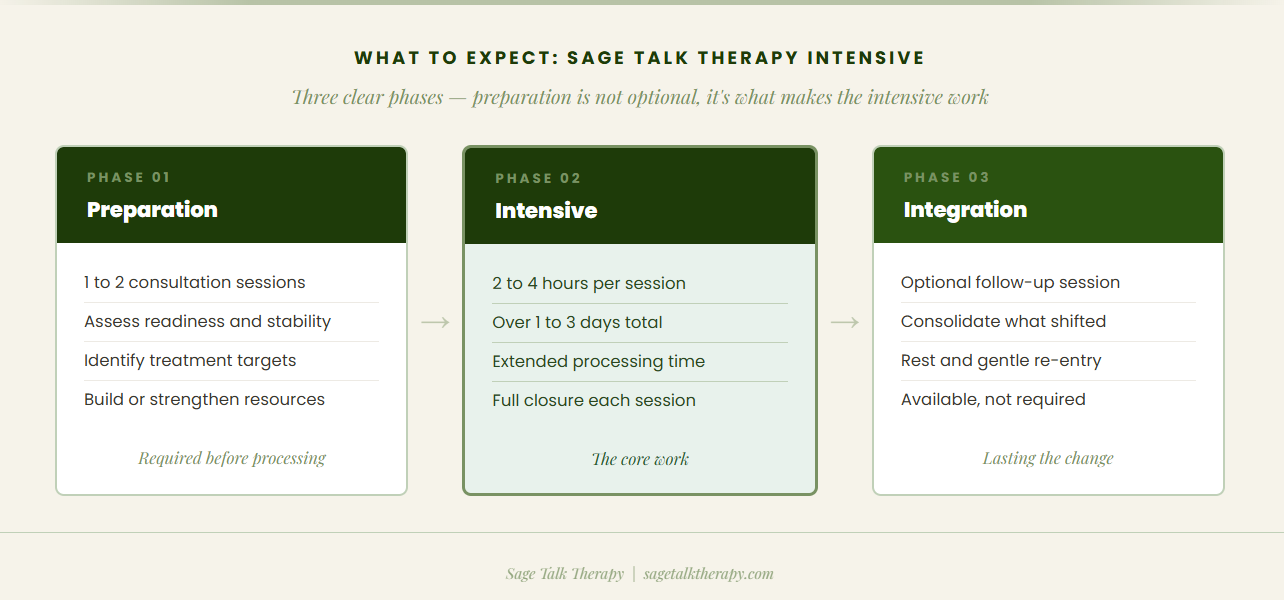
At Sage Talk Therapy, EMDR Intensives begin with a preparation consultation to assess readiness, identify treatment targets, and build or strengthen stabilization resources. This preparation phase is not optional. It is what allows the intensive itself to be productive rather than destabilizing.
The intensive itself runs as extended processing sessions of three hours. Sessions include thorough opening and closing phases so the client enters each processing block resourced and leaves each one settled.
Integration support is available in the weeks following the intensive for clients to consolidate what shifted during the processing.
Intensives are available in person in White Plains, NY and online throughout New York and Connecticut. For clients who prefer to travel to White Plains for in-person work, accommodations are available nearby.
If you are trying to decide
The clearest way to decide is a consultation. In a free 15-minute call, I can hear what you are carrying, where you are in your process, and give you an honest assessment of which format is likely to serve you best — including whether you might benefit from weekly sessions first, an intensive now, or a combination of both.
There is no one-size-fits-all answer. The right format is the one that fits your nervous system, your life, and what you are genuinely ready to work on. That is what the consultation is designed to figure out together.
Learn more about Perfectionism Therapy.

Dadiana Lopez
LCSW · Anxiety & Trauma Therapist · EMDR Specialist
Dadiana Lopez is a Licensed Clinical Social Worker and EMDR therapist based in White Plains, NY. She specializes in anxiety, trauma, PTSD, and the patterns that form in the wake of both — including people-pleasing, perfectionism, and burnout. She sees clients in person in Westchester and online throughout New York and Connecticut.
Seeing clients in-person in White Plains, NY and online throughout New York and Connecticut.