
When "Family Is Family No Matter What" Isn't Safe: Estrangement in Immigrant Households
You grew up hearing it. Family is family. Maybe it was said gently, maybe it was said as a warning. Either way, the message was the same: you don't walk away from family.
And if you're reading this, something has made you wonder whether that's still true.
For a lot of immigrant households, that saying isn't just a saying. It's how people survived. It's why your parents crossed borders, worked two jobs, shared apartments, and sent money home. Family was the safety net when there was no other one.
So what do you do when the family itself is where the harm happened?
Why this feels different in immigrant households
Estrangement is hard in any family. In immigrant families it often comes with an extra weight.
Closeness and duty to family are deeply valued in many cultures. In Latinx communities it's often called familismo. In others it shows up as respect for elders no matter what. These values are real, and they carry real strength. They are part of why so many families made it through impossible circumstances.
Alongside that strength, there's often sacrifice. Your parents may have given up their homes, their language, their careers, and their community to build a life here. And sometimes that sacrifice turns into a debt that nobody names out loud, but everyone can feel. You may have heard some version of it:
"After everything we sacrificed for you."
"You think you're better than us now?"
"Aguanta, es tu familia."
Whether it was said or only implied, the message was clear. Stay close, stay grateful, and stay quiet about anything that hurts.
One thing I hear from first-gen adults is that they can plan a hard conversation for weeks, then freeze the moment a parent says "after all I did for you." That isn't weakness. It's a lifetime of learning that speaking up costs something.
Loyalty and safety are not the same thing
Here's the tangle that keeps many people stuck. Loyalty to your family and safety within your family got merged into one idea. If you're loyal, you put up with it. If you protect yourself, you're disloyal.
But those are two different questions. You can love your family, honor where you come from, and still not be safe with certain people in it. Both can be true at the same time.
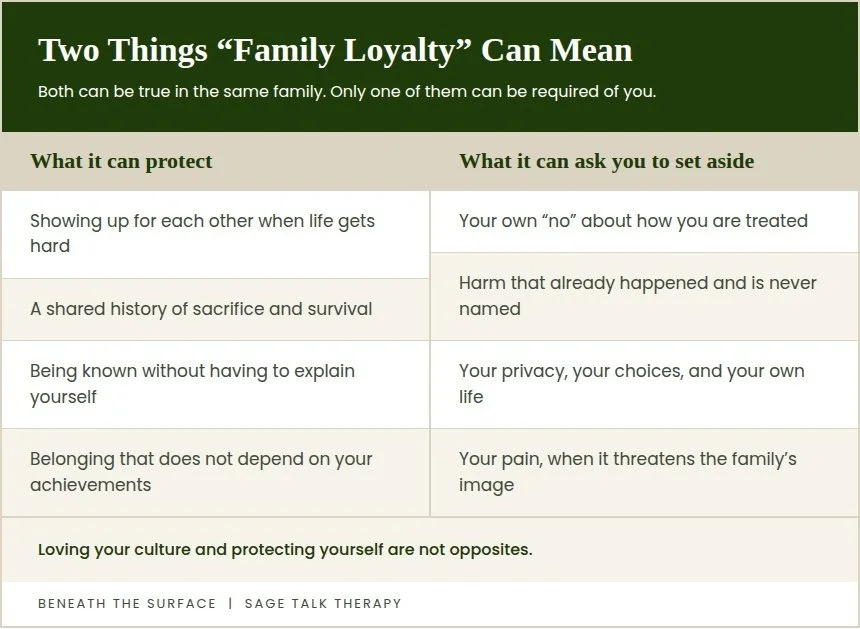
The good part of family loyalty is showing up for each other, sharing a history, and belonging without having to earn it. But when loyalty requires you to swallow harm, stay silent about what happened, or give up your own choices, it has stopped protecting the family and started protecting the harm.
What "not safe" can look like
Safety isn't only about physical danger, although sometimes it is. In immigrant households, what makes a relationship unsafe can be quieter and easier to dismiss, especially when everyone around you calls it normal.
It might look like:
Emotional or physical abuse that was called discipline
Being the one who translated for the adults, handled the paperwork, or managed a parent's moods when you were still a kid
Constant criticism, comparison, or contempt, framed as pushing you to succeed
Control over your adult choices, like who you date, where you live, or how you spend your money
Punishment through silence, shame, or threats to cut you off when you disagree
It can also look like having your pain brushed aside with "we did the best we could" or "don't be ungrateful," or being expected to keep the family's secrets.
Many first-generation adults tell me they spent years asking whether it was "bad enough" to count. If you've been asking that, it's worth noticing how much energy that question takes. You do not need a dramatic story for your experience to matter.
And to be fair, hard is not always the same as unsafe. A parent can be critical, old-fashioned, and exhausting without the relationship being harmful. Sorting out which is which is exactly the kind of thing worth doing with support.
Why stepping back can feel like betrayal
Even when the reasons are clear, the guilt can be enormous.
You're not only leaving a person. You may be leaving a whole community. Extended family, church, friend groups, and neighbors are often woven together. Stepping back from one parent can mean losing your place at every gathering, and hearing about it from cousins and aunts who take sides.
You may also be the one who "made it." If you're the first in your family to go to college or to live differently, it can feel like you owe your family your loyalty as proof that success didn't change you.
Your feelings can get treated as a cultural betrayal. Some people hear that therapy, boundaries, and "putting yourself first" are American ideas that don't apply to your family. That can make you doubt your own experience, as if wanting safety were a rejection of where you come from. It isn't.
You may still love them. This one gets missed a lot. Estrangement doesn't mean the love is gone. Many people grieve deeply. It's okay to miss someone who hurt you. You can miss someone and also know you can't be around them the way things were.
Estrangement is not the only option
When people hear the word estrangement, they often picture a complete cutoff. In real life there's a wide range. Some people set firm limits and stay in touch. Some see family only at group events. Some take a pause and see what they need. Some end contact fully, and for some that is the only safe choice.
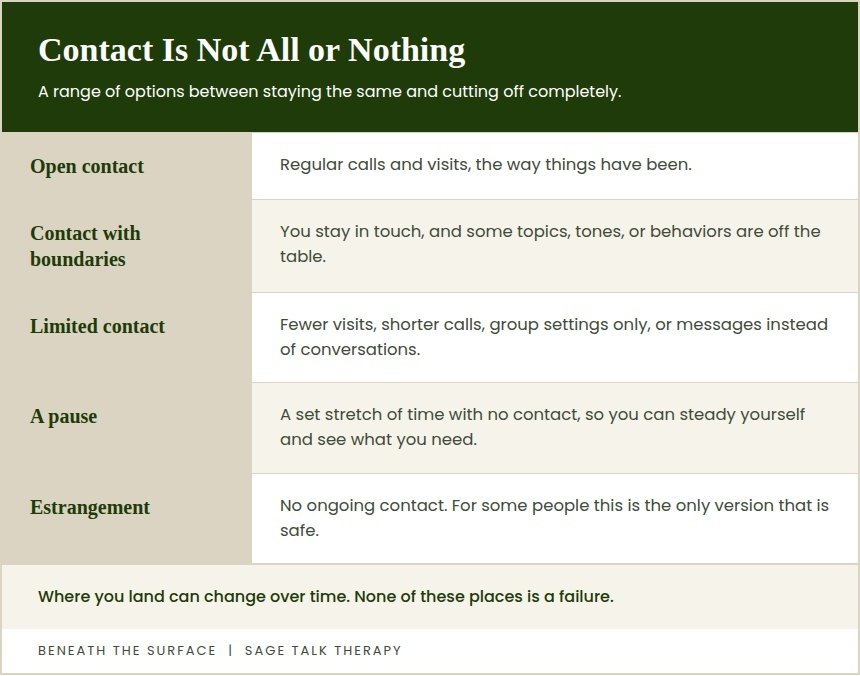
Where you land can change over time, and it can look different with different people in the same family. None of these is a failure.
Questions to sit with
If you're trying to figure out what you need, it can help to slow down before deciding anything. These questions aren't a test. They're a way to hear yourself.
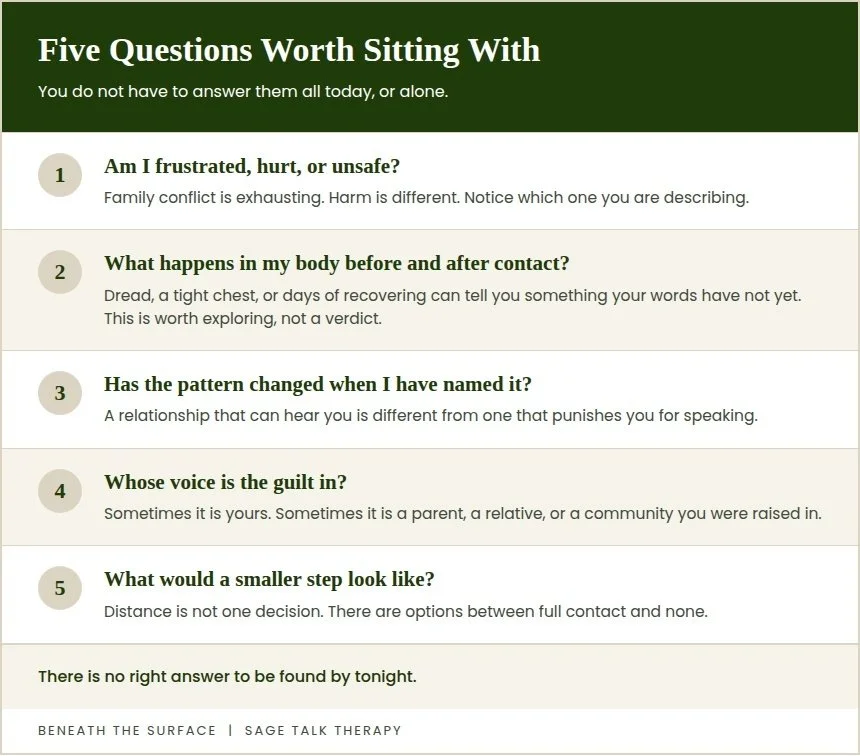
If your body reacts strongly around certain people, that's worth paying attention to. It doesn't tell you what to do, but it's worth bringing to a therapist so you can look at it together.
What Healing can look like here
Working through this isn't about deciding whether you're a good child or a bad one. It's about understanding what happened, what you learned to do to get through it, and what you want your life to look like now.
Many first-gen adults I work with have spent years being the responsible one, the peacekeeper, the translator, the one who doesn't cause problems. Those roles often made sense at the time. They also tend to follow people into adulthood, into relationships, work, and how they treat themselves.
Therapy can be a place to sort out your own experience without having to defend it. That includes making room for grief, guilt, love, and anger at the same time, and building ways to set limits that fit your values instead of someone else's rules. In my work, I use EMDR and IFS to help people process painful family experiences and understand the roles they took on growing up.
You don't have to hate your family to protect yourself. You don't have to leave your culture to leave a harmful dynamic. And you don't need anyone's permission to take your own experience seriously.
if YOU’RE READY TO TALK
I work with individuals and couples in Westchester, NY and online throughout New York and Connecticut, including many first-generation adults navigating complicated family relationships. If this post sounded like your life, you're welcome to reach out for a consultation.
Learn more about Intergenerational Trauma Therapy.

Dadiana Lopez
LCSW · Anxiety & Trauma Therapist · EMDR Specialist
Dadiana Lopez is a Licensed Clinical Social Worker and EMDR therapist based in White Plains, NY. She specializes in anxiety, trauma, PTSD, and the patterns that form in the wake of both — including people-pleasing, perfectionism, and burnout. She sees clients in person in Westchester and online throughout New York and Connecticut.
Seeing clients in-person in White Plains, NY and online throughout New York and Connecticut.