
Being First-Generation Is Its Own Kind of Trauma. Here's Why.
There is a particular kind of exhaustion that comes with being first.
First in your family to go to college. First to enter a certain profession. First to leave the country your parents or grandparents came from, or first to stay behind while everyone else did. First to step out of the patterns your family has always lived inside. First to ask the questions nobody in your family has asked before.
Being first-generation is widely framed as an achievement. And in many ways it is. But underneath the achievement narrative there is often something else that doesn't get named nearly as clearly: a specific, layered psychological weight that looks and functions very much like trauma.
Not metaphorically. Clinically.
This post is about naming that weight clearly, from a therapist who has lived it. If you are first-generation in any of the senses that word can mean, and you have spent years carrying something you couldn't quite articulate, this is an attempt to give it language.
What first-generation actually means
First-generation is often used narrowly, referring specifically to the first person in a family to immigrate to a new country, or the first to be born after that immigration. But the psychological experience of being first extends further than that definition.
You are navigating first-generation territory if you are the first in your family to pursue higher education in a system your parents couldn't guide you through. If you are leaving behind patterns of addiction, poverty, abuse, or emotional unavailability that have been present across multiple generations. If you are the first to seek therapy in a family where therapy was never considered or was actively stigmatized. If you are building a professional or personal life that has no template in your family history.
What these experiences share is not a specific cultural origin. It is a specific structural position: you are doing something that has not been done before in your family, without a map, often without full support, and frequently with the weight of other people's sacrifices, expectations, fears, and unspoken needs pressing against the effort.
That position carries inherited patterns, expectations, and nervous system calibrations from the generations before you, and simultaneously demands that you navigate environments and systems those generations never encountered. The friction between those two things is real, persistent, and genuinely costly.
Why it qualifies as trauma
The word trauma gets used carefully in clinical contexts. It is worth being precise about why the first-generation experience qualifies.
Trauma, broadly understood, refers to experiences that overwhelm the nervous system's capacity to process and integrate what is happening. It does not require a single catastrophic event. Cumulative, chronic stress, the kind that accumulates over years of navigating environments that weren't built for you, of holding contradictions that have no resolution, of being caught between worlds with no map for either, produces the same physiological effects as more recognized forms of trauma.
The research supports this. Intergenerational trauma can shape cultural identity and influence how individuals and communities perceive themselves in the context of their historical trauma. Social and systemic effects extend beyond the family unit to impact communities and societies, contributing to cycles of poverty, violence, and social disparities.
For first-generation individuals specifically, the trauma is often not in any single experience but in the accumulated weight of the position itself. The chronic low-level stress of navigating systems that assume a kind of background knowledge and support you don't have. The emotional labor of translating between cultures, generations, and worldviews. The absence of the specific kind of support, mentorship, and modeling that people who aren't first experience as ordinary.
Historical context is everything. You might not be someone who considers yourself a victim of trauma. But the structural and cultural forces shaping your experience are real and have measurable effects on mental health.
And the nervous system responds to those forces whether or not the thinking brain has named them as traumatic.
The specific weights first-gen people carry
These are the particular experiences that show up most consistently in clinical work with first-generation clients. Not all of them will apply, but most people who are first-generation will recognize several.
1. The grief that doesn't have a name
There is a particular grief in the first-generation experience that is very hard to articulate because it doesn't fit neatly into cultural narratives of loss.
It is the grief of leaving something behind to build something new, and not being entirely sure whether what you're building is worth what you left. The grief of being fluent in a world your family doesn't fully have access to, and the loneliness that creates. The grief of watching your parents or grandparents carry things they never had the tools or space to process. The grief of the version of yourself you might have been in different circumstances.
This is real loss. It deserves to be held as such rather than rationalized into gratitude. Both things can be true at once: enormous pride and real grief. Most first-generation people are more practiced at the pride than the grief.
2. The guilt of wanting something different
This one is almost universal.
Wanting a different kind of life than the one your family has known can feel like betrayal. Like ingratitude. Like you are reaching for something that implicitly says the life your parents or grandparents lived wasn't enough.
It is none of those things. But the guilt doesn't respond easily to logical argument, because it lives below logic. It lives in the relational fabric of what it means to belong to your family, to honor where you came from, to not become someone who forgets. And wanting to change certain things can feel, at the level of the nervous system, like exactly that.
This guilt is one of the most significant clinical features of first-generation experience, and one of the least discussed. It affects the ability to pursue goals, to set limits with family, to prioritize personal wellbeing, and to access the full support available to you without feeling that taking up that space is taking something from someone else.
3. The loneliness of being between
First-generation people often describe a particular kind of loneliness: not fully belonging in either of the worlds they inhabit. Too changed for the world they came from, not quite at home in the one they've entered.
This experience of being between is not resolvable through achievement or assimilation. It is structural. And it is lonely in a way that is difficult to communicate to people who haven't experienced it, which means it often goes unspoken even in close relationships.
For many first-generation people this loneliness shows up as a high-functioning anxiety: the appearance of thriving while privately carrying a sense of not quite belonging anywhere, of performing rather than inhabiting, of watching yourself succeed from a slight distance.
4. The invisible labor of translation
First-generation people often carry a particular kind of labor that is invisible because it is constant and because no one else in the room is doing it.
The cultural translation. The code-switching. The managing of family expectations alongside professional or academic demands. The explaining of your background in environments where it is unexpected. The bridging of worlds in both directions — bringing the professional world back to family, and bringing family context into spaces that don't understand it.
This labor is exhausting precisely because it is continuous and unacknowledged. It doesn't appear on any job description or course requirement. But it is real cognitive and emotional work, and it accumulates.
5. The particular pressure of being the symbol
When you are the first to do something in your family, you often carry the symbolic weight of everyone who came before you. Your success is not just yours. Your failure would not be just yours either.
This creates a specific kind of pressure that is distinct from ordinary achievement anxiety. The perfectionism it generates is not simply fear of personal failure. It is fear of failing the people whose sacrifices made your position possible. That is a much heavier thing to carry, and it tends to produce the kind of relentless, fear-based drive that looks like motivation from the outside and feels like terror from the inside.
6. The fawn response amplified
People-pleasing and over-accommodation are already common patterns in trauma survivors. In first-generation people, they are often compounded by the specific interpersonal dynamics of the first-generation position: the need to manage family expectations, the learned skill of reading rooms and adjusting behavior to fit different cultural contexts, the training in being easy and accommodating that often develops when you are always the one navigating someone else's terrain.
The person who has spent years making themselves adaptable, inoffensive, and easy to accept in environments that weren't built for them has often developed a level of fawning and self-effacement that goes well beyond what their individual history alone would produce.
What makes healing complicated
Seeking therapy as a first-generation person carries its own layer of complexity.
Therapy, for many, wasn't modeled or seen as necessary. It may have felt like a luxury. But caring for yourself is not selfish — it's a revolutionary act.
Beyond the cultural stigma around mental health in many communities, there are structural barriers: cost, access, availability of therapists who share or understand the cultural context, and the energy required to seek help when you are already operating on a depleted tank.
There is also the particular challenge of finding a therapist who understands the first-generation experience from the inside rather than just from a clinical framework. A therapist who has not personally navigated this territory may inadvertently pathologize the complexity, miss the structural dimension of what they're hearing, or default to individualistic frameworks that don't account for the relational and cultural weight involved.
And there is the resistance that comes from within: the sense that seeking help is an indulgence, that other people had it worse, that you should be grateful rather than struggling, that therapy is for people with more visible problems than yours.
All of these things are worth naming, because they are part of what makes the first-generation experience hard to heal from, separate from any specific traumatic content.
What healing actually looks like
Healing first-generation trauma does not mean becoming someone who is no longer connected to where they came from. It does not require choosing between your worlds. It does not mean that the complexity of your position will disappear.
What it means is developing enough internal freedom from the particular weights described above that they stop running the show.
The guilt losing its grip enough that you can make choices based on what you actually want and need rather than what feels like the least disloyal option. The grief getting to be felt rather than suppressed in service of the gratitude. The loneliness getting to be acknowledged rather than performed around. The perfectionism losing some of its fear-based urgency. The fawning having enough space to be examined rather than just enacted.
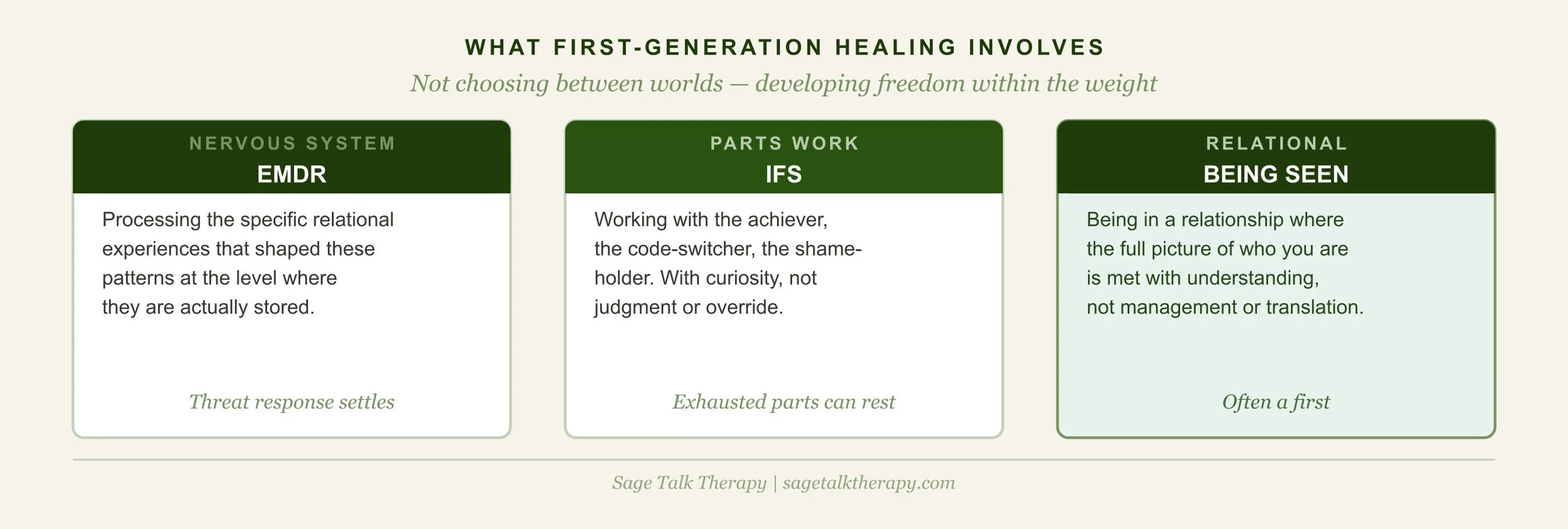
EMDR is particularly useful here for the specific relational experiences that shaped these patterns: the moments where belonging felt conditional, the experiences of not fitting or being marked as different, the accumulated weight of navigating systems that weren't built for you. Processing those experiences at the nervous system level allows the threat response they activated to settle.
IFS is useful for understanding the parts that developed in response to the first-generation position: the achiever part performing for the family, the shame-holding exile, the code-switcher who is constantly adapting, the translator who is exhausted from being fluent in two worlds simultaneously. Working with those parts with curiosity rather than judgment tends to produce more lasting change than trying to simply override them.
There is also something specific to the relational healing dimension of this work. Many first-generation people need, for the first time, to be in a relationship where they are not performing, not translating, not managing the other person's response to their complexity. Where the full picture of who they are and where they come from is met with genuine understanding. That experience in therapy is not a minor thing.
A Note From Someone Who Has Been There.
I want to say something personal here, because this post is one where personal context matters.
I am a first-generation Latina therapist. I have navigated the territory this post describes from the inside, and I continue to navigate it. I know what it feels like to carry the weight of your family's sacrifices into every professional space you enter. To feel the pull between the world you came from and the world you are building. To have the guilt about wanting something different live right alongside the genuine gratitude for how you got here.
I am not neutral about this topic. I am clinically trained in it and personally familiar with it. And I can say from both of those positions: the weight is real, the complexity is real, and healing is possible without having to choose which part of yourself to leave behind.
Both things. All of it. That is the work.
if this resonates
I work with first-generation clients in Westchester, NY and online throughout New York and Connecticut. If what you've read here lands, I'd welcome the chance to talk.
Learn more about Trauma Therapy.
Learn more about Intergenerational Trauma Therapy.

Dadiana Lopez
LCSW · Anxiety & Trauma Therapist · EMDR Specialist
Dadiana Lopez is a Licensed Clinical Social Worker and EMDR therapist based in White Plains, NY. She specializes in anxiety, trauma, PTSD, and the patterns that form in the wake of both — including people-pleasing, perfectionism, and burnout. She sees clients in person in Westchester and online throughout New York and Connecticut.
Seeing clients in-person in White Plains, NY and online throughout New York and Connecticut.