
The Fawn Response: Why People-Pleasing Is a Trauma Response, Not a Personality Type
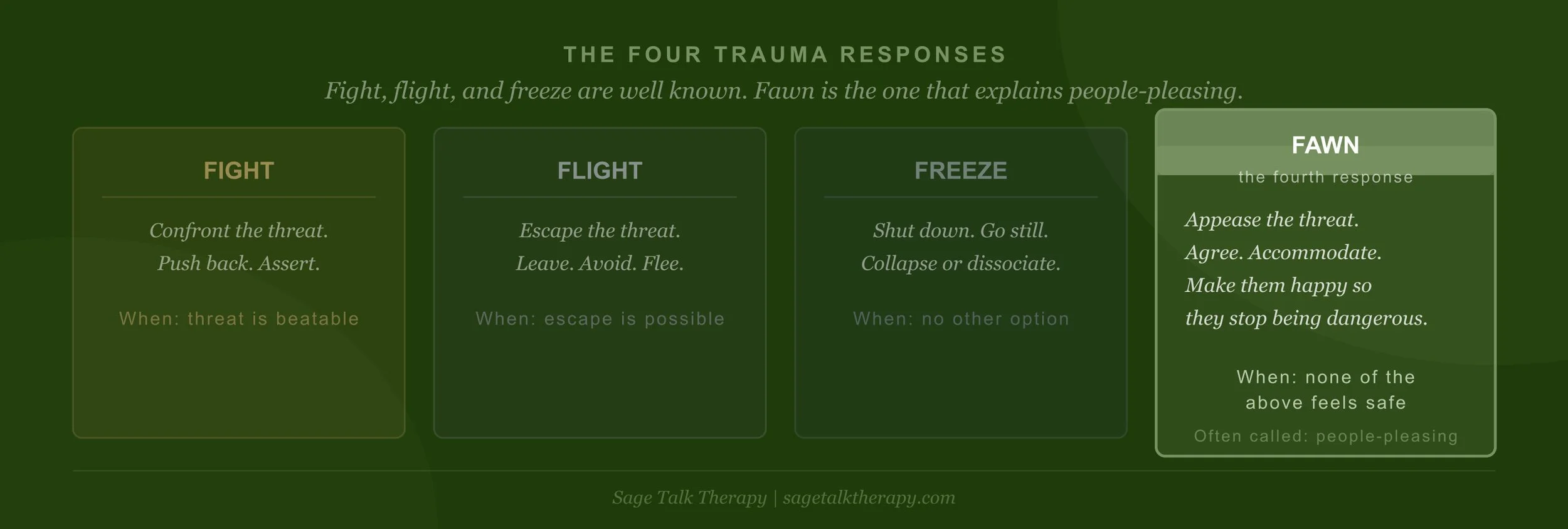
You've probably heard of fight, flight, and freeze.
When your nervous system detects a threat, it selects a response: confront it, escape it, or lock up entirely. These three responses are widely understood, widely discussed, and widely accepted as the body's survival architecture.
What gets far less attention is the fourth one.
The fawn response is the fourth trauma response — identified and named by therapist Pete Walker — and one of the most pervasive, least-recognized patterns in trauma work. It's not a personality type. It's a survival strategy — one that was extraordinarily effective in childhood and is slowly, in adulthood, consuming the person it was designed to protect.
If you are someone who consistently puts other people's needs ahead of your own, who feels compelled to agree, appease, and accommodate even when you desperately don't want to, who loses track of what you actually think or feel in the presence of someone you perceive as threatening — this post is for you.
What you've been calling being too nice, or not having a backbone, or being a pushover is something else entirely. It is a nervous system response. And it can change.
What The Fawn Response actually is
The fawn response is a trauma response characterized by the automatic, compulsive appeasement of a perceived threat through agreement, accommodation, compliance, and the suppression of one's own needs, preferences, limits, and identity.
Fawning kicks in when none of the other options feel safe. If you can't overpower the threat, can't escape it, and freezing won't protect you, your nervous system tries one more thing: make the threatening person happy so they stop being dangerous.
This is the key distinction that most discussions of people-pleasing miss. Fawning is not primarily about being kind, generous, or conflict-averse as character traits. It is the nervous system selecting the appeasement strategy because it has assessed the other options as unavailable or unsafe. It happens automatically, before conscious thought. The smile, the agreement, the sudden flexibility about what you want — these are not choices. They are responses.
The relief that follows — the moment the tension in the room drops, the moment someone stops being angry — is not emotional satisfaction. It is the nervous system registering that the threat has temporarily receded. And like all nervous system relief responses, it reinforces the behavior that produced it.
Where it comes from
The fawn trauma response develops when a person learns to prioritize the emotions and needs of others for their own safety, to access basic human needs like connection and validation, and to avoid conflict. It is commonly developed in childhood where a caregiver is both the source of care and a threat.
That last part is worth staying with. When the person who is supposed to keep you safe is also the person whose moods are dangerous, whose anger is threatening, whose love feels conditional — you cannot fight them, cannot flee them, and cannot simply freeze and wait for the threat to pass. They are your caregiver. You are dependent on them. The only viable option is appeasement.
A child in that situation learns, at the nervous system level, that reading the room is survival. That sensing what the other person needs and providing it before they ask is safety. That having your own needs, your own opinions, your own anger — expressing any of that — is dangerous.
These lessons don't arrive as conscious conclusions. They are encoded in the nervous system as automatic responses, run below the level of language and choice. By the time the child becomes an adult, they are simply how you operate in relationships.
It's also worth noting that fawning can develop in response to adult relational trauma — abusive partnerships, coercive work environments, any sustained experience where appeasement was genuinely the safest strategy available. The developmental context is the most common, but it is not the only one.
What it Looks Like in Real Life
This is where fawning becomes recognizable — not in the clinical definition, but in the daily texture of living inside it.
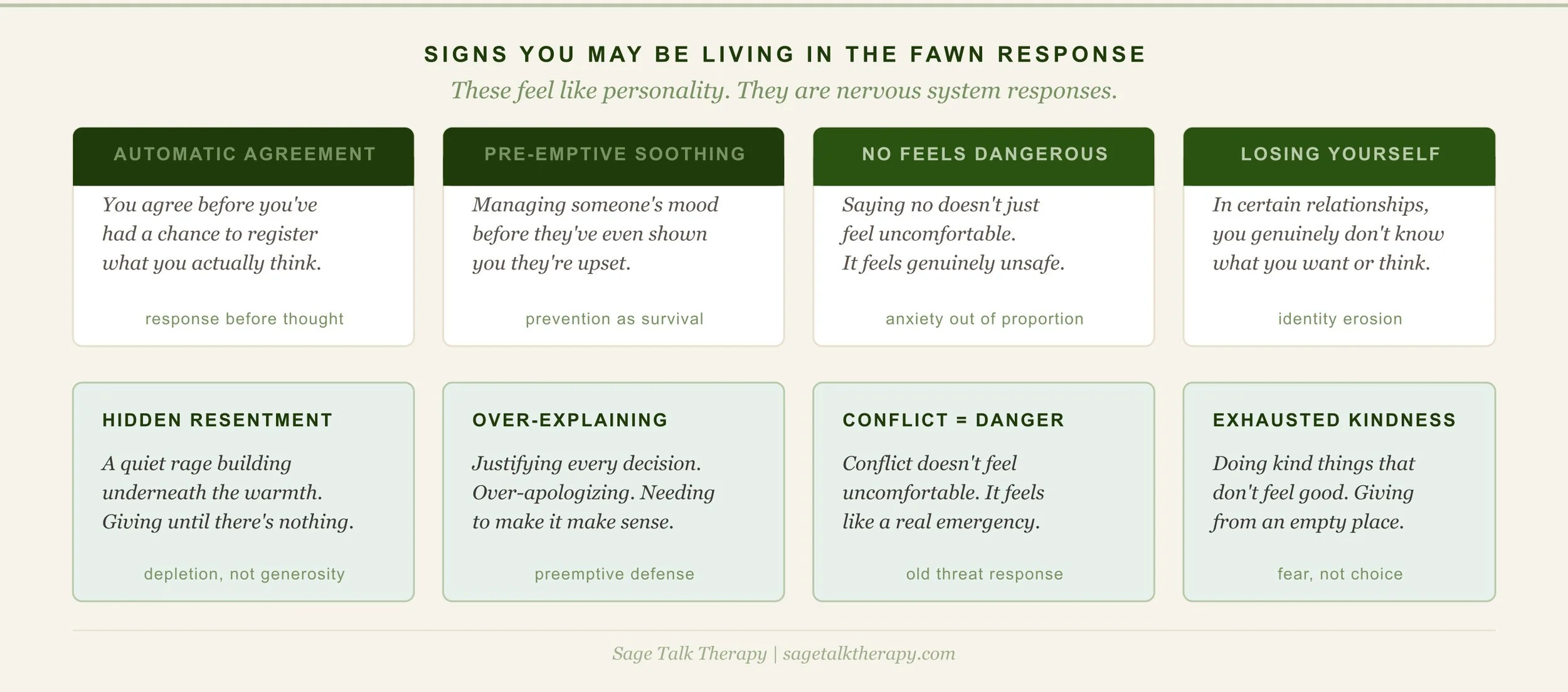
Automatic agreement: Someone expresses an opinion and you find yourself nodding before you've even had a chance to register whether you actually agree. The agreement comes first. Your actual view forms later, or never.
Pre-emptive appeasement: You sense someone might be upset — there's a tension in the air, a certain tone — and before they've said anything, you're already managing it. Softening your voice. Finding something nice to say. Rearranging yourself to prevent the conflict before it starts.
The inability to say no without dread: Saying no feels genuinely dangerous. Not just uncomfortable — dangerous. The anxiety that rises when you consider it is not proportionate to the actual stakes. It belongs to a different time, when saying no had real consequences.
Losing track of yourself in relationships: What do you think? What do you want? What do you feel? In the presence of certain people — particularly people you perceive as having power over you — the answers to these questions become genuinely unclear. You've been calibrating to them for so long that your own signal has gotten quiet.
The resentment that builds underneath: This is the hidden cost that eventually becomes impossible to ignore. You've been giving and accommodating and making yourself small for so long that a quiet rage has been building underneath. It surfaces as exhaustion, as irritability that surprises you, as the sudden and overwhelming desire to disappear from your own life.
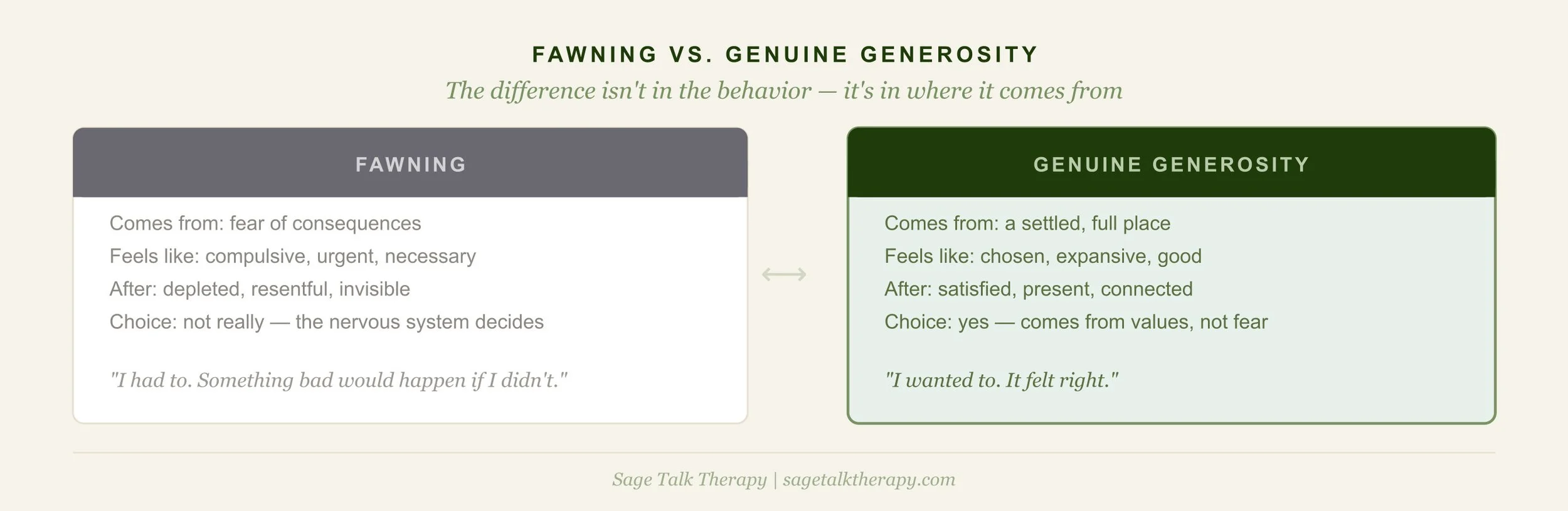
Confusion about whether it's kindness or fear: This is one of the most disorienting aspects of the fawn response. Many people who fawn genuinely care about others. The kindness is real. But there's a meaningful difference between generosity that comes from a full, settled place and generosity that comes from fear of what happens if you don't give. Kindness and generosity come from a settled, regulated nervous system — they feel chosen, expansive, and genuinely pleasant to enact. Fawning comes from a threat-activated nervous system — it feels compulsive, urgent, and leaves you feeling depleted or resentful rather than fulfilled.
The question worth sitting with is not whether you're kind. It's whether the giving feels chosen.
The Identity Cost
Over time, fawning can act as a mask, hiding the individual's true feelings and inhibiting authentic connections.
This is the aspect of the fawn response that tends to surface deepest in therapy, and it's worth addressing directly.
When you've been organizing yourself around other people's needs and emotional states for years — for decades — you can lose track of yourself in a way that goes beyond not knowing what you want for dinner. You lose track of what you actually believe, what genuinely matters to you, who you are when you're not in service of someone else's comfort.
The self that remains is performative rather than genuine — the version of you that keeps everyone comfortable, that manages every room, that is reliably easy and accommodating. That version is exhausting to maintain and leaves you profoundly unseen, even in relationships where you are objectively present and invested.
Many people with the fawn response present as highly functional, warm, and capable from the outside — which is exactly why the cost of it goes unrecognized for so long.
The grief of recognizing this — of understanding how much of yourself was suppressed in service of keeping others comfortable — is real and significant. It deserves to be honored, not rushed through.
Why Willpower Doesn’t Fix It
If you've recognized yourself in what you've read so far, you may also recognize this: you've tried to change it. You've told yourself to speak up. To stop apologizing so much. To just say no. And then something gets activated — a tone of voice, a sense of someone's displeasure, a moment of potential conflict — and before you've had a chance to consciously intervene, the fawn response has already fired.
That's not weakness or lack of discipline. That's what it looks and feels like to be dealing with a nervous system response rather than a conscious choice.
The fawn response operates below the level of the thinking brain. By the time conscious thought arrives, the automatic appeasement has already happened. Willpower operates at the conscious level. The response operates beneath it.
This is why approaches that work purely at the cognitive level — reminding yourself that it's okay to say no, challenging the belief that people will leave if you disappoint them — often produce insight without change. The insight is real. It just hasn't reached the level where the response is encoded.
What actually changes the pattern
Changing the fawn response requires working at the level where it lives — the nervous system, the automatic threat-detection machinery, the embodied responses that fire before thought.
EMDR works specifically with the experiences that trained the nervous system toward fawning. The moments, relationships, and environments where appeasement was genuinely the safest option — EMDR helps the nervous system process those experiences as past rather than ongoing, allowing the threat response to stop firing in situations that no longer warrant it.
Internal Family Systems is particularly well-suited to fawn response work because it approaches the fawning part with curiosity rather than confrontation. The part that people-pleases developed for a real reason — it protected you when protection was needed. IFS allows you to understand what that part has been protecting, build a genuine relationship with it, and gradually create the internal conditions where it doesn't need to work so hard.
Somatic work matters here too. The fawn response is a body response — the subtle physical collapse, the voice that softens, the muscles that slightly submit when a perceived threat is present. Building body-level awareness of when the response is activating — and developing the capacity to pause there, even briefly — is where behavioral change begins to become genuinely possible.
And relational experience — actually being in relationships where it is safe to be honest, where disagreement doesn't end connection, where your real needs are met rather than just your performed agreeableness — gives the nervous system the new evidence it needs to update its threat assessment.
For many people, the fawn response is also part of a larger intergenerational pattern — the accommodation was not just their own survival strategy but one passed down through the family system. Understanding that broader context can be both clarifying and, eventually, freeing.
A Word on Who You are Underneath It
Here is something I want to say directly to the person reading this who has spent years, maybe decades, managing everyone else's comfort at the expense of their own.
You are not your fawn response.
The accommodation, the agreement, the reflexive self-erasure — that is what your nervous system learned to do to survive. It is not who you are. Underneath it is a person with genuine opinions, real needs, actual preferences, and the full range of human emotional experience. That person has been there all along, navigating a nervous system that has been working very hard to keep them safe.
The work is not about becoming a different person. It's about coming back to the one that was always there.
if this resonates
People-pleasing and the fawn response are central to the work I do with anxiety, trauma, and the patterns that keep people stuck. If you recognize yourself in what you've read here — the compulsive accommodation, the dread of conflict, the quiet erosion of yourself — that recognition is the beginning.
Learn more about people-pleasing therapy.
Learn more about Intergenerational Trauma Therapy.

Dadiana Lopez
LCSW · Anxiety & Trauma Therapist · EMDR Specialist
Dadiana Lopez is a Licensed Clinical Social Worker and EMDR therapist based in White Plains, NY. She specializes in anxiety, trauma, PTSD, and the patterns that form in the wake of both — including people-pleasing, perfectionism, and burnout. She sees clients in person in Westchester and online throughout New York and Connecticut.
Seeing clients in-person in White Plains, NY and online throughout New York and Connecticut.