
Perfectionism Is Not About High Standards. It's About Fear.
Here is the reframe that changes everything for most perfectionists:
Your perfectionism isn't actually about wanting things to be excellent.
It's about what you believe will happen if they're not.
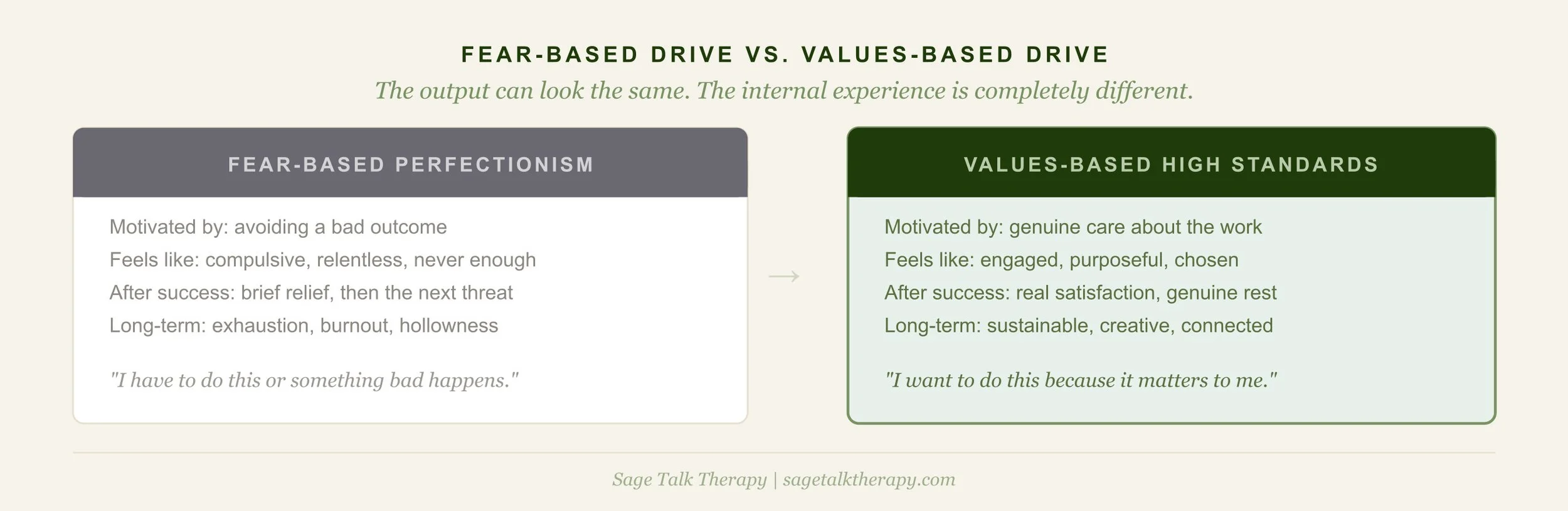
That distinction sounds small. It isn't. The difference between pursuing excellence because it genuinely matters to you and pursuing excellence because the alternative feels dangerous is the difference between drive and fear. And those two things require completely different approaches to address.
Most treatments for perfectionism focus on the standards — lowering them, challenging the all-or-nothing thinking, practicing good enough. That approach treats perfectionism as a problem of expectation. What it misses is the problem of threat. And when the standards are driven by fear of what happens without them, adjusting the standards without touching the fear produces temporary relief at best, and a quiet sense of failure at worst.
This post is about understanding perfectionism as the fear-management system it actually is — and what changes when you treat it that way.
What Fear is Actually Underneath It
Perfectionism is associated with a persistent fear of failure and negative evaluation and various emotional, social, physical, cognitive, and behavioral implications.
But the fear underneath perfectionism is rarely just about the work. It's about what the work represents.
For most people who struggle with perfectionism, producing something less than excellent — making a mistake, falling short, being criticized, failing to meet the standard — isn't just uncomfortable. It triggers something that feels much more fundamental. A sense of exposure. Of being found out. Of something important being taken away.
What that something is varies. For some people it's love or belonging — the childhood learning that approval was conditional on performance, that disappointing the people who mattered carried real emotional consequences. For others it's safety — a family system where things being under control was the only thing keeping chaos at bay, and maintaining high standards was a way of maintaining stability. For others still it's identity — the sense that being the capable, excellent, reliable person is not just something they do but who they are, and that anything less would leave them exposed and unrecognizable.
Perfectionism feeds anxiety by creating impossibly high standards that generate constant fear of falling short. When individuals believe that anything less than perfect is unacceptable, they live in perpetual anxiety about making mistakes, receiving criticism, or disappointing others.
The fear is real. The threat it's responding to may no longer be current — but the nervous system doesn't automatically update based on changed circumstances. It keeps running the equation it learned: excellence equals safety, failure equals threat.
The Many Faces of Perfectionist fear
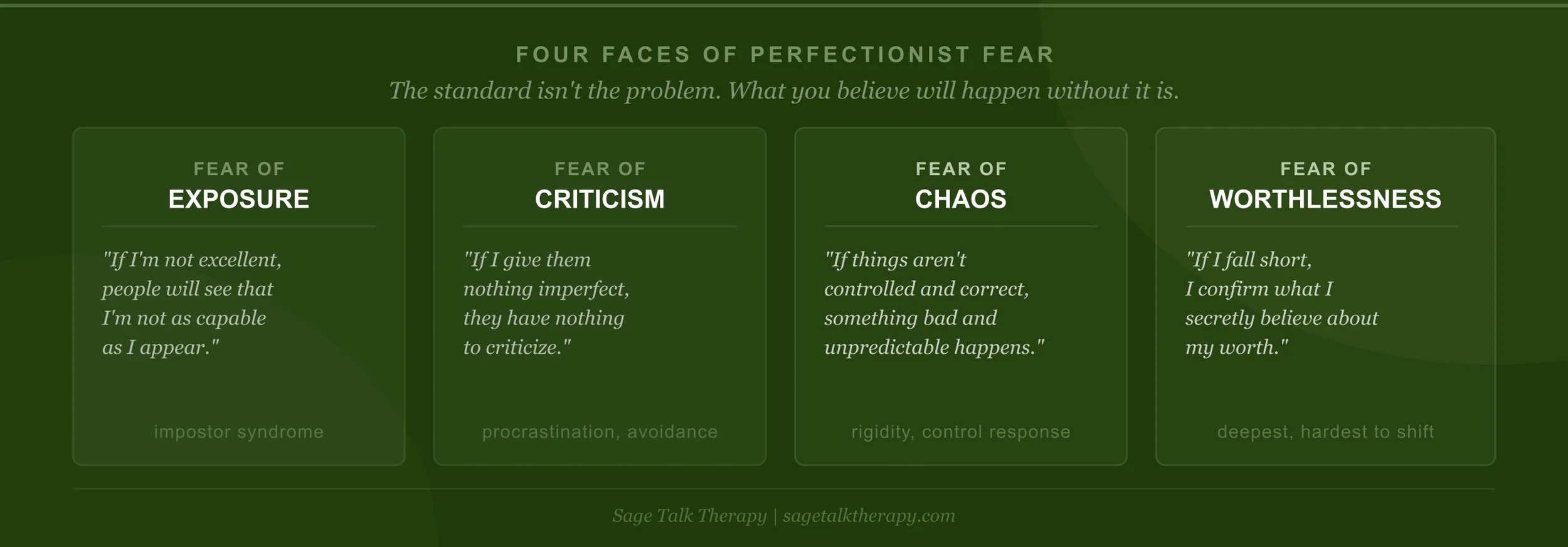
Perfectionism is often discussed as a single thing. In practice it shows up differently depending on which fear is most prominent.
Fear of failure and exposure
This is the version most associated with the anxious overachiever. The high standards aren't really about the output — they're about what the output proves. While everything is excellent, the secret fear of not being as capable, as competent, or as together as you appear stays hidden. The moment something is less than excellent, that fear of being found out becomes real.
This version of perfectionism often comes with a particular relationship to success — achievement produces not satisfaction but temporary relief, followed almost immediately by the pressure of the next thing. Because the goal was never the achievement. The goal was managing the exposure fear underneath it.
Fear of criticism and judgment
Perfectionism, at its core, is anxiety about what will happen to you if you fail or aren't good enough. Will you be called a fraud? Laughed at? Rejected by colleagues or loved ones?
This version is closely related to the fawn response. When early environments made criticism dangerous — when disapproval had real consequences, when being found wanting produced significant emotional fallout — the nervous system learned to manage that threat through performance. If everything is excellent, there's nothing to criticize. If you never submit anything imperfect, you can never be rejected for it.
This is also why perfectionism so frequently produces procrastination. If you don't finish it, you can't find out what people think. Not submitting is safer than submitting something imperfect.
Fear of losing control
For some people, perfectionism is primarily a control response. When early environments were unpredictable, chaotic, or unsafe, maintaining high standards in the areas you could control became a way of creating stability. Doing things correctly, thoroughly, and without error was one of the few things that felt within reach.
This version of perfectionism tends to be particularly rigid — the standards are not just high but specific, and deviation from them produces significant anxiety. The anxiety is the signal that control is slipping, that something unpredictable might happen, that the safety that came from order is at risk.
Fear of worthlessness
This is the deepest version and often the hardest to see clearly. Perfectionistic concerns include the inclination of being self-critical in terms of your own actions, being preoccupied by how others perceive yourself, and having difficulties feeling content about your performance.
When worth became entangled with performance early in life — when love was implicitly or explicitly conditional on achievement, when the message was that doing well made you acceptable and falling short made you less so — the person internalizes the equation. Worth equals output. Failure equals worthlessness.
This version of perfectionism is exhausting in a particular way because there is no finish line. No achievement is ever enough to permanently settle the underlying question of whether you are worthwhile. The standards keep moving because the fear they're managing isn't really about the specific outcome — it's about the fundamental verdict on the self.
Why Trying to lower your standards doesn’t work
The most common advice given to perfectionists is some version of: lower the bar. Aim for good enough. Practice letting things be imperfect. Accept that mistakes are normal.
This advice is not wrong. It's just insufficient on its own. And for many perfectionists, it also carries a subtle sting — because it frames the perfectionism as the problem, rather than as the response to a problem.
Here is why standard adjustment tends to produce limited lasting change:
The fear doesn't disappear when the standard changes.
If you lower the bar but the nervous system is still running the equation where falling short equals threat, you'll meet the lower bar and still feel anxious. Or the bar will quietly re-raise itself. Or you'll manage the anxiety through a different route — procrastination, avoidance, over-explanation, or chronic second-guessing.
Adjusting the standard is working on the output of the fear. Genuine change requires working on the fear itself. This means working at the level of the nervous system where the threat response is encoded, not just at the level of the thoughts and behaviors it produces.
Where the fear comes from
Perfectionism rarely develops in a vacuum. What begins as a desire for excellence gradually transforms into an anxiety-driven compulsion to avoid any possibility of mistakes or criticism. That transformation almost always has a context.
For many people, that context is early experience. A home where love was conditional on achievement. A parent whose own anxiety made mistakes feel dangerous. A school environment where capability was the primary currency of belonging. A family system where being the capable, reliable child was both a role and a survival strategy.
For others, perfectionism is part of a larger intergenerational pattern — high standards and fear-based performance modeled across generations without ever being named or questioned. The family that produced perfectionists often did so without intending to, because the same fear-based standards were simply how things operated.
Understanding where the fear came from matters not because it assigns blame but because it changes the treatment target. If the perfectionism is a response to something that happened, then addressing what happened is more effective than just managing the response.
What Actually Addresses It
Effective treatment for perfectionism works at two levels simultaneously: the cognitive patterns that maintain it and the nervous system fear that drives it.
Cognitive Level
At the cognitive level, the work involves understanding the specific fear underneath the standard — naming what you actually believe will happen if you fall short — and examining whether that belief is accurate in your current circumstances. This is not about dismissing the fear but about distinguishing between what was true in the environment that created it and what is true now. Often they are not the same thing.
Nervous System Level
At the nervous system level, EMDR is particularly effective for perfectionism with roots in specific experiences — the critical parent, the childhood environment where failure had real consequences, the early relational learning that tied worth to performance. EMDR helps the nervous system process those experiences as past rather than ongoing, reducing the automatic threat response that fires when standards aren't met.
Inner Parts Level
Through an IFS lens, the perfectionist is a part — a manager part that developed specifically to keep you safe through performance. IFS approaches that part with curiosity rather than confrontation: what is it afraid of? What has it been protecting? What does it need in order to relax? Working with the perfectionist part, rather than against it, tends to produce more durable change than trying to simply override it through willpower or standard adjustment.
Relational & Identity Level
At the relational and identity level, the deeper work involves building a sense of worth that doesn't depend on output — not through affirmations or forced self-compassion, but through genuine new experience. Through being in relationships where you are acceptable as a person, not just as a performer. Through therapy that allows you to be honestly imperfect and still met with care. Through the accumulation of evidence that the threat the fear was managing is not as real as the nervous system believes.
The goal is not lower standards
This is worth being direct about because it's one of the most common fears people bring to perfectionism therapy: that addressing the perfectionism will undermine their drive, their quality, their ability to produce excellent work.
The goal is not to lower your standards. The goal is to free your standards from fear.
When the same energy that currently goes into anxiety management, threat avoidance, and pre-emptive performance gets redirected toward work that genuinely matters to you — when the drive is values-based rather than fear-based — it tends to produce better, more sustainable, more creative work. Not less.
Treatment helps individuals develop self-compassion and realistic expectations while maintaining their desire for quality and achievement. The ambition stays. The exhaustion and dread that currently accompany it don't have to.
A Note on the Inner Critic
Most people with perfectionism are also living with a very loud inner critic — the voice that catalogs every shortcoming, that notices what was imperfect about the thing you just did before you've had a chance to feel okay about doing it.
The inner critic is not the enemy. It is a part — usually a part carrying significant fear — that has been trying to manage the threat through pre-emptive self-attack. If I find the flaw first, no one else can surprise me with it.
Working with the inner critic, rather than against it, is often where the most significant shifts happen. Not silencing it, which usually doesn't work, but understanding what it's afraid of, what it's been trying to protect, and what it would need to feel safe enough to stand down.
That conversation is quieter and more lasting than any standard adjustment.
if this resonates
Perfectionism therapy is some of the most meaningful work I do — because the people who come in with it are almost always intelligent, self-aware, and already doing everything they can think of. What they haven't tried is addressing the fear underneath the standards. That's where the real work is.
Learn more about perfectionism therapy.
Learn more about Anxiety Therapy.

Dadiana Lopez
LCSW · Anxiety & Trauma Therapist · EMDR Specialist
Dadiana Lopez is a Licensed Clinical Social Worker and EMDR therapist based in White Plains, NY. She specializes in anxiety, trauma, PTSD, and the patterns that form in the wake of both — including people-pleasing, perfectionism, and burnout. She sees clients in person in Westchester and online throughout New York and Connecticut.
Seeing clients in-person in White Plains, NY and online throughout New York and Connecticut.