
Why Your Brain Won't Stop Spinning at Night (And What to Do About It)
It's late. You're genuinely tired. You turned the lights off twenty minutes ago.
And your brain is reviewing every conversation you had today, rehearsing the ones you'll have tomorrow, cataloguing the things you forgot to do, and revisiting the thing you said three weeks ago that probably didn't land right.
You've tried the tips. The sleep hygiene routines. The no-screens rule. The lavender. The magnesium. The weighted blanket. Maybe even the meditation app that you've started and abandoned four times.
And still — here you are, staring at the ceiling at 2am wondering why you can't just make it stop.
Here's what nobody tells you clearly: nighttime overthinking isn't primarily a sleep problem. It's an anxiety problem. And for most people who struggle with it chronically, it's a nervous system problem that has been building throughout the day long before you turned the light off.
The sleep hygiene tips treat the symptom. This post is about the cause.
What's actually happening in your brain at night
At night, external stimuli decrease significantly, which means the brain has fewer distractions from the thoughts and worries that have been running in the background all day. The brain also processes and consolidates memories during sleep, particularly in REM stages — a process that can sometimes bring unresolved issues or emotional experiences to the forefront.
In plain language: your daytime life is full of enough noise and demand that the anxiety gets partially managed through activity. When everything quiets down at night, the nervous system finally has space — and all the material it was holding during the day floods forward.
Your brain is not trying to ruin your night. It is trying to keep you safe. It just has terrible timing.
The thinking that won't stop at night is the nervous system's threat-management program running in the absence of other inputs. It's the same anxiety that drove you all day — the scanning for problems, the anticipating of what could go wrong, the replaying of interactions to assess for threat — but now it has nothing to compete with.
Understanding that changes the approach entirely. The goal isn't to force your brain to stop. It's to address what's been keeping the threat-management program running in the first place.
Why nights specifically
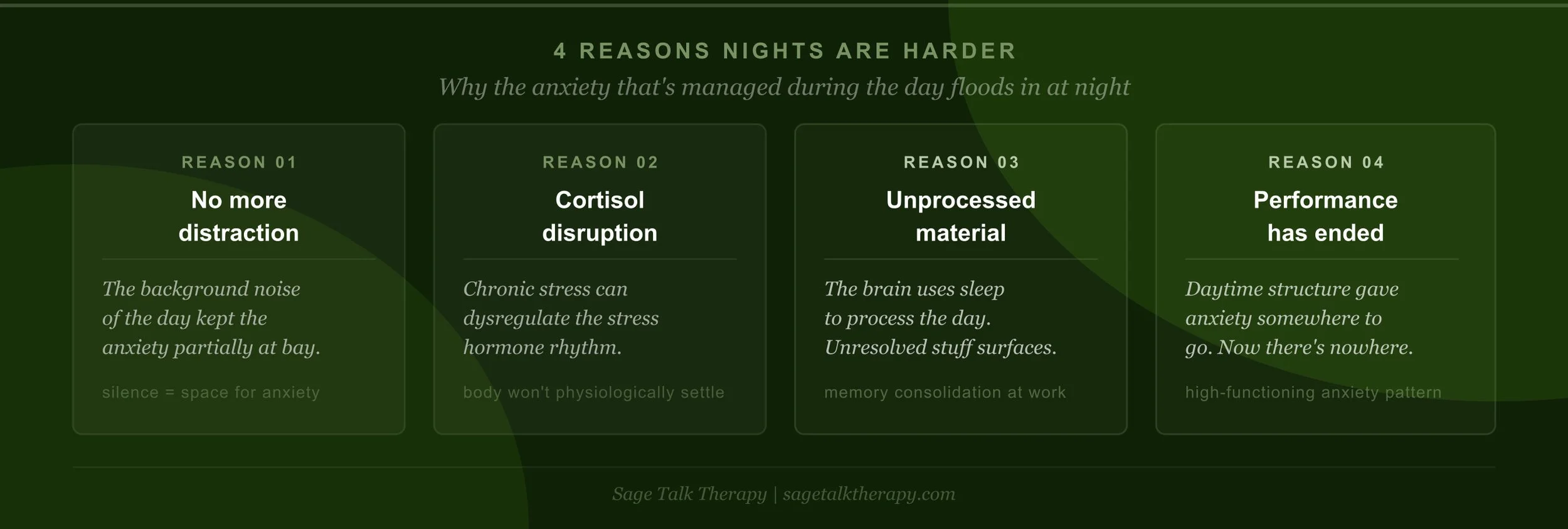
There are several specific reasons why anxiety tends to surface and intensify at night, beyond just the absence of distraction.
The cortisol rhythm gets disrupted
Cortisol, the stress hormone, normally rises in the morning and drops at night. But if that rhythm is disrupted — by stress, trauma, or irregular sleep — it can spike at night, mimicking anxiety or amplifying it. For people running chronic stress responses during the day, the cortisol rhythm can become dysregulated in ways that make physiological settling at night genuinely difficult.
The nervous system hasn't downshifted
If your nervous system has been in a sympathetically activated state for most of the day — which is the case for anyone with chronic anxiety, high-functioning anxiety, or significant stress — it doesn't automatically switch off at bedtime. Lying down doesn't tell your nervous system that the day's threats are resolved. The body stays activated, the mind follows.
Unprocessed material surfaces
The brain uses sleep to process and integrate the experiences of the day. When there is significant unprocessed material — unresolved conflict, suppressed emotion, experiences that generated anxiety and were pushed through rather than felt — that material tends to surface in the hours before and during sleep. This is not malfunction. It is the system doing what it's supposed to do. The problem is that without the right conditions to actually process it, the material just keeps circling.
The day's performance ends
For high-functioning anxious people, the daytime hours are full of structure, task, and performance — all of which give the anxiety somewhere to go. At night, the performance stops. The anxiety that was being managed through activity has nowhere left to channel. And the thoughts that were being kept at bay by busyness finally arrive.
The difference between thinking and rumination
Not all nighttime thinking is the same. There is a meaningful distinction worth understanding.
Thinking is purposeful. It moves toward something. It asks a question, explores it, and arrives at some kind of resolution or resting point. Thinking at night — reviewing a decision you need to make, processing something that happened — can actually be useful.
Rumination is different. Rumination says "What if I never figure this out?" It is repetitive, emotionally loaded thinking that focuses on problems, fears, regrets, or what-ifs — cycling through the same material without arriving anywhere new.
Rumination is the nervous system's threat-management program stuck in a loop. It keeps returning to the same material because it hasn't resolved the threat — not because thinking about it more will help, but because the system doesn't know what else to do.
This is an important distinction for treatment. Most tips for nighttime overthinking are designed to interrupt rumination — journaling, thought-stopping, postponement techniques. These can be genuinely helpful in the moment. But they don't address why the nervous system keeps generating rumination in the first place. For that, you need to work at a different level.
What's really driving the chronic version
Occasional nighttime overthinking is normal. Chronic nighttime overthinking — the kind that has been happening for months or years, that leaves you exhausted and is affecting your daily functioning — is a signal worth taking seriously.
For many people, chronic nighttime overthinking is driven by the same fear-based patterns that drive daytime anxiety: perfectionism that keeps processing every interaction for error, a nervous system trained toward vigilance by early experiences, the accumulated pressure of managing a life that requires a lot while allowing very little genuine rest.
The nighttime brain isn't random. It tends to return to the specific categories of threat that the nervous system has been trained to monitor. The relationship that feels uncertain. The work performance that feels inadequate. The conversation that might have been received badly. The thing you said that you can't take back. These aren't arbitrary — they're the places where the threat-detection system has learned to focus.
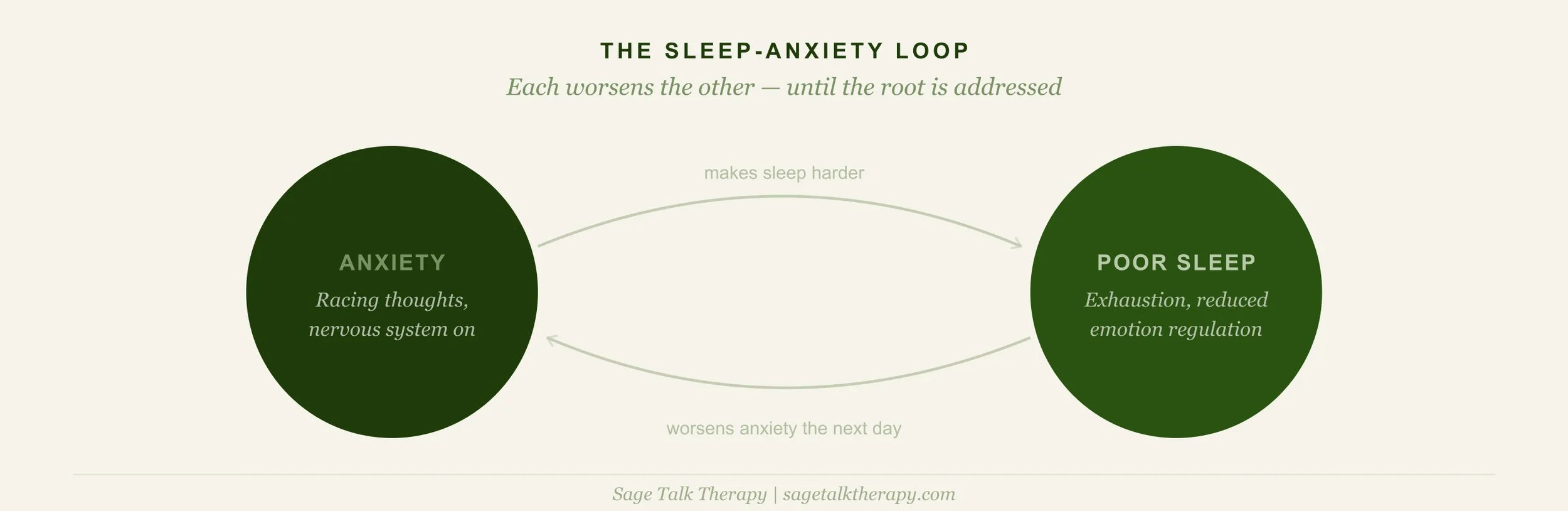
Sleep and mental health influence each other in a continuous loop. Poor sleep makes it harder to regulate emotions, manage stress, and cope with anxiety. And anxiety makes sleep harder — which then worsens the anxiety the next day.
Understanding what your brain specifically returns to at night tells you something important about where your anxiety is most active. That's clinical information, not just insomnia.
WhAT aCTUALLY hELPS — iN THE SHORT TERM
There are genuinely useful tools for managing the acute experience of nighttime overthinking. These are not the whole solution, but they're worth having.
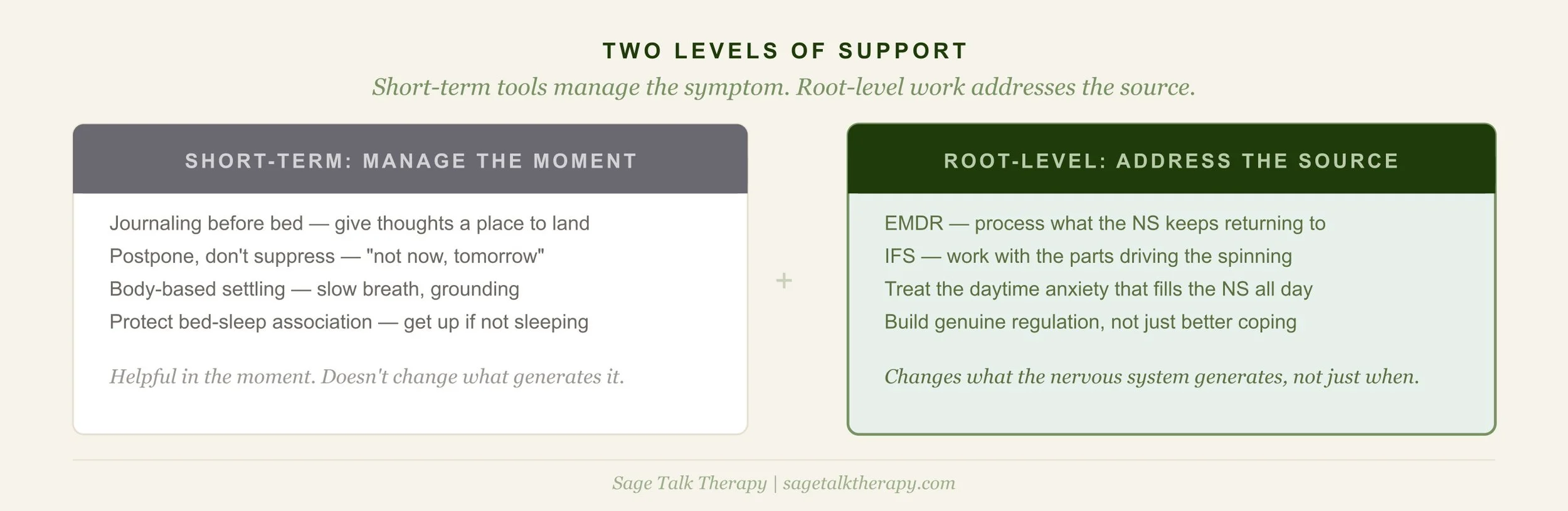
Give the thoughts somewhere to land: Journaling before bed — not processing journaling, just a brief download of what's on your mind — reduces the pressure the brain feels to keep cycling through it. Setting aside 15 to 20 minutes earlier in the evening to write down worries reduces rumination before bed by giving the mind a designated outlet. The brain can more easily let something go when it trusts it's been recorded.
Postpone rather than suppress: Trying to force yourself not to think something generally makes you think about it more. A more effective approach is to acknowledge the thought and explicitly postpone it: "I hear that. We're not doing this at 2am. I'll return to it tomorrow." This gives the nervous system permission to release it temporarily rather than demanding it disappear.
Work with the body, not just the mind: Deep breathing, meditation, and physical grounding can help calm the nervous system — these approaches reduce physiological arousal linked to nighttime anxiety. The key is that these work better when they're practiced consistently rather than only deployed in crisis moments. A nervous system that's learned to settle through regular practice settles faster when you need it to.
Protect the association between bed and sleep: If you spend significant time in bed awake and anxious, the bed itself becomes associated with anxiety rather than rest. If you've been awake and spinning for more than twenty minutes, getting up and doing something quiet in dim light, then returning to bed when you feel sleepy, preserves the bed as a signal for sleep rather than a trigger for rumination.
What actually helps — at the root
The tools above are valuable and genuinely help in the short term. But if chronic nighttime overthinking has been a feature of your life for a significant period, those tools are managing symptoms that keep regenerating from an unaddressed source.
Addressing the source requires working at the level of the nervous system that is generating the anxiety — not just at the level of the thoughts the anxiety produces.
EMDR is particularly relevant here for people whose nighttime thinking tends to return to specific experiences, relationship patterns, or threat categories that have roots in the past. When the nervous system's threat-detection system is calibrated by earlier experiences — and keeps returning to those threat categories regardless of current circumstances — EMDR helps the system update its assessment. The material that keeps surfacing at night loses its charge when the experiences driving it are genuinely processed rather than just managed.
IFS is useful for understanding the specific parts driving the nighttime thinking. The hypervigilant planner that keeps running through tomorrow's scenarios. The self-critical part that replays today's interactions. The anxious protector that won't let you sleep because it doesn't trust that things will be okay. Working with those parts — understanding what they're afraid of, what they need — tends to produce more durable quiet than trying to silence them.
More fundamentally, addressing the daytime anxiety that fills the nervous system throughout the day is the most significant thing you can do for nighttime overthinking. A nervous system that has been running in activated mode all day does not settle easily at night. A nervous system that has genuine capacity to regulate — that has been treated for the anxiety driving it rather than just managed — settles differently.
A Note on What This is Telling YOu
If your brain won't stop at night — if this has been happening regularly for months or years — that's not just a sleep inconvenience. It's information.
It's telling you that the anxiety you've been managing during the day hasn't been resolved, only routed. That the nervous system is running a threat-response program with significant accumulated material. That the strategies you've been using to get through the day are working during the day and failing at night.
That's worth paying attention to. Not as something to add to your list of problems, but as a signal pointing toward something that deserves real support.
if this resonates
Chronic nighttime overthinking is one of the most common presentations I see in practice — and one of the most treatable when it's addressed at the right level. If you've tried the tips and they haven't been enough, that's probably because the tips were aimed at the wrong target.
Learn more about Anxiety Therapy.

Dadiana Lopez
LCSW · Anxiety & Trauma Therapist · EMDR Specialist
Dadiana Lopez is a Licensed Clinical Social Worker and EMDR therapist based in White Plains, NY. She specializes in anxiety, trauma, PTSD, and the patterns that form in the wake of both — including people-pleasing, perfectionism, and burnout. She sees clients in person in Westchester and online throughout New York and Connecticut.
Seeing clients in-person in White Plains, NY and online throughout New York and Connecticut.