
Impostor Syndrome Is Not a Confidence Problem. Here's What It Actually Is.
You have the credentials. You have the track record. People around you trust your judgment and rely on your work.
And you are quietly, persistently convinced that you are not as capable as they think you are. That at some point, someone is going to notice. That your success has been a combination of luck, timing, and convincing people of something that isn't entirely true.
You've probably tried the standard advice. Focus on the evidence. List your accomplishments. Remember what you've actually built. And for a moment, maybe it helps. Then the next challenge arrives and the voice is back, exactly where it was.
That pattern is telling you something important: impostor syndrome is not primarily a confidence problem. Collecting more evidence of your worth doesn't resolve it in any lasting way because evidence isn't the issue. What's underneath it is.
This post is about what impostor syndrome actually is, where it comes from, and why addressing it well requires a genuinely different approach than most people take.
What impostor syndrome actually is
Impostor syndrome is a psychological phenomenon where people feel like a fraud despite clear evidence of success, attributing achievements to external factors like luck rather than their own abilities.
That description is accurate as far as it goes. But it stops at the symptom without describing the mechanism underneath it.
Here is a more precise framing: impostor syndrome is the lived experience of a deep, often unconscious belief that the real you, if fully seen, would not be accepted.
The performance, the achievement, the competence on display, is not experienced as a genuine expression of who you are. It's experienced as a front. A constructed version of yourself that has managed to convince people of something. And the anxiety that defines impostor syndrome is the anxiety of maintaining that front, of the gap between what you project and what you secretly believe is true about yourself.
In impostor syndrome, being seen is experienced as being exposed. What would be a reassuring and self-affirming experience becomes a source of fear and anxiety. The fear of being seen is sometimes connected to a fundamental mistrust about whether others will accept us for who we are.
That's not a confidence problem. That's a shame response. And shame has roots that go much deeper than self-doubt about professional competence.
The shame underneath the fraud feeling
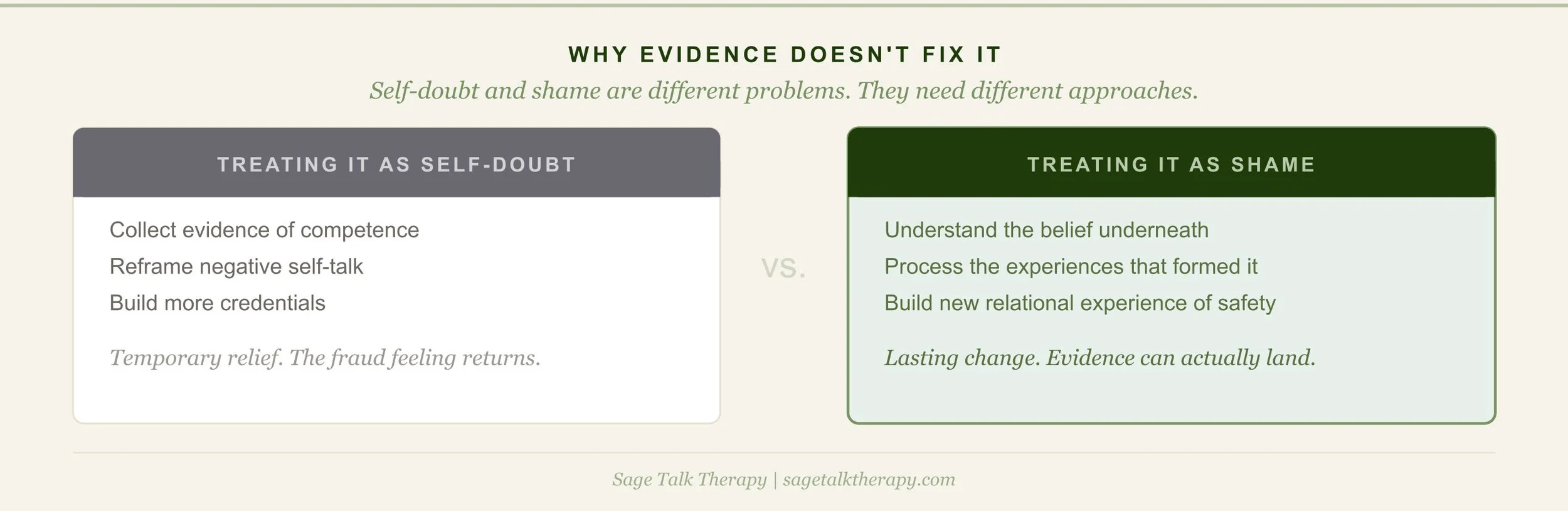
Shame and self-doubt are different experiences. Self-doubt is "I'm not sure I'm capable of this." Shame is "There is something fundamentally wrong with me, and if people knew, they would withdraw."
Impostor syndrome is much closer to shame than self-doubt. The fear isn't simply that you might fail at something. It's that failure would reveal something true and damning about who you are underneath the performance.
When we feel under the oppressive need to put up a facade of competence or show others that we have our life together, we might end up distancing ourselves from our needs, wishes, desires, and contradictions.
This is why collecting evidence of competence tends not to resolve impostor syndrome in a lasting way. Evidence speaks to capability. Shame speaks to worth. And no amount of achievement quiets the part of you that believes your worth itself is contingent, uncertain, or secretly insufficient.
The relationship between impostor syndrome and low self-esteem is direct and meaningful. Both involve a fundamental disconnection between how you appear and how you secretly believe you are. Both are driven by the belief that full visibility would result in rejection.
Where it comes from
Imposterism was strongly positively correlated to the subtypes of rigid and self-critical perfectionism. It appears imposterism and perfectionism are closely related constructs.
That connection makes clinical sense. Both perfectionism and impostor syndrome are organized around the fear of being found wanting. Both involve performing at a high level partly to prevent exposure. Both tend to intensify under success rather than resolving with it.
But understanding where impostor syndrome comes from requires looking further back than the professional environment where it tends to surface.
For many people, the roots of impostor syndrome are in early relational experiences. Environments where love or approval was conditional on performance, where the authentic self was not quite welcomed, where showing up fully was not reliably safe. When a child learns that certain versions of themselves are acceptable and others are not, they develop a performing self and a more private self, and the gap between the two becomes the architecture of later impostor experiences.
A parent who praised achievement but was unresponsive to vulnerability. A family where being the capable one was both your role and your protection. An environment where showing uncertainty, confusion, or failure had real consequences. These early experiences don't just produce a belief about competence. They produce a belief about acceptability, about whether the full, unperformed version of you is something other people can actually handle.
For some people, impostor syndrome is also part of a larger intergenerational pattern. The first-generation professional who succeeded in a world their family never accessed, and carries a complicated relationship to that success. The person of color in a predominantly white professional environment where they have always had to work twice as hard to be seen as half as credible. The woman in a field that has historically questioned her right to be there. In these contexts, impostor syndrome is not just personal psychology. It's a rational response to a world that has in fact communicated that certain people are less likely to belong.
Why the standard advice doesn't work
The most common advice for impostor syndrome falls into two categories: build more evidence, and reframe your thinking.
Build more evidence: keep a folder of positive feedback, list your accomplishments, remind yourself of what you've actually done. Useful, not sufficient. Evidence speaks to the thinking brain. The shame that underlies impostor syndrome lives at a different level. The thinking brain can hold the evidence and the body can still fire the fraud response. You can know you've earned your place and still feel, viscerally, that you haven't.
Reframe your thinking: challenge the thought that you're a fraud, look for cognitive distortions, replace the negative self-talk with more accurate assessments. Also useful, also insufficient for the same reason. Impostor syndrome that is rooted in shame and early relational experience isn't primarily a thought problem. Reframing the thoughts is working at the cognitive level while the response keeps generating from below it.
This is why impostor syndrome so persistently accompanies high achievement. The achievements provide temporary relief, maybe even a brief genuine sense of having made it, before the next challenge reactivates the same response. The pattern persists because the belief it's organized around, that the real you is not enough, hasn't been reached.
What impostor syndrome looks like in practice
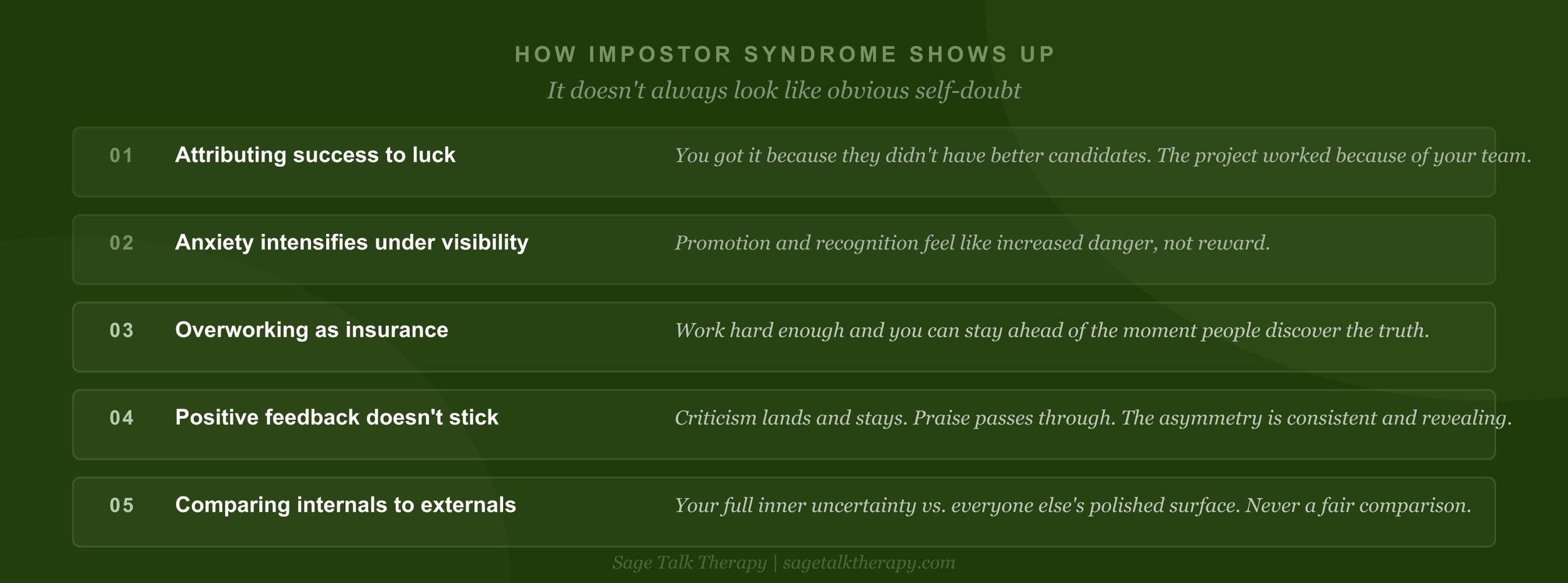
It's worth being specific about how impostor syndrome shows up, because it doesn't always look like obvious self-doubt.
Attributing success to luck or external factors.
You got the job because they didn't have enough strong candidates. The project succeeded because your team carried it. The praise is because people are being kind, or don't know enough to see the flaws. Genuine competence is almost never available as an explanation, even when it's the most accurate one.
Intensifying anxiety under increased visibility.
Promotion, public recognition, being asked to present or lead something, getting more responsibility, any increase in visibility activates the exposure fear more acutely. Success should feel good. For someone with impostor syndrome, it often feels like increased danger.
Overworking as insurance against exposure.
If you work hard enough, thoroughly enough, prepare exhaustively enough, you can stay ahead of the moment when people discover what you believe is true. The overwork isn't ambition. It's anxiety management.
Inability to internalize positive feedback.
Criticism lands and sticks. Praise is dismissed or rationalized away. The feedback that challenges the negative self-belief passes through without leaving a mark while the feedback that confirms it settles in and stays. This asymmetry is one of the most telling features of impostor syndrome.
Comparing your internal experience to others' external presentation.
You see how polished and confident everyone else appears and compare it to how uncertain and unsteady you feel inside. The comparison is not between equivalents. You have access to your full internal experience and only to other people's performed surface, but the comparison happens anyway, and always unfavorably.
What treating it well actually requires
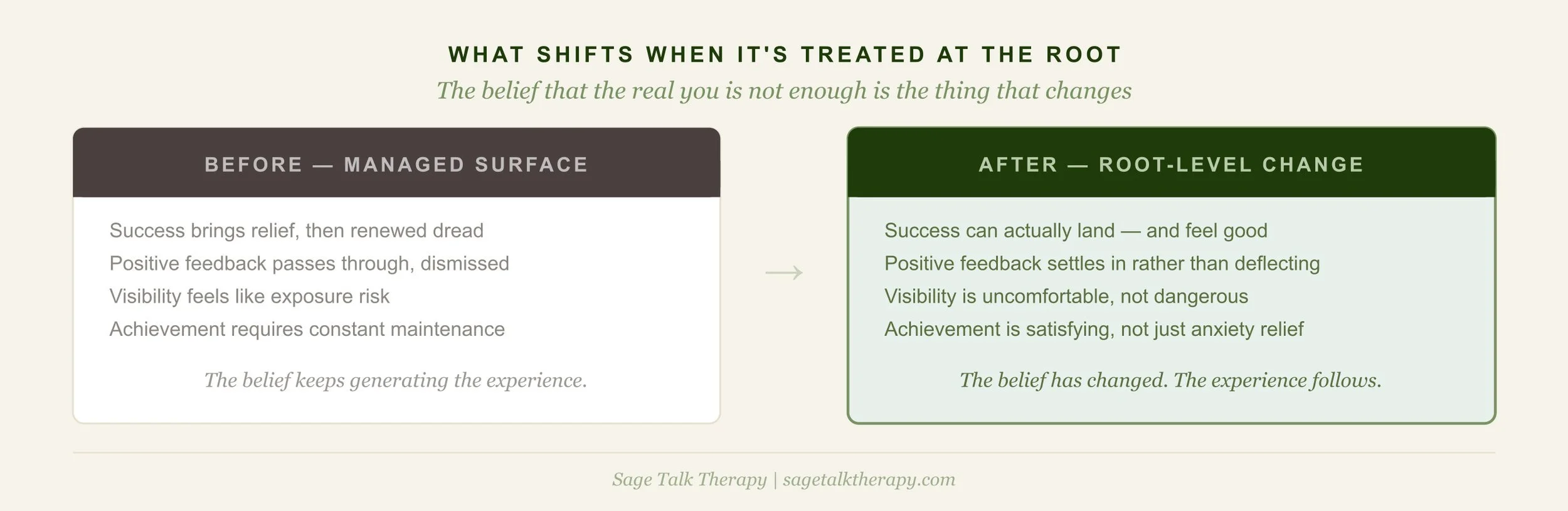
Effective treatment for impostor syndrome works at the level of the belief underneath it, not just the thoughts above it.
EMDR is particularly useful for impostor syndrome with clear developmental roots. The experiences that formed the belief that the real you is not acceptable, the early relational environments where certain versions of yourself were not welcomed, can be processed at the nervous system level. When those experiences are genuinely worked through, the belief they produced loses its charge. It becomes possible to receive evidence of competence and actually let it land, because the underlying shame response is no longer generating the same automatic rejection of it.
Internal Family Systems offers a useful frame for understanding the structure of impostor syndrome. There is typically a performing part, the one that works hard, achieves, and maintains the front. And there is usually an exile underneath it, a younger part carrying the shame and the belief about not being enough. The performing part has organized its entire existence around keeping that exile hidden. IFS allows you to work with both, understanding the performing part's fear and building a genuine relationship with the part carrying the original wound rather than just managing the symptom at the surface.
The relational dimension matters too. Impostor syndrome is a relational wound, formed in relationships where certain versions of the self were not acceptable. It tends to heal most fully in relational contexts that offer a genuinely different experience, where showing up imperfect, uncertain, or unfinished is met with care rather than withdrawal. That experience in therapy, over time, provides the nervous system with new evidence that contradicts the core belief in a way that no amount of professional achievement can.
It's also worth noting the connection to people-pleasing and the fawn response. Many people with impostor syndrome also struggle with people-pleasing, and the two patterns share a root: the belief that who you actually are is not quite enough, and that maintaining the performance is what keeps you acceptable to the people who matter.
A Note on What you are not
Here is something worth saying directly to the person reading this who has spent years managing this quietly.
You are not a fraud.
The gap you experience between how you appear and how you feel is not evidence that the appearing version is false. It's evidence that the feeling version has not yet caught up to what is actually true about you. The belief that you are not enough, that the real you would not be accepted, is not an accurate read of your worth. It is an old story, formed in a specific context, that has been running so long it feels like fact.
The work isn't about proving the story wrong with better evidence. It's about understanding where the story came from and doing the deeper work of actually changing it, at the level where it lives.
That change is possible. More fully than most people carrying impostor syndrome believe.
if this resonates
I work with high-functioning adults in Westchester, NY and online throughout New York and Connecticut whose impostor syndrome is connected to anxiety, shame, and early relational experiences. If what you've read here sounds like something worth exploring, I'd welcome the conversation.
Learn more about Low Self-Esteem Therapy.
Learn more about Perfectionism Therapy.
Learn more about Anxiety Therapy.

Dadiana Lopez
LCSW · Anxiety & Trauma Therapist · EMDR Specialist
Dadiana Lopez is a Licensed Clinical Social Worker and EMDR therapist based in White Plains, NY. She specializes in anxiety, trauma, PTSD, and the patterns that form in the wake of both — including people-pleasing, perfectionism, and burnout. She sees clients in person in Westchester and online throughout New York and Connecticut.
Seeing clients in-person in White Plains, NY and online throughout New York and Connecticut.