
High-Functioning Burnout: How to Be Completely Depleted While Still Appearing Fine
The most dangerous thing about high-functioning burnout is that it doesn't look like burnout.
It looks like a full calendar. A high output. Someone who shows up, delivers, and manages their obligations without visible strain. From the outside, the person in high-functioning burnout often looks like one of the most capable people in the room.
From the inside, the tank has been empty for a long time.
High-functioning burnout is when you're still getting things done, but at a cost that's no longer sustainable. You might still appear competent, social, even ambitious. But internally, you feel disconnected from joy, purpose, and your own body.
This is the version of burnout that flies under the radar the longest. Because the performance continues, the signal that something is wrong doesn't get sent in the way it would if the performance had collapsed. And the people in it are often the last to name it, because naming it would require acknowledging something their entire system has been organized to deny: that they are not okay.
What makes it different from regular burnout
Burnout in general is characterized by three dimensions: emotional exhaustion, depersonalization or cynicism, and a reduced sense of personal accomplishment. High-functioning burnout contains all three. What distinguishes it is that the behavioral output hasn't changed yet.
One of the defining features of high-functioning burnout is that it is masked by continued productivity. Because you are still performing, others may not notice what you are experiencing. You may also minimize your own distress, especially if you compare yourself to more visible forms of burnout.
That minimization is part of what makes it so difficult to address. The person in high-functioning burnout has a ready comparison available: other people who are visibly struggling, not showing up, falling apart in ways that are externally apparent. Compared to that, they're fine. The performance is evidence. Except performance is not the same as okay, and the two have become decoupled in ways the person themselves may not fully recognize.
This is a specific, modern phenomenon where high-achievers maintain their professional performance while experiencing significant internal distress. It is the exhausting act of appearing fine on the outside while quietly losing it on the inside.
What drives it
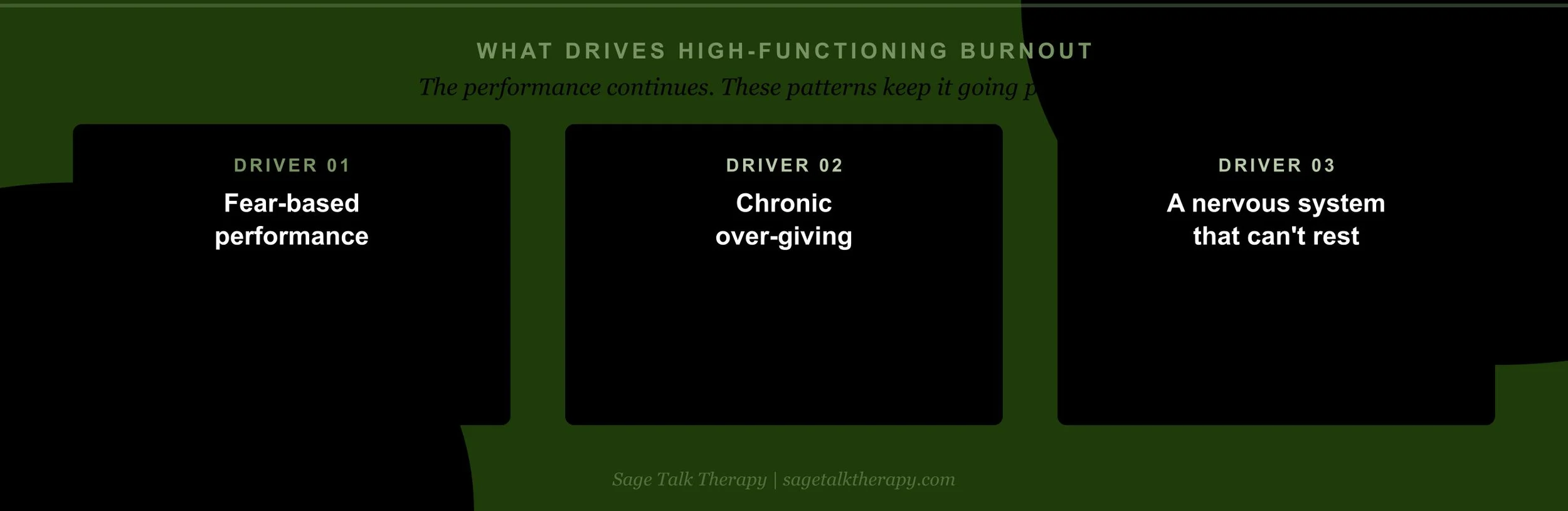
High-functioning burnout doesn't develop randomly. It develops in people whose psychological architecture makes it both likely and hard to stop.
The connection to high-functioning anxiety is direct and important. Many people in high-functioning burnout have been running on anxiety-fueled performance for years. The drive was never purely aspirational. It was, in significant part, fear-based: fear of falling short, fear of being exposed as inadequate, fear of what happens if the output stops. Perfectionism that ties worth to performance keeps the engine running long past empty, because stopping feels more dangerous than continuing.
People-pleasing compounds it. The person who cannot say no, who absorbs other people's needs and manages other people's emotional states as a matter of course, who has organized their entire functioning around being useful and available, is giving out of a tank that is never being refilled. The giving continues because stopping feels dangerous, not because there's anything left to give.
For many people, the roots go further back. When rest was not modeled as valuable in the family of origin, or when being productive was the primary way of earning acceptance, or when the nervous system was trained early toward vigilance and activity as protective, the capacity to genuinely rest may never have developed properly. Rest doesn't feel restorative. It feels dangerous, unearned, or simply uncomfortable in a way that pushes back toward activity.
Early warning signs specific to high-functioning burnout include Sunday evening dread, emotional detachment from work achievements, and medically unexplained physical symptoms. A systematic review found these symptoms often get dismissed as normal stress until exhaustion becomes overwhelming.
The signs that are easy to miss
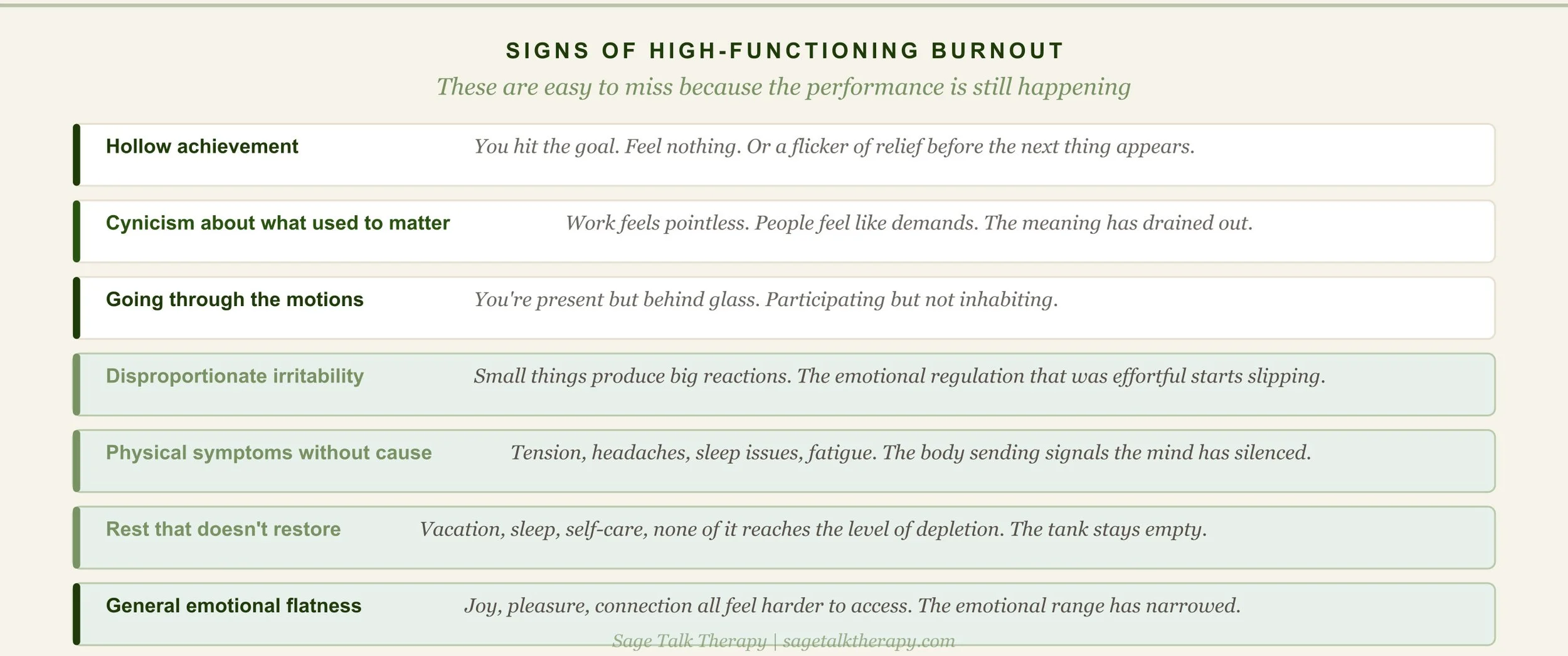
Because high-functioning burnout doesn't look like what most people think burnout looks like, the signs are subtler and more internal.
Here is what to look for:
The hollowness of achievement.
Things that should feel good don't. You hit the goal, finish the project, receive the recognition, and feel nothing. Or feel a brief flicker that disappears almost immediately. Success no longer produces satisfaction, only relief that you made it through, followed by the next thing.
Cynicism about things that used to matter.
Work you used to find meaningful starts to feel pointless. People you used to engage with start to feel like demands. The world narrows to obligation, and the sense that any of it matters recedes.
Going through the motions.
You're present but not really there. Conversations happen and you're participating, but from behind glass. Your body is in the room and your mind is slightly elsewhere, managing rather than inhabiting.
Irritability that surprises you.
Small things generate outsized reactions. A minor frustration produces a flash of anger that's disproportionate to the situation. The emotional regulation that has been effortful for a long time starts to slip.
Physical symptoms that don't have a medical explanation.
Chronic tension. Headaches. Disrupted sleep. Digestive issues. Fatigue that doesn't improve with rest. Burnout significantly increases the risk of sleep disturbances and physical health complications including cardiovascular disease and gastrointestinal issues. These are the body's signals that something is very wrong, arriving because the cognitive and emotional signals have been managed into silence.
Rest that doesn't restore.
You take the vacation. You sleep in. You do the self-care activities. And you don't feel better. The exhaustion is at a level where surface rest can't reach it. Two weeks of vacation won't undo months of chronic stress patterns. Research shows that vacation wellbeing effects diminish within two to four weeks when workplace stressors remain unchanged.
Difficulty feeling anything.
Not just numbness toward work, but a general flatness. Joy, connection, pleasure, these things are harder to access than they used to be. The emotional range has narrowed, and the feelings that do break through are more likely to be anxiety or irritability than anything positive.
Why it Keeps Going So Long
High-functioning burnout can persist for months or years before it fully registers. Several factors keep it in place.
The performance itself provides cover. As long as the output continues, the internal experience can be rationalized as manageable. Everyone is tired. Everyone is stressed. This is just how demanding work feels.
The identity investment in being capable keeps the signal from being heard. For the person whose sense of self is organized around being productive and reliable, registering that they're burned out feels threatening. It would require acknowledging a gap between who they believe they are and what they're currently experiencing.
There is often a strong internal drive to keep going. This may come from personal standards, professional expectations, or a deeper belief about self-worth being tied to achievement. When rest feels undeserved or unproductive, it becomes difficult to step back, even when the body and mind are signaling a need for it.
The fear of stopping is real. For many people in high-functioning burnout, stopping feels more dangerous than continuing. What happens to the obligations if I slow down? What happens to how people see me? What happens to the sense of purpose and structure that work provides, even depleting work? The familiar exhaustion of continuing feels safer than the unknown territory of rest.
And the comparison to others helps maintain the denial. Compared to someone who is visibly falling apart, the person in high-functioning burnout is fine. This comparison is not accurate, but it is available, and it is used.
What recovery actually requires
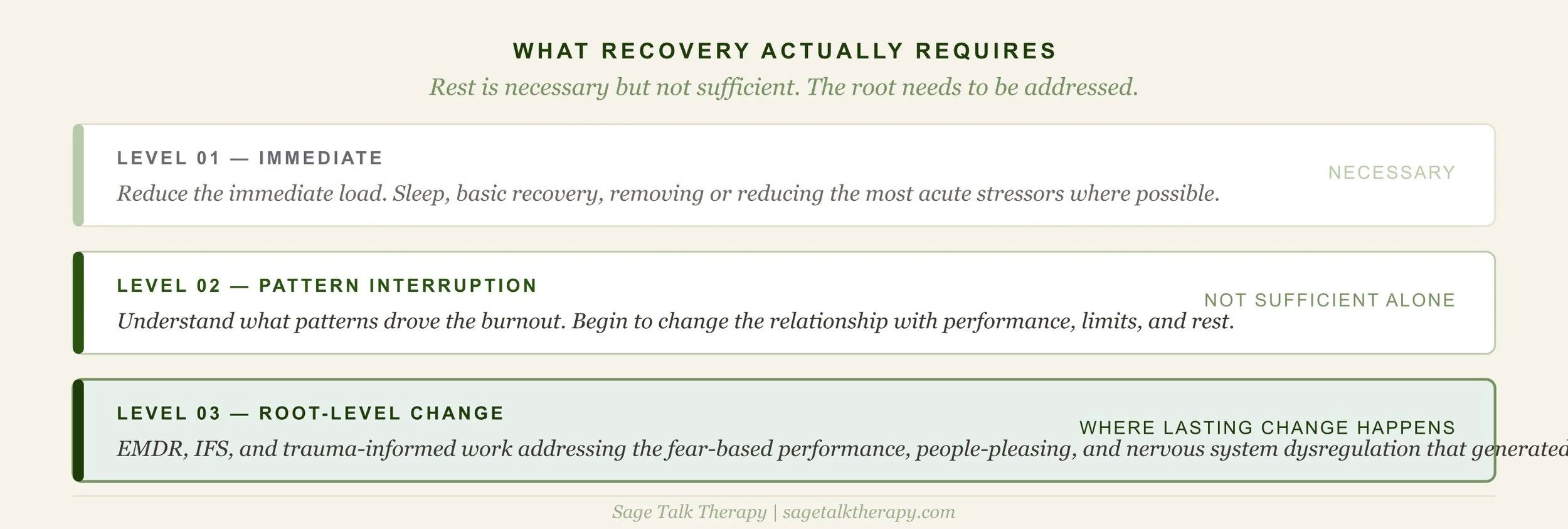
The standard burnout advice, take a break, set better limits, prioritize self-care, is not wrong. It is insufficient without also addressing what drove the burnout in the first place.
High-functioning burnout requires addressing the cognitive patterns, values misalignment, or nervous system dysregulation driving the cycle, not just temporary relief.
The nervous system piece is significant. A nervous system that has been running in a sustained activation state doesn't reset with a vacation. The deactivation pathways, the capacity to genuinely settle and restore, need to be rebuilt. This is physiological work, not just behavioral work.
EMDR addresses the roots of burnout that sit in earlier experience: the perfectionism trained by conditional love, the people-pleasing learned as safety, the nervous system calibrated toward performance and vigilance because that's what the early environment required. When those roots are addressed rather than just managed, the patterns that generated the burnout lose some of their driving force.
IFS is useful for understanding the internal structure of high-functioning burnout. There is typically a part that cannot stop: the manager, the achiever, the over-functioner who has been keeping everything running. That part is usually protecting something: a deeper fear of what happens if performance fails, a younger part carrying the belief that worth depends on output. Working with that part, understanding what it's afraid of and what it needs, creates internal conditions where genuine rest becomes possible rather than just a gap between obligations.
The relational dimension matters too. Burnout is partly a consequence of giving more than you receive, of operating in relational contexts where your needs are consistently last. Recovery includes building the capacity to receive, to ask for support, to be in relationships where you don't have to be the capable one.
Burnout recovery isn't just about doing less. It's about doing differently. It means learning what your nervous system needs in order to downshift. It means being with yourself in new ways: not through force or discipline, but through curiosity, care, and connection.
A Note on The Cost Of Continuing
Here is something worth saying plainly to the person who is in this and has been telling themselves it's manageable.
The fact that you're still functioning is not evidence that you're okay. It's evidence of how long you have been overriding your own signals. At some point, high-functioning burnout stops being high-functioning. The performance eventually gives way, usually in a way that is harder to recover from than an earlier, more intentional stop would have been.
You are likely part of the 55% of the workforce currently quietly cracking. This is the exhausting act of smiling on the outside while losing it on the inside.
You don't have to wait for the collapse to justify getting support. The tank being empty is sufficient reason, regardless of whether the car is still moving.
if this resonates
I work with high-functioning adults in Westchester, NY and online throughout New York and Connecticut who are running on empty while appearing to have it all together. If you recognize yourself in what you've read here, reach out for a free 15-minute consultation.
Learn more about Burnout & Overwhelm Therapy.
Learn more about Anxiety Therapy.

Dadiana Lopez
LCSW · Anxiety & Trauma Therapist · EMDR Specialist
Dadiana Lopez is a Licensed Clinical Social Worker and EMDR therapist based in White Plains, NY. She specializes in anxiety, trauma, PTSD, and the patterns that form in the wake of both — including people-pleasing, perfectionism, and burnout. She sees clients in person in Westchester and online throughout New York and Connecticut.
Seeing clients in-person in White Plains, NY and online throughout New York and Connecticut.