
EMDR Intensives for the Latinx and First-Gen Community
There's a particular kind of weight that first-generation Latinas and Latinos carry that doesn't always have a name.
It's not one event. It's not a single memory. It's the accumulation of what your family survived, what they couldn't say, what they passed on without knowing they were passing it on, and what you absorbed trying to hold everything together while also building something different for yourself.
You didn't choose it. But it's yours now. And it shows up in ways you recognize: anxiety that feels like a baseline you've always operated from, an inability to rest without guilt, patterns in your relationships that you can trace but can't seem to stop, a hypervigilance that made sense in context and hasn't turned off.
This post is for first-generation Latinas and Latinos in Westchester County and the broader New York and Connecticut area who are ready to address that weight at its source, not just manage its symptoms.
What Gets Inherited and How It Travels
Intergenerational trauma doesn't move through families in a straight line or with a clear label. It travels through the nervous system, through patterns of relating, through what was modeled as normal, and through what was never allowed to be said.
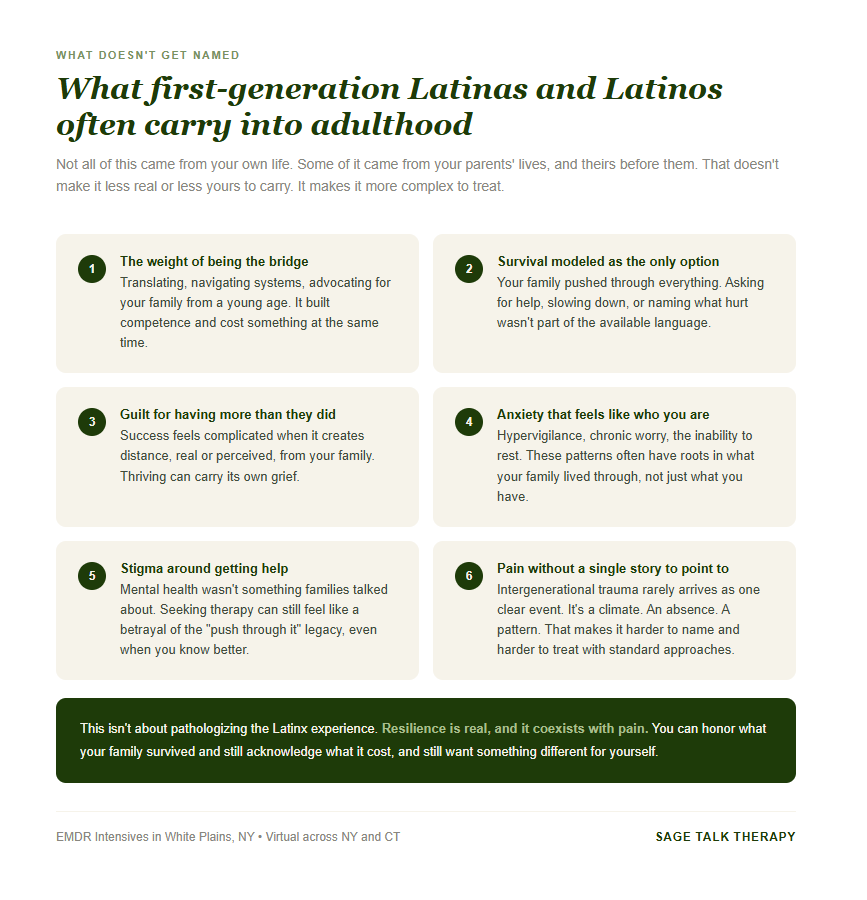
For many first-generation Latinas and Latinos, the inheritance looks something like this:
Parents who survived things they never talked about, and whose silence had its own weight.
A family culture where you pushed through, didn't complain, and treated struggle as something to outlast rather than address.
The role of the bridge: translating, navigating systems, advocating for your family from an early age, in ways that built competence and cost something at the same time.
The guilt that comes with having more than your parents did, and the grief that can come with the distance that success sometimes creates.
Stigma around mental health that still lives somewhere in you, even when your mind knows better.
None of this makes your family wrong. Most of it was survival. But the fact that it was survival doesn't mean it didn't leave a mark, or that you have to keep carrying the mark indefinitely.
WhAT Standard Therapy Often Misses
Many first-generation Latinas and Latinos who reach out for therapy describe a similar experience: they find a therapist, do the work, gain insight, and still feel like something important isn't being touched.
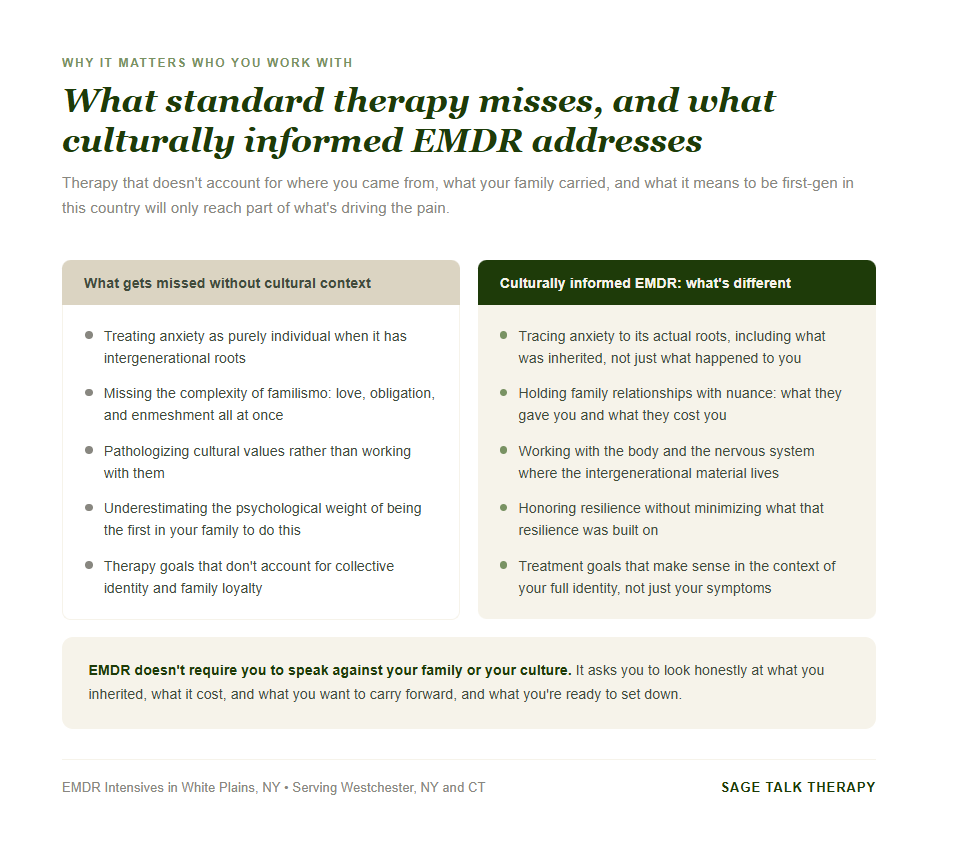
Part of that is about cultural context. Therapy that doesn't account for familismo, for the complexity of being between two worlds, for what it means to be the first in your family to do this, tends to treat the symptoms without understanding their terrain. You end up explaining yourself constantly rather than being met with understanding you don't have to earn.
Part of it is also about what kind of work is being done. The anxiety and relational patterns that have intergenerational roots don't primarily live in the thinking mind. They live in the nervous system, in the body, in the automatic responses that were shaped by what your family experienced before you were born or before you were old enough to choose. Talk therapy can build understanding of that. It rarely reaches it directly.
This is where EMDR therapy becomes particularly relevant. EMDR works with the nervous system directly, helping the brain reprocess stored material so it stops generating the same automatic response. It doesn't require you to narrate your family's history repeatedly. It helps you process the way that history lives in you, and shift that at the level where it actually operates.
Why the Intensive Format Fits
The specific contours of first-generation experience make the Intensive format particularly well-suited in ways worth naming explicitly.
You already know how to focus when something matters. First-generation adults are, almost by definition, purposeful and outcome-oriented. You didn't get where you are by half-committing. The Intensive asks for exactly that kind of focused effort, turned toward yourself.
A defined block of time is easier to justify than an indefinite weekly commitment. Many first-generation adults struggle to prioritize themselves over family obligations. There's less guilt, and less friction, in protecting one or two specific blocks of time than in carving out a weekly slot for an unknown number of months.
The work goes deep enough to reach what was inherited. Intergenerational patterns don't live in the rational mind. Extended EMDR processing reaches the nervous system level where this material actually operates. Weekly fifty-minute sessions often don't get there.
You're ready to move, not just understand. Many first-generation adults arrive with significant self-awareness. They've read, reflected, and done their own analysis. What they're looking for isn't more insight. It's work that changes something at a level that insight alone hasn't reached.

What This Work Addresses
In my work with first-generation Latinx clients in Westchester County and virtually across New York and Connecticut, the patterns that bring people to an Intensive most often include:
Anxiety that feels like a baseline rather than a response to anything specific. High-functioning anxiety that has been there so long it feels like personality. A nervous system that doesn't know how to come off alert.
Perfectionism and self-criticism that were adaptive in the family of origin and are now running at a cost. The internal voice that says you could have done more, been more, given more, that has never learned when enough is enough.
People-pleasing and the inability to set limits, particularly in family relationships where obligation and love are densely entangled. The fawn response as a survival strategy that outlived its original context.
Burnout that keeps returning regardless of how much you try to manage it, because the structural driver, a nervous system shaped by generations of not-enough, hasn't been addressed at its source.
Relational patterns that repeat across different relationships and different contexts, because the attachment wounds underneath them haven't been processed.
A Word on Seeking Help When Your Family Didn’t
One of the most common things I hear from first-generation Latinas and Latinos who reach out is some version of this: "I know I need this but it still feels like a betrayal."
That feeling deserves to be named directly.
Seeking therapy when your family didn't, when asking for help wasn't part of the available language, when strength was measured by your ability to push through, can feel like you're doing something disloyal. Like you're saying their way was wrong. Like you're choosing something for yourself at the expense of something collective.
That's not what this is.
Addressing what you inherited doesn't mean rejecting where you came from. It means being honest about what the inheritance included, the resilience and the weight, and deciding what you want to carry forward and what you're ready to set down.
That's not betrayal. That's exactly what the people who came before you were trying to make possible.
Working WIth Me
I'm Dadiana Lopez, a Licensed Clinical Social Worker and EMDR therapist in White Plains, NY. I'm a first-generation Latina clinician, and that identity is central to how I understand the work.
I don't require you to explain the texture of being first-gen before we can begin. I don't need you to justify why your family's history is relevant to your anxiety. I understand the specific weight of being the one who made it, and the specific cost that often comes with that.
I work with first-generation Latinas and Latinos from White Plains, Scarsdale, Bronxville, Pleasantville, Eastchester, and across Westchester County, as well as virtually throughout New York and Connecticut.
I offer EMDR Intensives on a limited basis each month. If this is landing for you, the best first step is a conversation.
Learn more about Intergenerational Trauma.
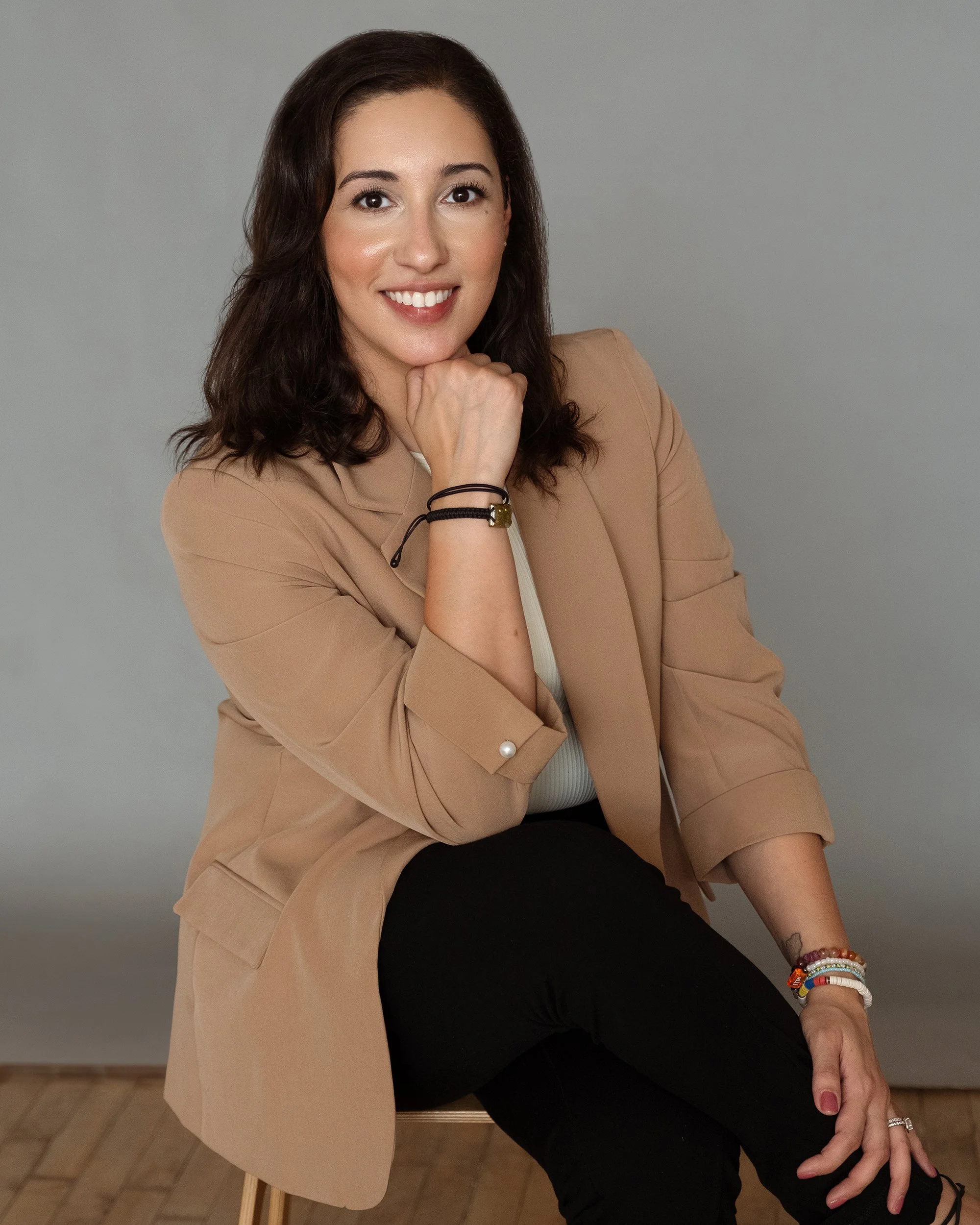
Dadiana Lopez
LCSW · Anxiety & Trauma Therapist · EMDR Specialist
Dadiana Lopez is a Licensed Clinical Social Worker and EMDR therapist based in White Plains, NY. She specializes in anxiety, trauma, PTSD, and the patterns that form in the wake of both — including people-pleasing, perfectionism, and burnout. She sees clients in person in Westchester and online throughout New York and Connecticut.
Seeing clients in-person in White Plains, NY and online throughout New York and Connecticut.