
Family Estrangement Isn't the Failure You've Been Told It Is
If you've stopped speaking to a parent or a sibling, you already know the reaction you get when it comes up. The pause. The careful question. The assumption, spoken or not, that something must be wrong with you for walking away from family.
You've probably asked yourself the same question a hundred times. What if I'm the problem? What if I'm overreacting? What if I could have just tried harder?
Here's what's true instead: you didn't fail at family. You ran out of ways to stay safe, respected, or real inside it.
This post was inspired by "The real reason many Americans are cutting ties with their parents and siblings", published in The Conversation, drawing on sociologist Rin Reczek's research and her book Families We Lose.
This isn't the story you've been told
Most of us grow up believing family ties are supposed to be permanent, no matter what. You show up to the holiday even after last year's blowup, because that's what family does. You take care of a parent when they're sick, because they're your parent. The relationship is assumed, not built.
That assumption runs deep, and it's reinforced by more than habit. It's baked into cultural expectations, into what gets called "family loyalty," even into law in some states. So when the relationship stops being about mutual respect and starts being about obligation alone, walking away can feel less like a decision and more like a betrayal of something bigger than yourself.
A recent piece in The Conversation, drawing on new research into family estrangement, put language to this that a lot of my clients have been circling for years. The researcher, sociologist Rin Reczek, calls the old model "compulsory kinship": the idea that blood ties come with unconditional, permanent obligation, regardless of how someone treats you. What she found in her interviews for her book Families We Lose is that the people who go no-contact are usually operating from a different framework entirely, one built around accountability, safety, and whether the relationship actually functions, not whether you share DNA.
That reframe matters, because it moves estrangement out of the category of "something broken in you" and into the category of "a boundary that was necessary."
One woman in the article, identified as Molly, described why she cut contact with her mother after years of trying to name the harm out loud. She told her mother directly: "You've done all these horrible things. I just need you to acknowledge it."
No acknowledgment came. And Molly came to understand that needing accountability wasn't an unreasonable ask. It was the baseline for any relationship worth keeping.
That's the part so many of my clients get stuck on. Not the conflict itself, but the exhausting, years-long wait for a parent or sibling to finally see it, finally say it, finally understand the impact they had. When that acknowledgment never comes, the estrangement isn't really about a single fight. It's about finally believing that you're allowed to stop waiting.
The guilt doesn't mean you're wrong
Here's what nobody tells you about going no-contact: the guilt doesn't leave when the relationship does.
You might miss them and still know you can't go back. You might feel like a terrible daughter, son, or sibling on a random Tuesday, for a decision you know was right. Both of those things can be true in the same breath. That contradiction isn't a sign you're doing this wrong. It's a sign you're a person who still has love in the mix, even for someone who hurt you.
This tension often runs even deeper if you grew up in a first-generation or immigrant household, where family loyalty wasn't just an expectation, it was closer to a rule. Choosing distance from a parent in that context can carry an extra layer of guilt, and sometimes an extra layer of judgment from the people around you. That doesn't mean the boundary is any less valid. It means the cost of holding it is higher, and that cost deserves real support, not a pep talk to just get over it.
What happens when you don't deal with it
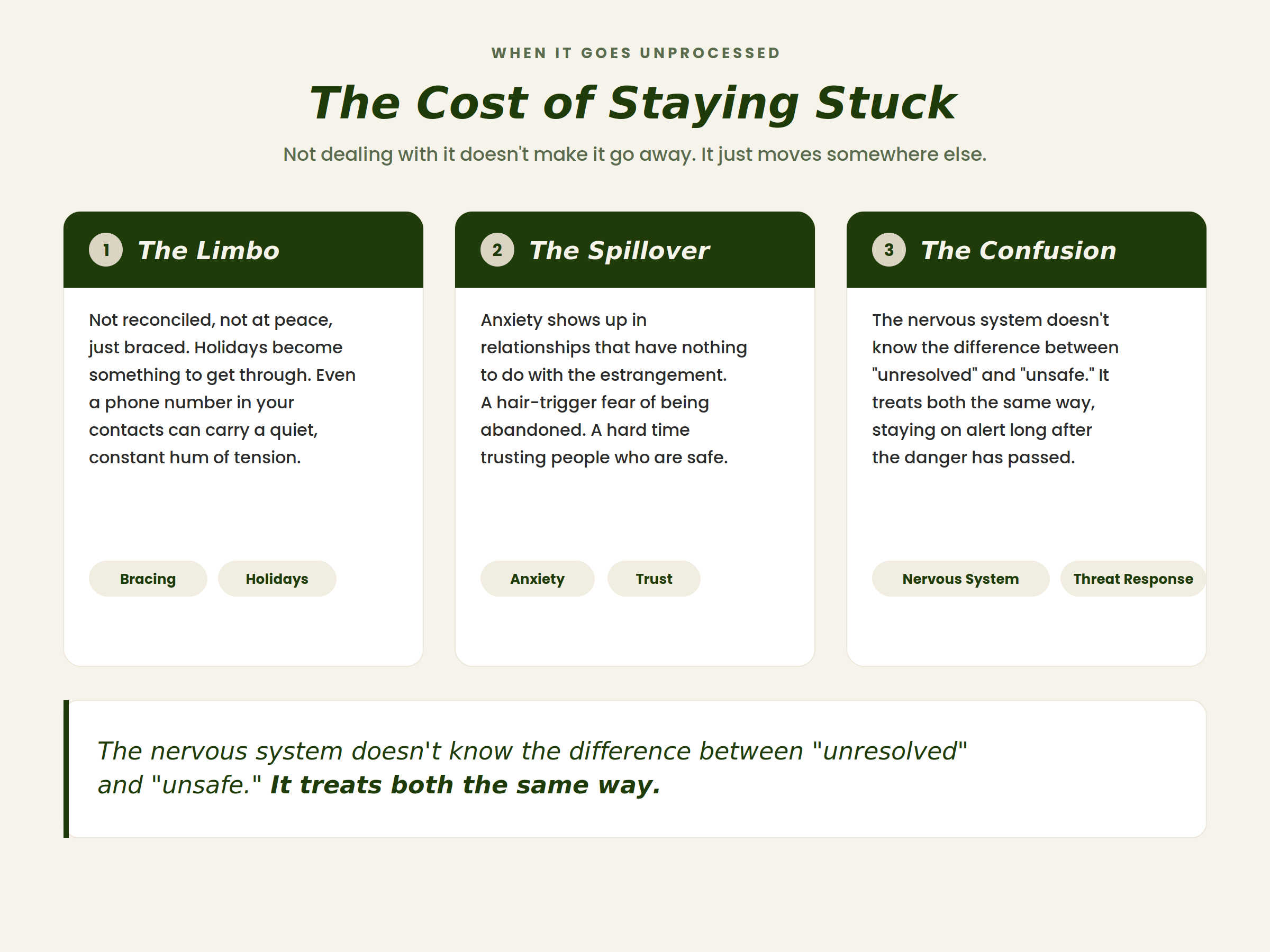
Estrangement without support tends to get stuck. You can end up in a strange limbo: not reconciled, not at peace, just braced. Holidays become something to get through instead of something to enjoy. A phone number sitting in your contacts becomes a low hum of tension you carry everywhere. Any mention of "family" in casual conversation makes you flinch a little.
Left unprocessed, this doesn't just sit quietly in the background. It shows up as anxiety around other relationships, as a hair-trigger fear of being abandoned or not good enough, as a hard time trusting people who are actually safe. The nervous system doesn't know the difference between "unresolved" and "unsafe." It treats both the same way.
What healing this actually looks like
Healing from estrangement isn't about reconciling. Sometimes reconciliation happens, sometimes it doesn't, and neither outcome is the measure of whether you've healed.
What healing actually requires is making peace with the decision itself, separate from whatever the other person ever does with it.
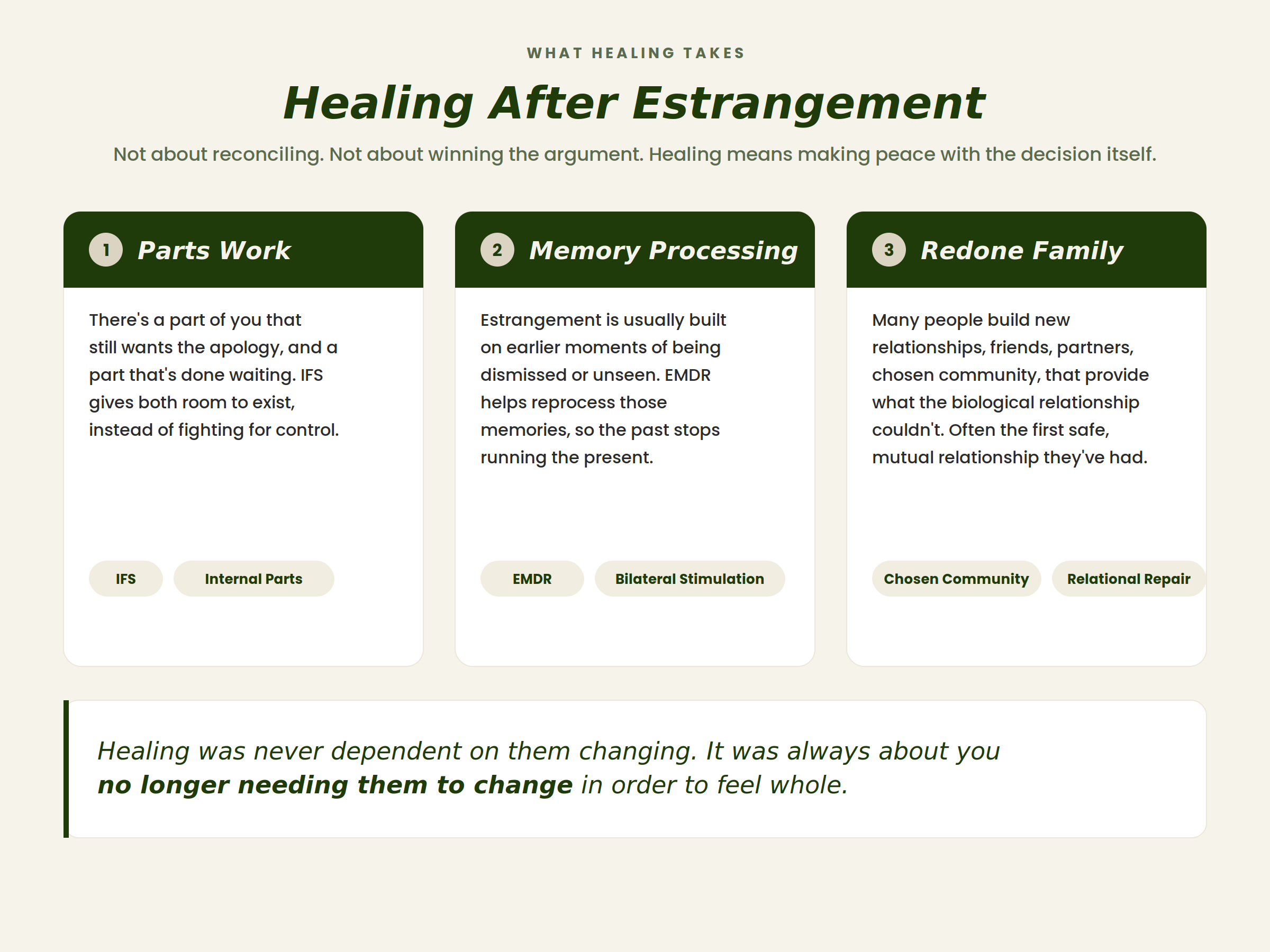
There is usually a part of you that still wants the relationship to have gone differently, that still wants the apology, the accountability, the parent or sibling who could meet you the way you needed. And there is another part that is done waiting, that has accepted this is the relationship as it is, not as you wish it were. Both parts are real. Neither one needs to win. Internal Family Systems work gives those parts a way to coexist instead of fighting each other for control of how you feel on any given day.
EMDR is often where the deeper shift happens, because a lot of what keeps people stuck isn't the estrangement itself, it's the earlier moments the estrangement is built on: the specific memories of being dismissed, blamed, or unseen. When those memories still carry their full emotional charge, every family event, every reminder, every casual "so how's your mom" reopens them. Processing those memories doesn't erase what happened. It changes your relationship to it, so the past stops running the present.
And there's a relational piece too. A lot of the people I work with on this eventually build what researchers are now calling "redone family," close relationships with friends, partners, chosen community, that provide what the biological relationship couldn't. That's not a consolation prize. For many people, it's the first time they've experienced what a mutual, safe relationship actually feels like.
If repair ever becomes possible
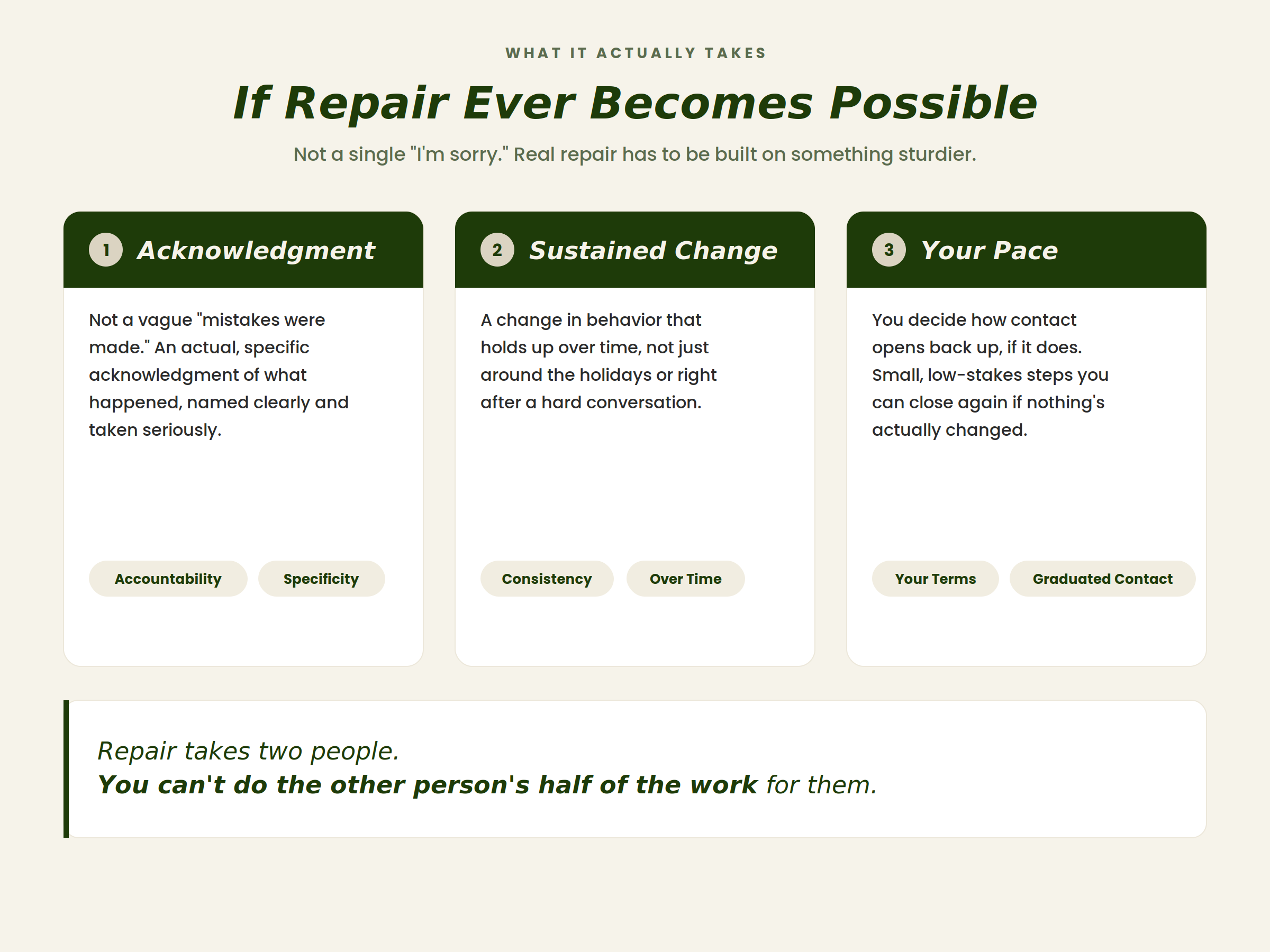
Reconciliation isn't off the table for everyone, and going no-contact now doesn't mean the door has to stay closed forever. But repair, if it ever happens, has to be built on something sturdier than a single "I'm sorry."
Real repair usually asks for three things. An actual acknowledgment of what happened, not a vague "mistakes were made." A change in behavior that holds up over time, not just around the holidays or right after a hard conversation. And a willingness to let you set the pace, instead of expecting the relationship to pick back up where it left off.
When those conditions do show up, and they don't always, repair often starts smaller than people expect. A short phone call instead of a holiday visit. A single conversation with a therapist in the room instead of full access back into your life. You get to test the relationship in small, low-stakes ways before deciding whether to open the door any wider, and you're allowed to close it again if what you find on the other side hasn't actually changed.
None of this applies if contact itself isn't safe, if there's ongoing abuse, active addiction, or another situation where reaching out puts you at risk. That's a different conversation, and distance there isn't a step toward repair. It's protection.
What repair should never require is lowering your standard for safety just to make the relationship easier to have. If acknowledgment and change never come, staying at a distance isn't a failure to attempt repair. It's understanding that repair takes two people, and you can't do the other person's half of the work for them.
A note on the apology you might not get
If you're waiting for your parent or sibling to finally understand what they did, you may be waiting a very long time. Possibly forever.
That's not a reason to stay stuck. Healing was never actually dependent on them changing. It was always about you no longer needing them to change in order to feel whole.
You don't owe anyone a relationship that costs you your own safety or sense of self, family included. And you don't have to carry the weight of figuring out how to feel at peace with that alone.
if This Resonates
If you're navigating estrangement from a parent or sibling, or the aftermath of finally setting that boundary, you don't have to sort through it alone. I work with adults in Westchester, NY and online throughout New York and Connecticut who are carrying exactly this. If what you read here sounds familiar, your first session is the place to start untangling it.
Learn more about Intergenerational Trauma Therapy.
Learn more about Internal Family Systems.

Dadiana Lopez
LCSW · Anxiety & Trauma Therapist · EMDR Specialist
Dadiana Lopez is a Licensed Clinical Social Worker and EMDR therapist based in White Plains, NY. She specializes in anxiety, trauma, PTSD, and the patterns that form in the wake of both — including people-pleasing, perfectionism, and burnout. She sees clients in person in Westchester and online throughout New York and Connecticut.
Seeing clients in-person in White Plains, NY and online throughout New York and Connecticut.