
What Actually Happens in Your Brain During EMDR (In Plain Language)
Most people who try EMDR know that it works before they fully understand why.
They experience the shift — the memory that used to flood the system now feels like something that happened rather than something still happening. The charge is gone. The image is the same, the facts are the same, but something fundamental has changed in how the brain and body hold it.
What exactly happened in there?
This question matters not just out of intellectual curiosity but because understanding the mechanism helps. It helps people trust the process when it feels slow or strange. It helps make sense of why EMDR reaches things that years of talk therapy couldn't. And it helps the change feel less mysterious and more real.
Here is the neuroscience of EMDR, explained without jargon, without oversimplification, and with genuine respect for what the research does and doesn't yet know.
First: how trauma gets stored differently
To understand what EMDR does in the brain, you first need to understand what trauma does to the brain.
When something overwhelming happens, the brain does not file the experience the way it files ordinary memories. Ordinary memories get processed, integrated, and stored with a sense of time and perspective attached. They feel like the past because they've been encoded as the past.
Traumatic memories are different. The neural networks that locked traumatic memories in their raw, triggering form store them in a way that keeps them perpetually present rather than past.
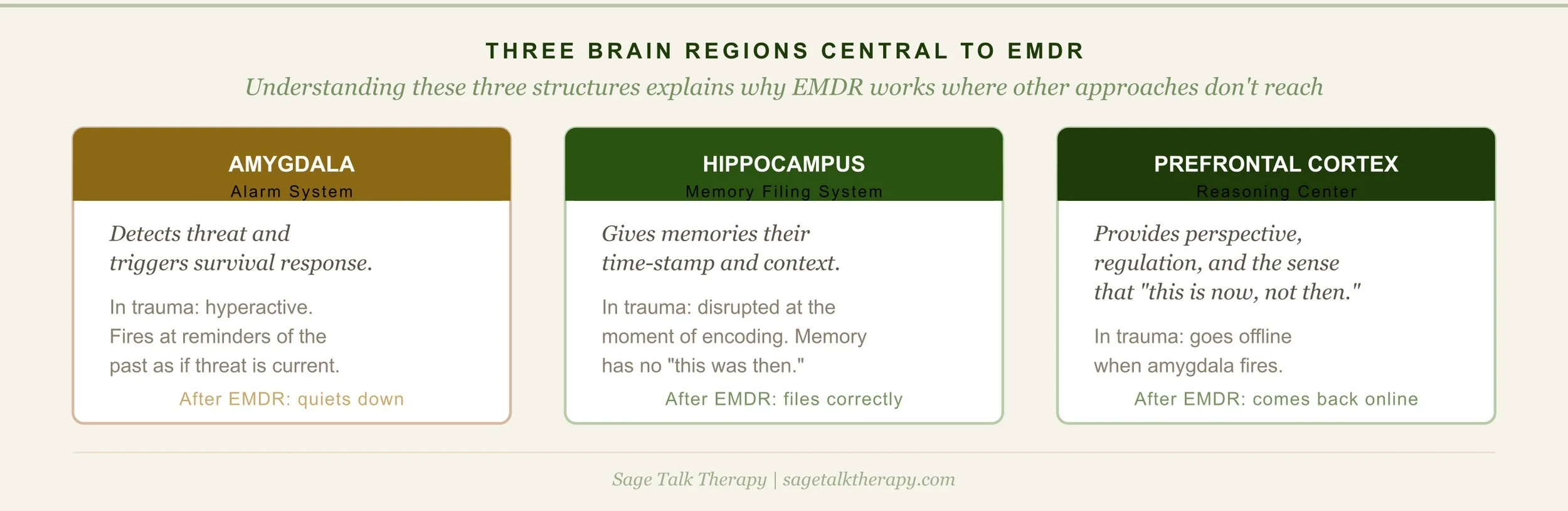
Here is what happens neurologically: under extreme threat, the brain's alarm system (the amygdala) fires at high intensity. The alarm is so loud that it disrupts the normal memory-filing process. The hippocampus, which is responsible for giving memories their time-stamp and context, gets partially overridden. The prefrontal cortex, which is responsible for reasoning, perspective, and the sense that "this is happening now but it will pass," essentially goes offline.
The result is a memory stored without its proper filing. No clear time-stamp. No contextual frame. No "this was then." Just the raw sensory and emotional content, stored in a fragmented, activated state, ready to fire whenever anything in the environment matches its patterns.
This is why trauma memories don't feel like memories. They feel like now.
In people with PTSD, neuroimaging studies consistently show the amygdala becomes hyperactive, responding strongly not only to genuinely threatening situations but also to reminders of past trauma. Research has documented this pattern across many studies.
The brain's alarm is calibrated to a threat that isn't currently present, firing at things that merely resemble the original experience.
The three key brain regions
Before going further, it helps to have a working understanding of three brain structures that EMDR research focuses on.
The amygdalais the brain's threat-detection and alarm system.When something feels dangerous, the amygdala fires, triggering the stress response and mobilizing the body for action. In people with unresolved trauma, the amygdala is chronically over-sensitized. It fires at things that resemble the original threat, even when no actual threat is present.
The hippocampus is the brain's filing system for autobiographical memory. It gives memories their context: when they happened, where they happened, what the circumstances were. It is the structure that allows a memory to feel like a memory rather than a current experience. In trauma, hippocampal functioning is disrupted precisely at the moment of encoding, which is why traumatic memories lack the "this was then" quality.
The prefrontal cortexis the brain's reasoning center. It is responsible for perspective, for the ability to think about what's happening rather than just react to it, for the regulatory function that keeps the amygdala's alarm in proportion to actual threat. When the amygdala is firing strongly, prefrontal functioning goes offline. This is why people in a triggered state can't "just think their way through it." The thinking brain has been bypassed.
EMDR works on the relationship between these three structures.
What bilateral stimulation does
The defining feature of EMDR is bilateral stimulation: a rhythmic, alternating left-right sensory input, most commonly eye movements following a therapist's moving finger or a light bar, though tapping and audio tones are also used. Why does this matter? There are several leading theories, and it is worth being honest that the exact mechanism is still being researched. The most supported explanations are not mutually exclusive:
Working Memory
The working memory theory suggests that holding a traumatic memory in mind while simultaneously tracking bilateral stimulation taxes the working memory system in a specific way. Working memory has limited capacity. When it is occupied by the bilateral tracking task, the emotional intensity of the memory held in mind reduces because there is less cognitive bandwidth available to sustain it at full intensity. The memory starts to lose its charge not because it has been suppressed but because the neural resources that sustained its intensity are being partially redirected.
REM Sleep
The REM sleep connection is one of the most compelling explanatory frameworks. During REM sleep, the brain performs its nightly memory consolidation work, processing and integrating the emotional experiences of the day. REM sleep is characterized by rapid eye movements, bilateral brain activity, and a specific pattern of neural processing that allows emotionally charged material to be integrated and filed. EMDR's bilateral stimulation appears to activate similar neural processes. The same neural networks that locked traumatic memories in their raw, triggering form are being reactivated and reintegrated through bilateral stimulation. EMDR may essentially be facilitating artificially what the brain does naturally in REM sleep, but for memories that were so overwhelming at the time of encoding that the normal REM processing couldn't fully complete.
Orienting Response
The orienting response theory proposes that bilateral stimulation activates the brain's orienting response, which is the automatic "what's that?" reaction to a new stimulus. The orienting response is associated with relaxation of the stress response and a shift in attention. When the orienting response is activated while a distressing memory is held in mind, it may help interrupt the freeze-like state that trauma memories tend to produce, creating a brief window of relaxed attention that allows the memory to be processed rather than just endured.
Bilateral stimulation in EMDR may act partly through the thalamus, helping to re-bind fragmented memory traces with their associated sensory and emotional information. The thalamus acts as a relay station between brain regions, and EMDR may be helping reconnect the fragmented pieces of a traumatic memory so they can be filed as a coherent, integrated whole.
What neuroimaging research actually shows
The research question most relevant to understanding EMDR is not just "does it work" (the evidence for that is strong and well-established) but "what specifically changes in the brain when it works."
Neuroimaging studies comparing brain activity before and after EMDR treatment have produced consistent findings:
EMDR therapy elicited significant functional decreases in deep gray matter including the amygdala, thalamus, and caudate nucleus, as well as cortical activities, as compared to healthy controls. In plain language: after successful EMDR treatment, the alarm centers quiet down. The amygdala, which was firing excessively at trauma-related material, becomes less reactive.
Neuroimaging studies reported decreased activation of limbic areas and increased activation of prefrontal brain regions related to cognitive control after completion of successful EMDR treatments. The prefrontal cortex, which was going offline every time trauma material was triggered, comes back online. The thinking brain, the reasoning and perspective center, regains access during what were previously overwhelming activations.
The impact of EMDR on cortical and subcortical brain regions has been proven by several investigations demonstrating a clear association between symptoms disappearance and changes in cortical structure and functionality. These are not subtle effects. They are measurable, structural changes in how the brain is processing trauma-related material.
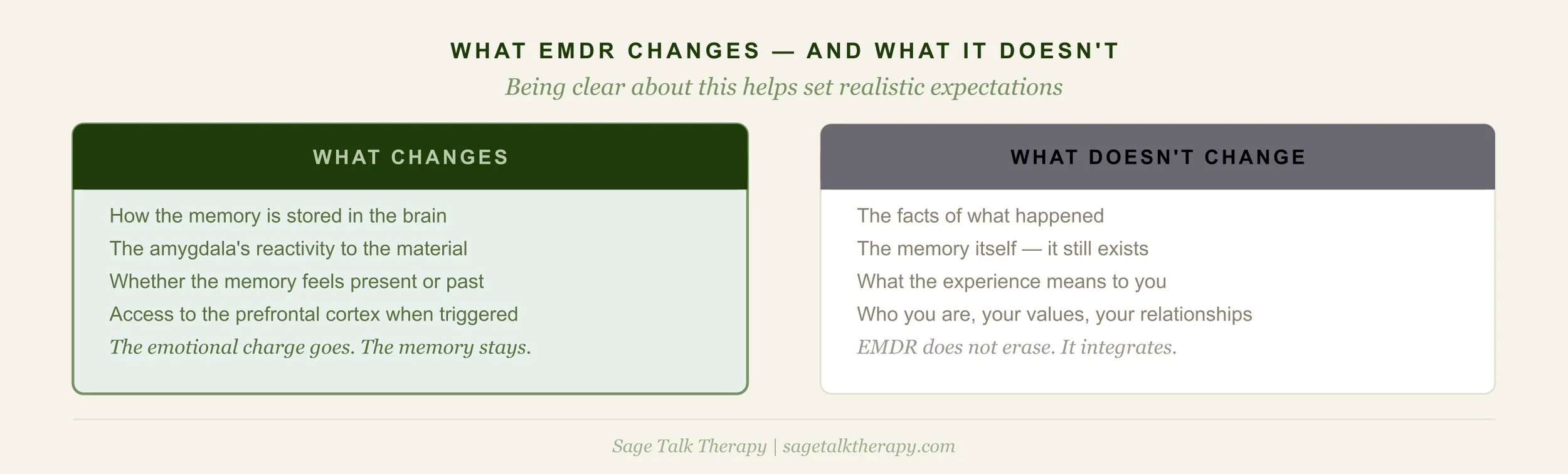
What this means in practical terms: after effective EMDR, the traumatic memory is no longer stored as an ongoing emergency. The hippocampus has been able to complete the filing it couldn't do at the time. The memory has a time-stamp. It belongs to the past. The amygdala no longer fires at it as if the threat were current.
The memory doesn't disappear. The person still knows what happened. But it no longer floods the system.
What This Feels Like From The Inside
The neuroscience is useful. What many people find equally useful is understanding what the processing experience actually feels like, because EMDR can be strange and disorienting if you don't have a frame for it.
During bilateral stimulation while holding a traumatic memory, most people notice the memory shifting. Images change. Associated memories surface. Physical sensations move through the body. Emotions arise and pass. The material seems to have a life of its own, moving in ways that don't follow the person's conscious direction.
This is the brain reprocessing. The neural networks associated with the traumatic memory are being activated and allowed to move, to connect with other memory networks, to find their way to integration. The person is not directing this movement consciously. The bilateral stimulation is facilitating the brain's own processing system, and the system is doing what it was designed to do: making sense of experience and filing it appropriately.
The sets of bilateral stimulation are followed by brief pauses where the therapist checks in. During these pauses, people often notice that something has shifted. The image is less vivid. The emotional intensity is lower. The physical tension has reduced. The memory feels further away.
Sometimes the shift is dramatic within a single session. More often it is gradual across multiple sessions, each one completing another piece of the processing until the memory holds together as an integrated whole rather than a collection of fragmented, charged pieces.
For people who want to go deeper in a shorter time, EMDR Intensives can accelerate this process significantly by providing extended, uninterrupted processing time rather than the compressed windows of standard sessions.
What EMDR does not do
It's worth being clear about what the research does and doesn't support, because EMDR is sometimes described in ways that overstate the mechanism.
EMDR does not erase memories. The experience still happened. The facts don't change. What changes is how the memory is stored and how the brain responds to it. It moves from an active, raw threat response to a filed, integrated recollection.
EMDR does not work the same way for everyone or every type of material. Single-event trauma, the car accident, the assault, the specific incident, tends to respond quickly, often within a small number of sessions. Complex developmental trauma, the accumulated experience of years of difficulty, takes longer because there is more material to process and the nervous system needs more time to build the capacity to do the work safely.
EMDR is also not a passive process. The client is actively engaged throughout. The bilateral stimulation facilitates processing, but it is the person's own brain doing the reprocessing work. The therapist's role is to create the conditions and guide the process, not to do something to the person.
Why This Matters for Your Understanding of Therapy
Understanding the neuroscience of EMDR is useful for two reasons beyond intellectual interest.
The first is trust. EMDR can feel strange during processing. The sensations, the images that arise unbidden, the emotional movement that doesn't follow conscious intention, can be disorienting if you don't understand what's happening. Knowing that this is the brain's reprocessing system at work, doing exactly what it was designed to do with bilateral stimulation facilitating it, helps people stay with the process rather than pulling away from it.
The second is realistic expectation. EMDR works at the level where trauma is actually stored. Talk therapy, even excellent talk therapy, works primarily at the cognitive level. The reason EMDR can reach things that years of talk therapy couldn't is not that talk therapy was ineffective. It's that EMDR is working on a different part of the system. Both have their place. For trauma that lives in the nervous system and the body, EMDR addresses it where it actually lives.
if this resonates
EMDR therapy at Sage Talk Therapy is available in-person in White Plains, NY and online throughout New York and Connecticut. If you're curious about whether EMDR is a good fit for what you're working on, I'd welcome the conversation.
EMDR is effective for trauma and PTSD, but also for anxiety, negative core beliefs, and the patterns that form in the wake of difficult experiences at any stage of life.

Dadiana Lopez
LCSW · Anxiety & Trauma Therapist · EMDR Specialist
Dadiana Lopez is a Licensed Clinical Social Worker and EMDR therapist based in White Plains, NY. She specializes in anxiety, trauma, PTSD, and the patterns that form in the wake of both — including people-pleasing, perfectionism, and burnout. She sees clients in person in Westchester and online throughout New York and Connecticut.
Seeing clients in-person in White Plains, NY and online throughout New York and Connecticut.