
Why Trauma Lives in the Body — And What That Means for Healing
You can know exactly what happened to you.
You can have years of therapy. You can understand the patterns, name the experiences, trace the origins, and articulate with clarity how your history shaped you. You can hold all of that knowledge and still, on a given day, feel the tightening in your chest when you hear a particular tone of voice. Still find your body braced before you've had time to think. Still feel the weight of something that your mind knows belongs to the past but your body is clearly treating as the present.
That gap — between what you know intellectually and what you feel physically — is not a failure of insight or effort. It is pointing directly at something important: trauma is not stored primarily in the thinking mind. It is stored in the body. And that has significant implications for how healing actually works.
What it means to say “trauma lives in the body”
This phrase gets used often enough in therapy spaces that it can start to feel like a metaphor. It is not a metaphor. Trauma is not merely a mental occurrence. It inhabits the body as chronic muscular tension, a startle reflex that never calms down, a tightening in the stomach around certain memories, and a nervous system that never entirely relaxes.
Here is the physiological reality:
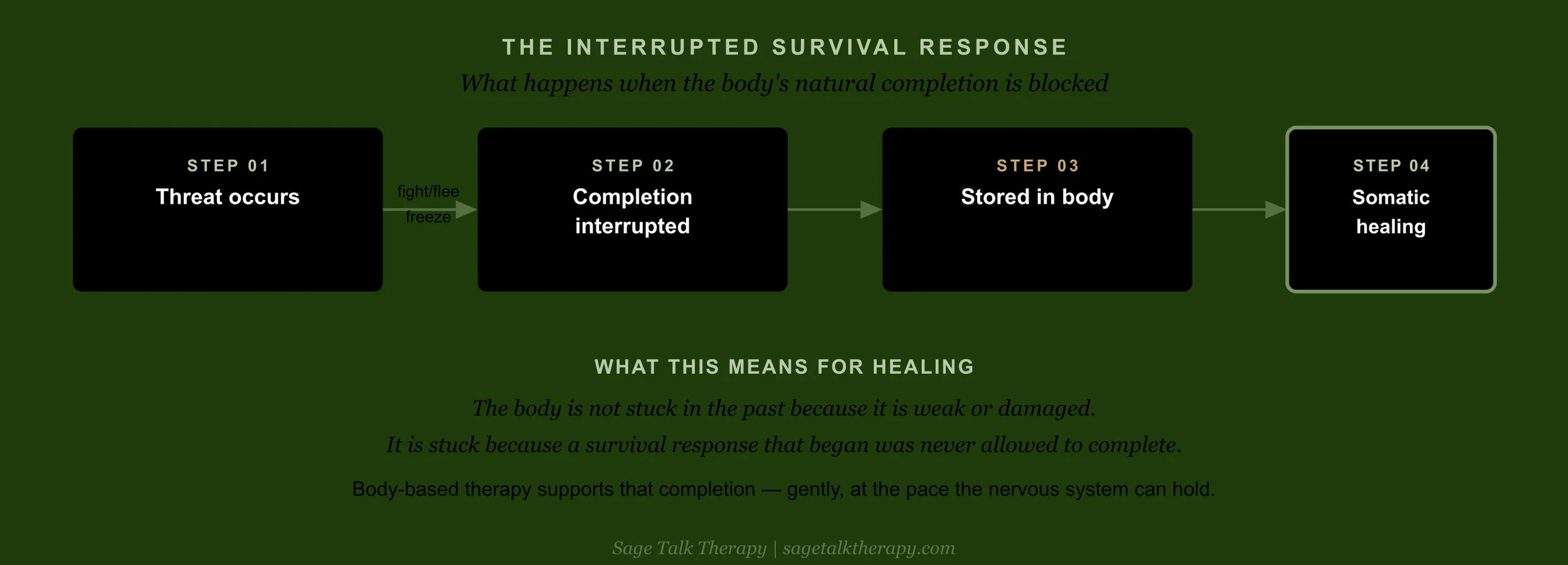
When a traumatic experience happens, the nervous system mobilizes a survival response. The body prepares to fight, flee, or freeze. Stress hormones flood the system. Muscles contract. Breathing changes. The heart rate shifts. This is the body doing exactly what it is designed to do.
In ordinary circumstances, when a stressor passes, the survival response completes and the body returns to baseline. The activation resolves. The muscles release. The nervous system settles.
In traumatic experiences, particularly those that were overwhelming, inescapable, or happened repeatedly, the completion doesn't happen. The survival response gets interrupted or frozen before it can resolve. The activation stays in the body, encoded as a physiological state that is ready to fire again whenever the environment presents anything that resembles the original threat.
Trauma is stored in somatic memory and lives in the body. Trauma reshapes both brain and body, creating lasting imprints that extend far beyond conscious thoughts or memories.
This is not a psychological weakness. It is a measurable physiological reality. The National Institute of Mental Health acknowledges that PTSD is associated with quantifiable neurobiological changes including dysfunction of the autonomic nervous system, disruption of stress hormone responses, and altered functioning of threat detection systems in the brain.
The body is not misremembering. It is accurately encoding what the nervous system learned about safety and threat. The problem is that the encoding happened in a context that no longer exists, and the body hasn't received the information that things are different now.
What this looks like in real life
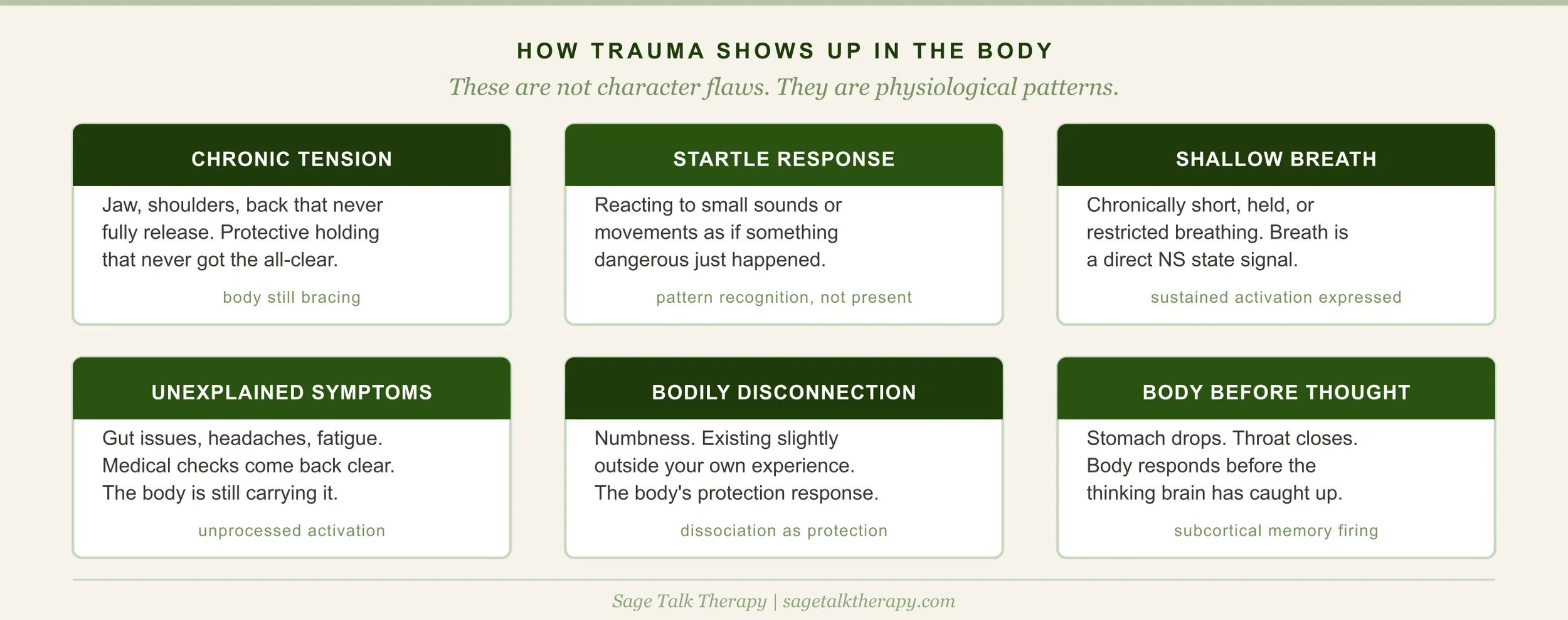
The tightness in your chest when you hear a loud noise. The way your legs freeze in certain situations. The hypervigilance that makes concentration impossible. The numbness that makes you feel disconnected from your own life. These are not psychological weaknesses or character flaws. They are measurable changes in how the nervous system functions.
Here is what body-stored trauma tends to feel like from the inside:
Chronic tension with no clear physical cause
The jaw that is always clenched. The shoulders that never fully drop. The back that carries a tightness that massage helps temporarily and never resolves completely. These are often the body's holding patterns — protective contractions that developed in response to threat and never released.
A startle response out of proportion to the stimulus
A door slams and you feel it throughout your whole body. Someone comes up behind you and your nervous system fires as if something dangerous just happened. The body is responding to the pattern, not the present moment.
Breath that is chronically shallow or held
Many trauma survivors discover, often not until they're specifically asked to notice, that they hold their breath in certain situations, or that their breathing is consistently shallow. Breath is one of the most immediate expressions of nervous system state, and chronic shallow breathing is a signal of sustained activation.
Physical symptoms that don't have a medical explanation
Gastrointestinal issues. Headaches. Fatigue that doesn't respond to rest. Chronic pain that moves or shifts. These can have many causes, and medical evaluation is always appropriate. But when the evaluation comes back clear and the symptoms persist, the body may be expressing physiologically what has not been processed emotionally or neurologically.
Feeling disconnected from your own body
This is the flip side of the physical symptoms — not too much sensation but too little. Numbness. Dissociation. The sense of existing slightly outside your own physical experience. This is also a nervous system response, the body's protection against overwhelming activation.
Physical reactions to emotional content
Your stomach drops in a certain conversation. Your throat closes when you try to say something. Your body produces a response before your mind has caught up with what's happening. The body is reading cues that the thinking brain hasn't consciously registered, because it has been trained to recognize patterns associated with threat.
Why talking about it isn't always enough
Talk therapy can help a lot of people comprehend and digest traumatic events. Knowing what happened is one thing. Letting go of the way the body still holds it is another. Somatic therapy fills in that gap.
This is not a criticism of talk therapy. Understanding what happened, making meaning of it, developing insight into patterns — all of that has genuine value. The limitation is that talk therapy works primarily through the thinking brain, the prefrontal cortex, the verbal and analytical mind. And trauma is not stored primarily in the thinking brain. It is stored in the subcortical regions, in the nervous system, in the body's physiological patterns. These areas do not take their cues primarily from what the thinking brain knows.
This is why you can understand your trauma completely and still feel it in your body every day. The understanding lives in one system. The trauma lives in another. And insight, no matter how thorough, does not automatically transfer from one to the other.
Healing trauma stored in the body requires working directly with the body — with physical sensation, with nervous system regulation, with the physiological patterns that developed in response to threatening experience.
What the body is actually doing
To understand what body-based healing involves, it helps to understand what the body is doing when it holds trauma.
The work of Peter Levine, who developed Somatic Experiencing, and of Bessel van der Kolk, whose research shaped much of the current understanding of trauma and the body, both demonstrate that traumatic stress is not just a memory but a physiological activation of the nervous system. The body is not stuck in the past because it is weak or damaged. It is stuck because a survival response that began was never allowed to complete.
Animals in the wild complete their survival responses. A deer that escapes a predator will shake and shiver after the threat passes — the nervous system discharging the activation that was mobilized for survival. The shaking is not distress. It is completion. After it, the animal goes back to grazing.
Humans, for a variety of reasons social, cultural, practical, often interrupt this completion. We hold the activation in. We manage it cognitively. We push through. And the charge that was mobilized for survival stays in the system, looking for a resolution that never came.
Somatic therapy addresses the stress responses stored in the body. Physical sensations are taken as information and aid the nervous system to complete the cycles of activation that it could not complete at the moment the trauma occurred.
The goal is not catharsis — not deliberately inducing intense emotional release. It is gentle, titrated completion. Small doses of activation, carefully held, allowed to move through the nervous system in a way that is manageable and integrating rather than retraumatizing.
What Body-Based Healing Actually Looks Like
Body-based healing does not mean lying on a floor and shaking. It does not mean cathartic emotional release or anything dramatic or destabilizing. Done well, it is quiet, gradual, and deeply attentive.
In practice, body-based trauma work involves several elements:
Tracking sensation
Learning to notice what is actually happening in your body in a given moment — where there is tension, where there is ease, where sensation is present and where it is absent. For many trauma survivors, this capacity has been dimmed by years of disconnection from bodily experience. Rebuilding it is the foundation of everything else.
Building the capacity to tolerate sensation without being overwhelmed
The goal is not to dive into distress but to develop a slightly wider range of what the nervous system can hold without tipping into overwhelm or shutdown. This is gradual and requires patience.
Titrated activation and completion
Working in small doses with the activation that is stored, supporting it to move through the nervous system rather than being suppressed or avoided. This might involve noticing a body sensation, staying with it gently, and allowing it to shift rather than forcing it or running from it. The completion, when it comes, often feels subtle — a breath, a release of tension, a sense of something settling.
Orienting to safety
A significant part of somatic trauma work is helping the nervous system register that the present environment is actually safe — distinct from the environment in which the trauma occurred. This involves building sensory contact with the present moment: what you can see, hear, feel, where you are, that you have ground under your feet. It sounds simple. For a nervous system that has been running a chronic threat response, it is genuinely orienting in a way that purely cognitive work cannot achieve.
EMDR also works at the body level in important ways, even though it is best known for memory processing. The bilateral stimulation activates the body's processing system, and the shifts that happen during EMDR reprocessing are often felt physically before they are understood cognitively. The two approaches, somatic work and EMDR, are often complementary rather than competing.
Peter Levine emphasizes that healing occurs through pacing and safety, not catharsis. The goal is not to relive trauma but to renegotiate it. Over time, somatic therapy can help individuals feel more present in their bodies, less reactive to triggers, and more able to tolerate emotions without becoming overwhelmed.
What This Means for how You Approach Your Healing.
If you have been doing cognitive work on trauma and wondering why your body hasn't caught up, this is the explanation:
The insight is real and valuable. It just hasn't reached the level where the trauma is stored.
This is also true for intergenerational trauma — patterns passed down through the family system that may show up more in the body's automatic responses than in any specific memory or narrative. The body holds what was transmitted before there were words for it.
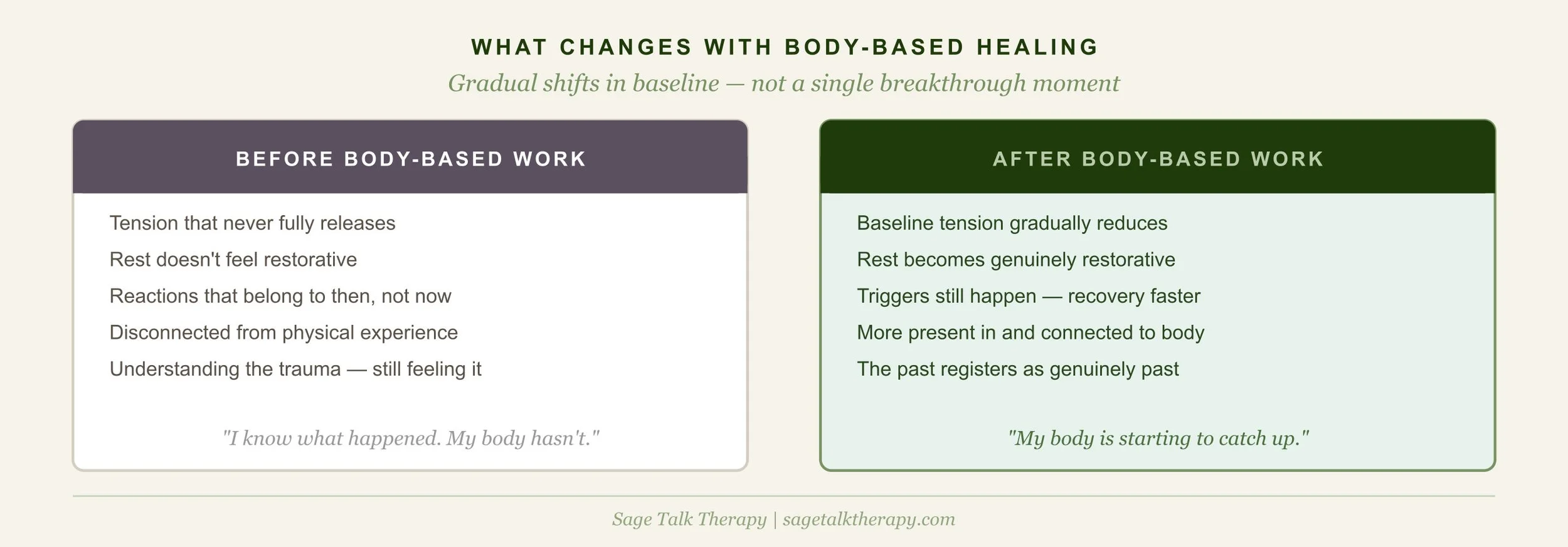
What genuine healing tends to look like for body-stored trauma is not a single breakthrough moment. It is a gradual shift in the baseline. The tension that was always there becomes less constant. The startle response settles. The breath deepens. Rest becomes actually restorative. Presence becomes more available. The body begins to register, at the level where it matters, that the threat has passed.
That shift is possible. Not through willpower, not through insight alone, but through the kind of careful, patient, body-level work that addresses trauma where it actually lives.
if this resonates
I integrate body-based and somatic approaches throughout my trauma work in Westchester, NY and online throughout New York and Connecticut.
If you recognize yourself in what you've read here — the chronic physical holding, the sense that cognitive understanding hasn't been enough, the body that is still responding to something that the mind knows is over — let’s talk.
Learn more about Trauma Therapy.

Dadiana Lopez
LCSW · Anxiety & Trauma Therapist · EMDR Specialist
Dadiana Lopez is a Licensed Clinical Social Worker and EMDR therapist based in White Plains, NY. She specializes in anxiety, trauma, PTSD, and the patterns that form in the wake of both — including people-pleasing, perfectionism, and burnout. She sees clients in person in Westchester and online throughout New York and Connecticut.
Seeing clients in-person in White Plains, NY and online throughout New York and Connecticut.