
When Weekly Therapy Isn't Working: How to know when Its time for something different
You've been in therapy. Maybe for a long time. You have a therapist you trust, a good working relationship, and a real understanding of your own patterns. You've done the reading. You know where things come from.
And something still isn't shifting the way you expected it to.
You find yourself covering the same ground. Having the same realizations. Going home from sessions with things half-open that you carry through the week and bring back the following Tuesday. You're not getting worse. You're not sure you're getting better. You're just going.
Before you conclude that this is just who you are, or that healing isn't available to you, there's something worth considering: it might not be the therapy that's the problem. It might be the format.
The Structural Limits of Weekly Therapy
Weekly therapy is the standard for a reason. For many people and many presentations, it works well. The consistent rhythm, the steady relationship, the gradual accumulation of insight and skill, these are genuinely useful things.
But for certain kinds of work, particularly trauma processing and deeply rooted patterns, the format has structural limits that don't get talked about enough.
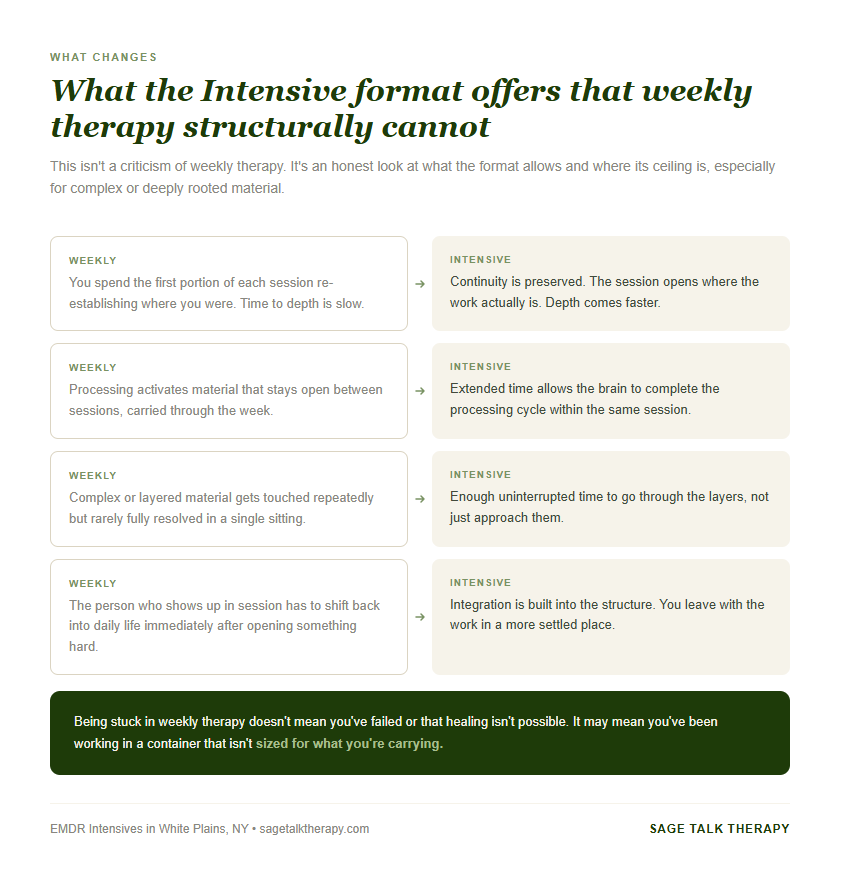
Every weekly session begins with reorientation. You spend the first portion arriving, catching up, re-establishing the thread from last week. By the time you reach depth, the hour is ending. You leave with material activated but not resolved, and carry it through a week of life before returning to pick it back up.
This start-stop rhythm is not a function of how good your therapist is or how hard you're working. It's the architecture of the format. And for material that requires sustained, uninterrupted processing to actually move, that architecture works against the healing.
What "Stuck" Actually Signals
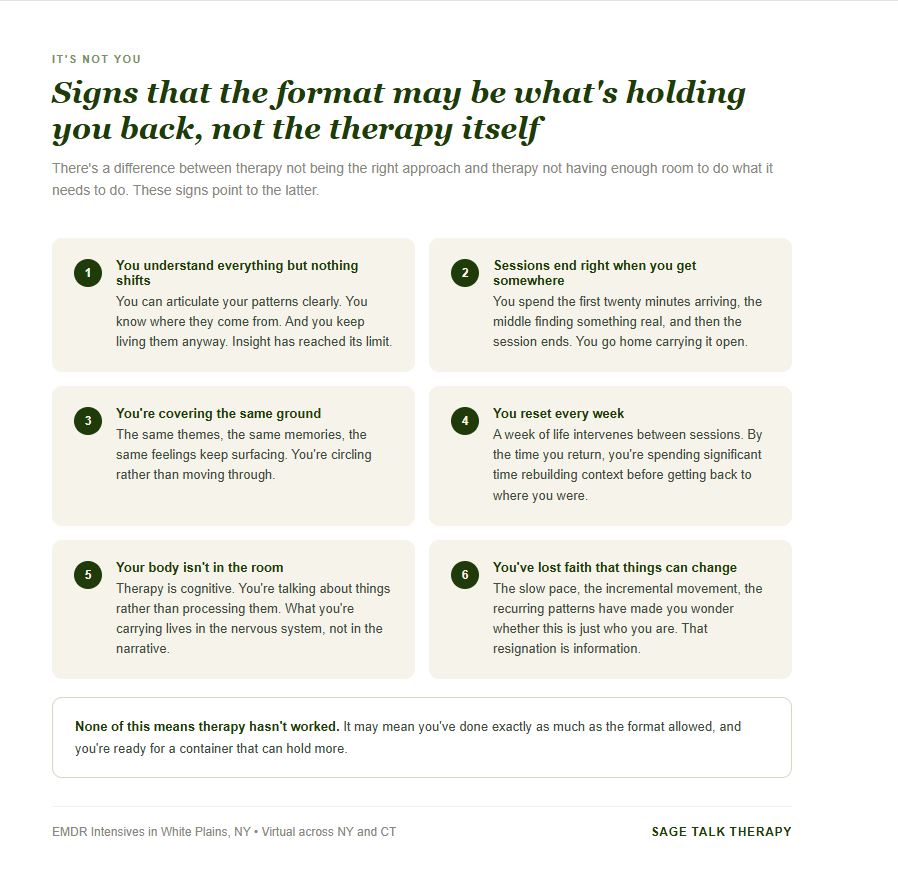
The experience of being stuck in weekly therapy often gets interpreted as a personal failure. You assume you're resistant, or not trying hard enough, or that the issue is simply too entrenched to change.
That interpretation is usually wrong.
More often, what stuck signals is that the work has reached the limit of what the current format can hold. You've gotten everything the talk-and-insight container can give you. The understanding is there. The readiness is there. What's missing is a container with enough uninterrupted time for the nervous system to actually complete the processing that insight has been pointing toward.
Why the Nervous System Needs More Than Fifty Minutes
The brain processes difficult experiences through a natural sequence. Activation, association, reprocessing, integration. In standard EMDR or even in well-facilitated talk therapy, that sequence begins. But fifty minutes is often not enough for it to complete.
What happens when a session ends mid-process is that the material stays activated. The neural pathways are open. The feelings are present. And then the session ends and you re-enter your life carrying all of that, waiting for next week's session to give it somewhere to go.
For people with complex trauma histories, this repeated activation without resolution can actually reinforce the stuck feeling rather than resolve it. The work is happening. It's just not finishing.
An EMDR Intensive gives the brain what the weekly format structurally cannot: continuous time to move through the full processing cycle, not just approach it. The depth that weekly sessions work toward over months can often be reached and moved through in concentrated, extended sessions that give the nervous system room to actually complete what it starts.
This Is Not About Leaving Your Therapist
One of the questions that comes up most often when I talk with people about Intensives is whether pursuing one means ending their current therapeutic relationship.
It doesn't have to.
Many people use an Intensive as an adjunct to ongoing weekly work. They bring a concentrated block of processing to address something specific, and then return to their regular therapist having moved something that had been stalled. In some cases, the Intensive unlocks momentum that makes the weekly work significantly more effective afterward.
In other cases, people who have been in weekly therapy for a long time use an Intensive as a way to make a meaningful shift after which they either continue with a different kind of support or find that the regular sessions are no longer necessary.
Both are valid. What matters is that you're not staying stuck out of loyalty to a format that isn't serving you anymore.
What Makes Someone Ready for an Intensive
Not everyone who feels stuck in weekly therapy is ready for an Intensive. A few things that typically indicate readiness:
You have genuine self-awareness and can articulate what you're working on, even if you can't get it to change. You've already done stabilization work and have some capacity to tolerate difficult material without being overwhelmed. You're ready to prioritize this at the level it requires, not just in terms of time, but in terms of showing up fully for concentrated work. You have some sense, even a vague one, of what the unresolved material is. It doesn't have to be precisely defined, but there should be something to work toward.
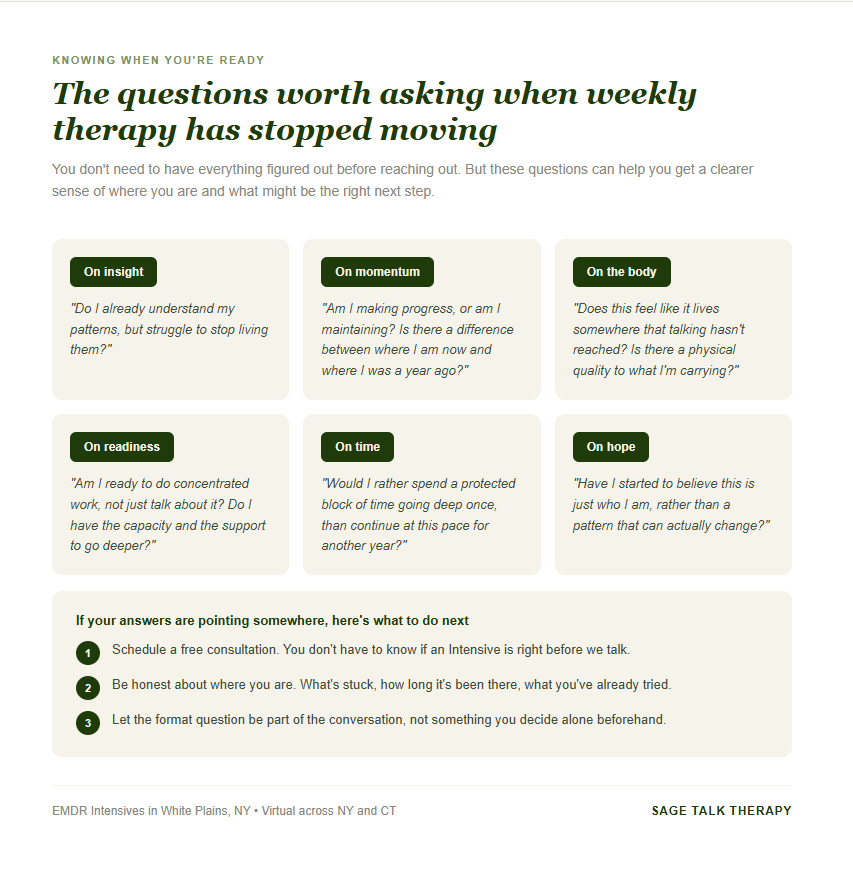
If you've been in weekly therapy for a while and feel stuck, the likelihood is that most of these are already true for you. The readiness is usually already there. What's been missing is the format.
What the Intensive Process Looks Like From Here
If you're coming from an existing therapy relationship and considering an Intensive, here's what the process looks like:
We begin with a free consultation where you tell me where you are, what you've already done, and what hasn't moved. I won't ask you to start over or re-explain your whole history. I'll want to understand the specific terrain of the stuck place and whether an Intensive is the right tool for it.
If it is, we build a treatment plan in a pre-intensive session. We identify what we're targeting, prepare your nervous system for the processing work, and establish clear goals for what the Intensive should accomplish.
The Intensive itself is extended EMDR processing with enough time to go deep and stay there, without the stop-and-start of the weekly format. The work builds on everything you've already done. It doesn't undo it.
Afterward, a post-intensive integration session closes the work carefully. You don't leave with things open. And whatever momentum the Intensive generates can carry forward, whether into continued work with me, a return to your existing therapist, or simply into your life.
Why This Matters More Than People Realize
There's a quiet harm in staying stuck in therapy for too long. Not because therapy is harmful, but because the experience of not changing when you're trying to change erodes the belief that change is possible. People start to adapt to the stuck place. They lower their expectations of what healing can look like. They begin to understand their patterns as permanent features of who they are rather than responses that can actually shift.
That erosion is worth taking seriously. And it's worth interrupting before it goes too far.
If any of this is familiar, the question is not whether you should keep trying. You clearly want to. The question is whether a different format might give what you're trying to do the room it needs.
Being Stuck Is Not Your Diagnosis
The narrative that we tell ourselves when we're not changing fast enough is usually some version of: this is just who I am. It's too deep. It's been there too long. Some things don't change.
That narrative isn't true. But it becomes more convincing the longer things stay the same.
You've been working. You've been showing up. You've been doing the part that required your effort. What if the missing piece wasn't more effort but more room?
That's what an Intensive offers. Not harder. Different. With enough space for the work to actually complete.
If this resonates
I'm Dadiana Lopez, a Licensed Clinical Social Worker and EMDR therapist in White Plains, NY. I work with adults in Westchester County and virtually across New York and Connecticut, including clients from White Plains, Scarsdale, Bronxville, Eastchester, Chappaqua, and Pleasantville.
Many of the people I work with in Intensives have been in therapy before and come specifically because they're ready for something that goes further. They're not starting from zero. They're looking for a format that matches where they already are.
I offer EMDR Intensives on a limited basis each month. If you've been stuck and you're ready to try a different approach, a free consultation is the place to start.

Dadiana Lopez
LCSW · Anxiety & Trauma Therapist · EMDR Specialist
Dadiana Lopez is a Licensed Clinical Social Worker and EMDR therapist based in White Plains, NY. She specializes in anxiety, trauma, PTSD, and the patterns that form in the wake of both — including people-pleasing, perfectionism, and burnout. She sees clients in person in Westchester and online throughout New York and Connecticut.
Seeing clients in-person in White Plains, NY and online throughout New York and Connecticut.