
What Trauma Brings Into a Relationship — And What Trauma-Informed Couples Therapy Does About It
Most couples who come to therapy describe a version of the same problem.
They have the same fights, over and over. The specific topic changes, but the dynamic stays the same. One person escalates, the other shuts down. Or one pursues and the other withdraws. Or they both go silent in ways that leave each person feeling profoundly alone.
They have tried to talk about it differently. They have read the books and learned the communication frameworks. They can articulate each other's attachment styles. And they still find themselves in the same place, looking at each other across the same impossible distance, wondering if something is simply broken.
Often, something specific is happening that the communication frameworks are not designed to address: trauma is in the room.
Not necessarily trauma that either person can point to clearly. Not always a single event or a diagnosable history. But the accumulated experience of what each person learned about safety, love, threat, and connection in their earliest relationships — those lessons are present in every interaction. And when both partners carry those histories into the same small space, the results are often exactly what couples describe: the same fights, the same distance, the same sense of trying hard and changing nothing.
This post is about understanding what trauma actually brings into a relationship, and what a genuinely different kind of couples therapy does to address it.
Why most couples therapy doesn't reach it
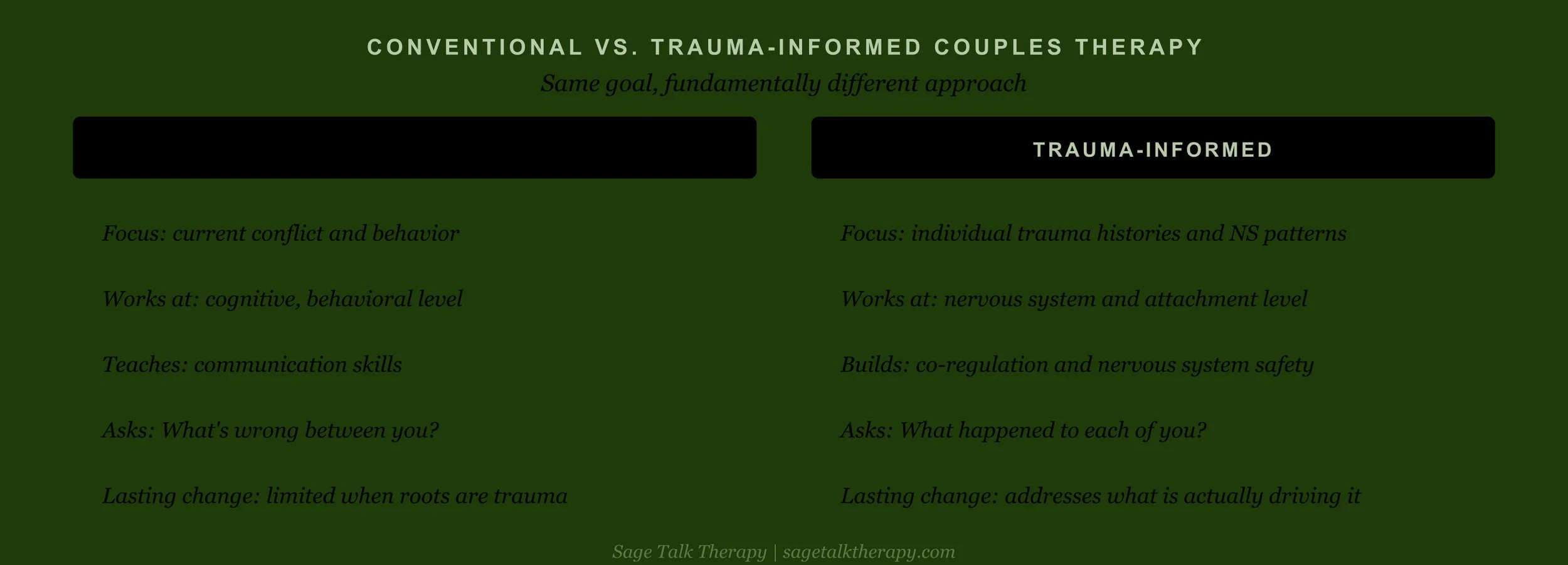
Conventional couples therapy tends to work at the level of behavior and communication. It teaches skills: how to express a need without blame, how to listen without defensiveness, how to repair after conflict. These skills are real and genuinely useful.
The limitation is that they work at the cognitive level — at the level of conscious choice and learned behavior. And much of what drives the recurring dynamics in relationships with trauma histories is not operating at the level of conscious choice. It is operating at the nervous system level, in automatic threat responses that fire before deliberate thought, in attachment patterns encoded before language.
Trauma-informed couples therapy asks "What happened to you?" rather than "What's wrong with you?" It understands that relationship problems often make sense when viewed through the lens of past experiences, and that our earliest relationships create templates for how we expect to be treated and how we treat others.
When a person has experienced betrayal, abandonment, unpredictability, or emotional unavailability in early relationships, those experiences don't stay in the past. They shape what the nervous system expects in intimate relationship — and the nervous system updates those expectations not through reasoning but through repeated experience. A communication script doesn't update the expectation. A nervous system-level experience of safety in relationship can.
Many couples who have tried therapy before describe the same pattern: sessions that felt like referee meetings, leaving one partner feeling labeled as the problem and the other feeling guilty but not actually closer. That outcome tends to happen when the approach treats the symptom without the root — addressing how conflict is happening rather than what is driving it.
What trauma actually brings into a relationship
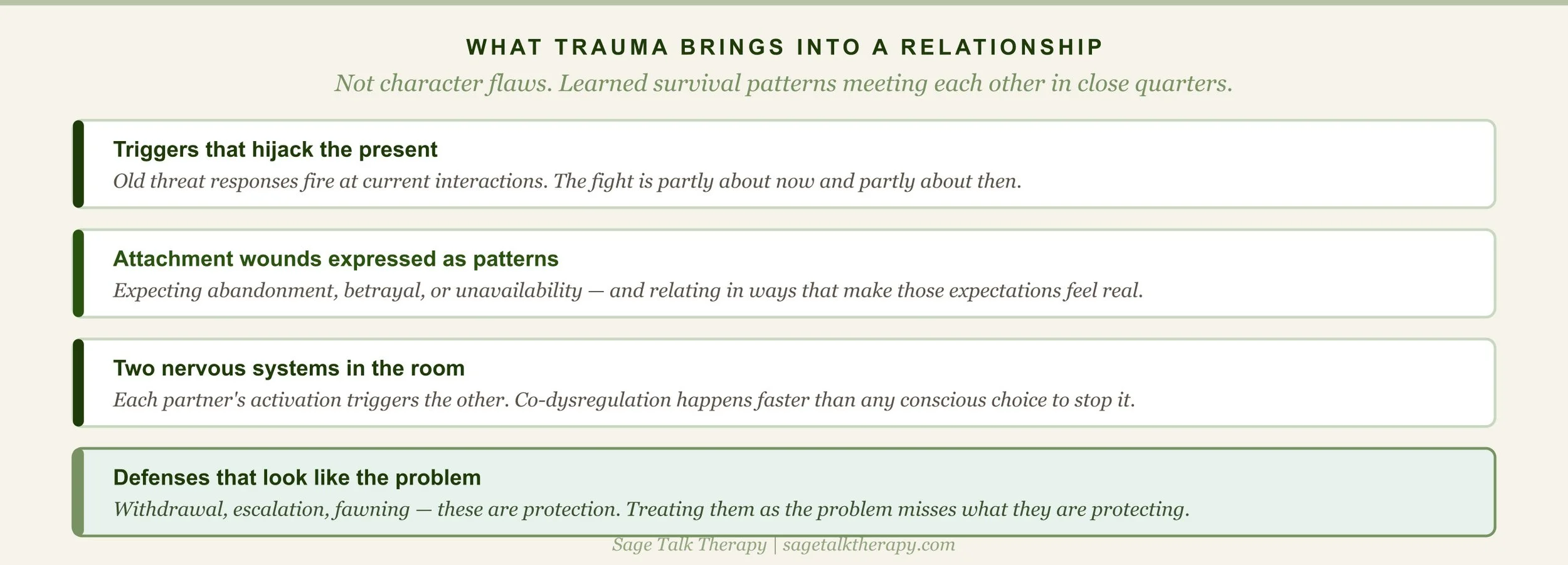
Here is what trauma histories tend to bring into intimate relationships. These are not character flaws in either partner. They are learned survival patterns meeting each other in close quarters.
1. Triggers that hijack the present
The most consistent feature of trauma in relationship is triggering: the moment when a current interaction activates a historical threat response, and the person is suddenly responding not just to what is happening now but to everything the current situation resembles from the past.
A tone of voice. A particular facial expression. The experience of being criticized, or ignored, or not believed, or overridden. These can activate the nervous system's full threat response, and when that happens the prefrontal cortex partially goes offline. The person is no longer fully in the present conversation. They are somewhere older and more dangerous, responding with the intensity that belonged to that context.
From the outside, this looks like overreaction. The partner on the receiving end of a triggered response often experiences it as disproportionate to the current situation, because it is. The response belongs partly to the past. Understanding this doesn't make the intensity easier to be on the receiving end of, but it fundamentally changes what it means. It is not an attack on the current partner. It is the nervous system trying to manage a threat that it has learned to expect.
2. Attachment wounds expressed as relationship patterns
Trauma can contribute to attachment wounds in relationships, where past experiences shaped beliefs about safety and connection. Trust requires emotional safety, and trauma can make vulnerability feel risky even in relationships that are genuinely safe.
What we learned in our first close relationships — about whether comfort is available, whether needs will be met, whether love is reliable or conditional — becomes the template for adult intimate relationship. Someone who learned that closeness is dangerous tends to manage closeness carefully, with distance, control, or preemptive withdrawal. Someone who learned that abandonment is always possible tends to manage anxiety about connection through pursuit, vigilance, or escalation.
These patterns are not random. They are the nervous system enacting the strategy that worked, or at least kept the person alive and relatively safe, in earlier relationships. In adult partnership, when two people bring their attachment strategies into contact with each other, they often activate exactly the fears each person is most organized to expect.
The pursuer's intensity confirms the withdrawer's expectation that closeness means being overwhelmed. The withdrawer's distance confirms the pursuer's expectation that love is unreliable. Each person's coping strategy becomes the evidence that makes the other's fear feel justified. The cycle sustains itself not because either person is wrong or bad but because both are responding from their history in ways that make the other's history feel real.
3. Two nervous systems in the room
Without understanding trauma responses, couples may misinterpret each other's behaviors. These responses often reflect the nervous system attempting to maintain emotional safety based on past experiences, and trauma-informed therapy helps couples reframe these behaviors with greater understanding, moving from criticism toward compassion.
A relationship is not just two people. It is two nervous systems in constant interaction, each one reading the other for signals of safety or threat, each one shaped by different histories that produce different automatic responses.
When one partner becomes dysregulated, it activates the other's nervous system. The escalation of one person's threat response triggers a threat response in the other. Within seconds, both people are responding not from their most resourced, connected selves but from their most protective ones.
This is co-dysregulation: the automatic transmission of activated nervous system states between people in close relationship. It is the opposite of co-regulation, which is the settling effect that two well-resourced, attuned people can have on each other's nervous systems. Most couples in conflict are doing the former without understanding it. Trauma-informed couples therapy works to build the capacity for the latter.
4. Defenses that look like the problem
The behaviors that bring most couples to therapy — the withdrawal, the criticism, the stonewalling, the explosiveness, the chronic people-pleasing — are not the problem. They are the defense. They are the nervous system's attempt to manage a threat, to protect an attachment, to maintain some kind of safety in a situation that the body is reading as dangerous.
The partner who is chronically accommodating and never expresses needs is not simply too easygoing. They have likely learned, somewhere, that having needs in relationship is dangerous. The partner who withdraws at the first sign of conflict is not simply avoidant as a personality. They have learned that conflict escalates, that things don't resolve, and that getting out is safer than staying in. The partner who escalates is not simply volatile. They have learned that being loud is the only way to be heard.
Treating the defense as the problem, which is what much conventional couples therapy does, asks people to stop doing the thing that their nervous system has concluded is necessary for survival. That is very difficult to sustain. Understanding what the defense is protecting, and building the internal and relational conditions where the protection is no longer needed, produces more durable change.
What conventional couples therapy misses
The common couples therapy experience is focused on the interaction: how you communicate, how you fight, how you repair. The therapist observes the dynamic, reflects it back, and helps the couple develop different patterns.
This approach can produce real change when the dynamics are primarily behavioral. When the drives underneath the behavior are trauma-based nervous system responses, behavior modification tends to produce temporary improvement followed by regression. The couple does well for a while. They use the tools. Then something activates the old patterns and the tools disappear, because the tools live in the prefrontal cortex and the trigger knocked the prefrontal cortex offline.
Unlike traditional couples therapy, which often focuses on present issues and conflicts, trauma-informed therapy delves deeper into the individual trauma histories of each partner, addressing how past trauma impacts current relationship dynamics. This therapy integrates trauma theory and attachment theory to explore the personal histories and coping mechanisms of both partners.
What is often missing in conventional couples work is the individual trauma processing dimension. Each partner's history needs to be understood and addressed at the nervous system level — not just made intellectually visible but actually worked through — in order for the relational patterns to genuinely shift. Couples therapy alone, without some individual processing component, can create a better understanding of the dynamic without producing the nervous system-level change that would allow the dynamic to be different.
What trauma-informed couples therapy actually does
Trauma-informed couples therapy works at several levels simultaneously, and it looks different from conventional couples therapy in specific ways.
It starts with psychoeducation
Before working on the dynamic, both partners need to understand what is driving it. Learning about the nervous system, about attachment, about what triggers are and what they mean, fundamentally changes how each person interprets the other's behavior. The same action that felt like attack or abandonment starts to be understood as a threat response. This reframe, from "my partner is doing this to me" to "my partner's nervous system is trying to manage a threat," is not just intellectual. Over time it changes the emotional experience of the conflict itself.
It addresses both individuals and the system
A trauma-informed approach recognizes that the relationship dynamic is not located in either partner alone. It is a system, shaped by both people's histories, expressing itself through their interactions. Effective work addresses each person's individual history while also understanding and addressing the patterns that emerge between them.
It prioritizes nervous system regulation before processing
Just as individual trauma therapy requires stabilization before processing, couples trauma work requires the establishment of enough safety and regulation capacity before going into more activating material. This means building co-regulation skills, developing the capacity to recognize when either partner is outside their window of tolerance, and having tools for settling before the conversation can continue productively.
It slows the interaction down
Much of what happens in traumatic relationship conflict happens very fast — the trigger fires, the threat response activates, the defense deploys, and the cycle is in motion before either person has processed what happened. Trauma-informed couples therapy works to slow this sequence down enough that choice becomes available. Not the elimination of triggers, but the creation of enough space between trigger and response that the thinking brain can come back online.
It makes the invisible visible
Both partners develop the capacity to track what is happening in their own nervous systems, to recognize when they are activated, and to communicate this in ways that the other person can respond to rather than escalate against. "I'm getting activated right now" is a fundamentally different message than the behavior that activation otherwise produces.
Reduced shame is one of the most consistent outcomes: partners report feeling less fundamentally broken, defective, or unlovable in the context of the relationship. Trust is rebuilt incrementally through consistent behavior, and partners begin noticing and naming evidence of that trust in ways they couldn't access before.
What this looks like over time
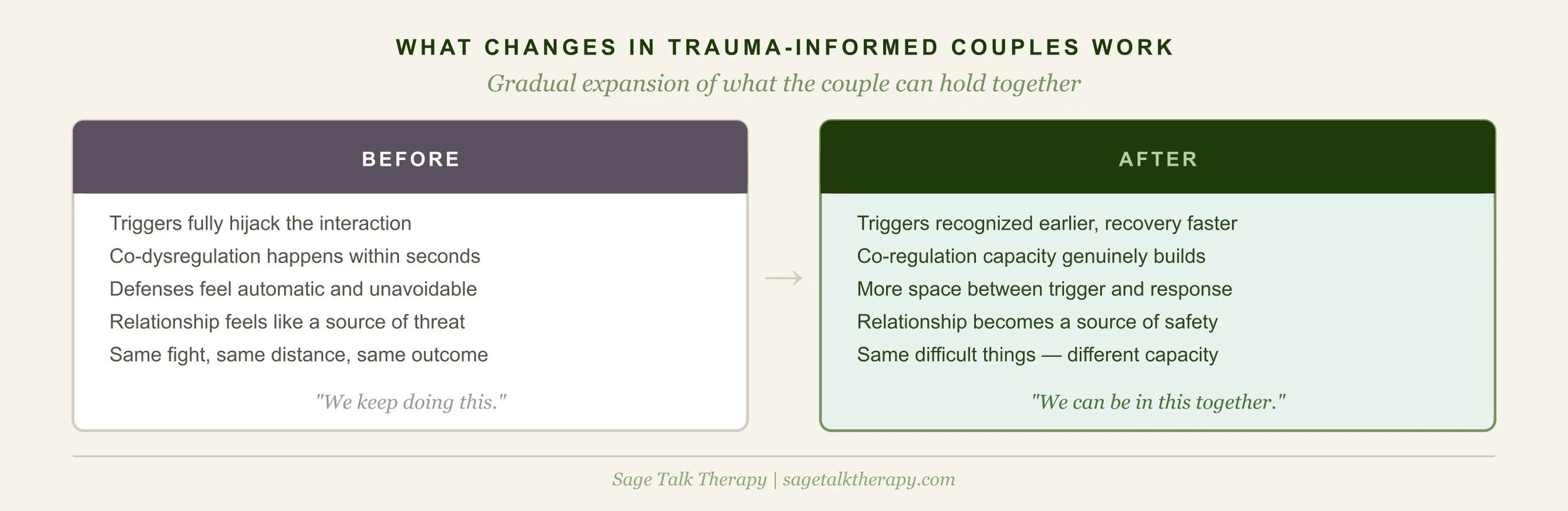
Progress in trauma-informed couples work is not linear and it is not fast. It tends to look like gradual expansion in the couple's capacity to be together in difficulty without the difficulty becoming catastrophic.
The same trigger fires, but the recovery is faster. The same dynamic starts to emerge, but one partner recognizes it earlier and can name it rather than enact it. The space between trigger and response widens, not because the trigger disappears but because the nervous system has more capacity to hold the activation without being fully hijacked.
Gradually, the relationship itself becomes a regulatory resource rather than a source of threat. The partners develop genuine co-regulation capacity — the ability to help each other settle rather than activate. This is not skill-based in the way that communication techniques are skill-based. It is nervous-system-level learning that comes from accumulated experience of the relationship being safe enough, often enough.
For couples where intergenerational patterns are significant, this work also has implications for the next generation. The nervous system patterns modeled in the parental relationship shape children's nervous systems. Two parents building genuine co-regulation capacity are providing their children with something that cannot be taught directly: a lived experience of what safety in relationship feels like.
A Note on When Individual and Couples Work Happen Together
One question that comes up frequently: should both partners do individual therapy alongside couples therapy?
The honest answer is that it depends and varies by couple. What is generally true is that individual trauma processing work and couples work are complementary rather than competing. When each partner has space to work on their own history, the load on the couples therapy changes. The couples sessions can focus on the relational system rather than being pulled primarily by one partner's individual processing needs.
In practice, I sometimes see couples together when one or both partners are also doing individual work, and sometimes work with individual clients whose presenting concerns are significantly relational. The approach is collaborative and tailored to what each specific couple needs at a given stage of their work.
if this resonates
If you and your partner have been doing the same dance for a long time and the communication tools have helped but haven't changed the pattern underneath, that is worth taking seriously. The pattern has roots. And roots can be reached.
I offer trauma-informed couples therapy in White Plains, NY and online throughout New York and Connecticut.

Dadiana Lopez
LCSW · Anxiety & Trauma Therapist · EMDR Specialist
Dadiana Lopez is a Licensed Clinical Social Worker and EMDR therapist based in White Plains, NY. She specializes in anxiety, trauma, PTSD, and the patterns that form in the wake of both — including people-pleasing, perfectionism, and burnout. She sees clients in person in Westchester and online throughout New York and Connecticut.
Seeing clients in-person in White Plains, NY and online throughout New York and Connecticut.