
Perfectionism in Parenting: When the Pressure to Be a Good Parent Becomes Its Own Wound
Parenting brings a particular kind of pressure that is unlike anything else.
Because it is the highest-stakes thing most people will ever do. Because the person at the receiving end of your choices cannot yet advocate for themselves. Because you are simultaneously trying to give your child what you needed and what you didn't have, to heal what was done to you while not replicating it, to be present and engaged and attuned and patient every single day, often while running on very little sleep, in the context of everything else your life contains.
For parents who already carry perfectionism, this territory is treacherous.
The same pattern that has been running in your professional life, your relationships, your sense of self, now has a new object: your child. And the stakes feel so much higher than getting a project right or keeping everyone at work happy that the perfectionism tends to intensify rather than soften. The fear of getting it wrong — of damaging your child, of repeating what was done to you, of failing the person who depends on you most — is enormous.
This post is about that particular form of perfectionism. Where it comes from, what it looks like in practice, what it costs you and your child, and what addressing it actually requires.
Where parenting perfectionism comes from
Perfectionism is not about high standards. It is about the fear of what happens when those standards aren't met. In parenting, that fear tends to have a specific shape and a specific source.
For many parents, parenting perfectionism is driven by one or both of the following:
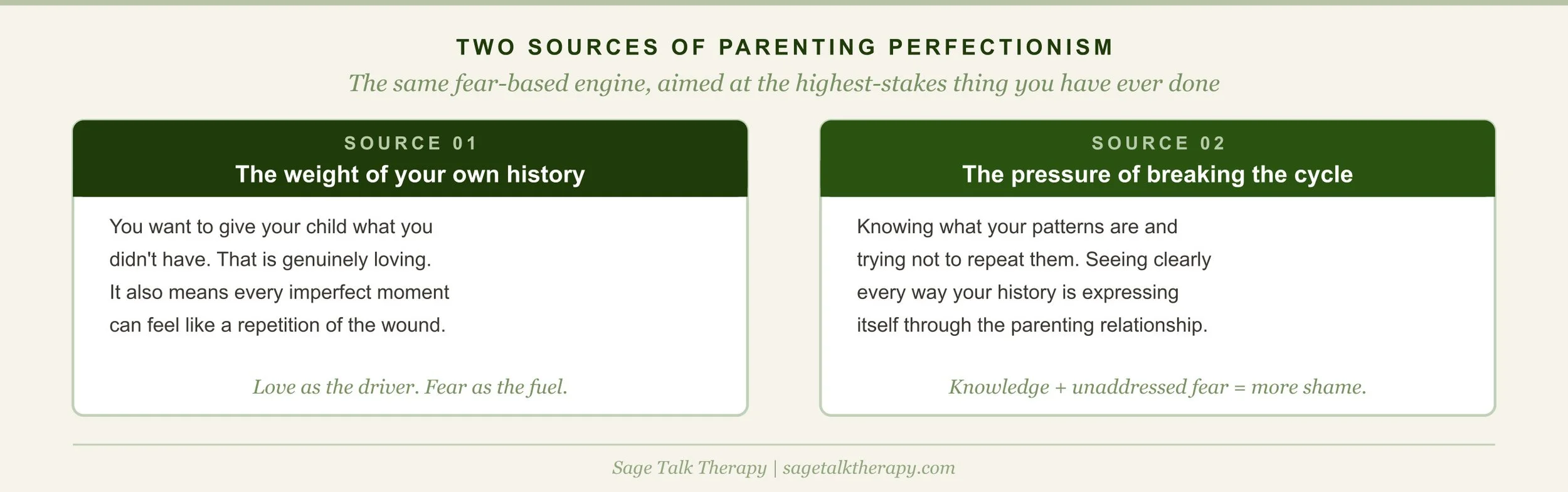
1. The weight of your own history
If you grew up in an environment where love felt conditional, where emotional attunement was inconsistent, where difficult experiences were dismissed or minimized, or where there was genuine neglect or harm, the drive to parent differently is real and legitimate. You want to give your child what you didn't have. That desire is one of the most loving things a person can bring to parenthood.
The problem is that it can also generate an impossible standard. Because now every moment of less-than-perfect attunement feels like a repetition of the wound. Every time you are tired and short-tempered, every time you miss what your child needed, every time you realize you've responded from your own activation rather than their actual need, it doesn't just feel like a bad moment. It feels like evidence that you are doing to your child what was done to you.
That is an enormous amount of weight to carry into ordinary parenting difficulty.
2. The pressure of breaking the cycle.
For parents who are consciously working to change intergenerational patterns — who have done enough of their own work to understand what they inherited and are actively trying not to pass it on — the pressure can be even more acute. Every mistake feels like the cycle continuing. Every rupture with your child feels like a failure of the entire project.
This is one of the most painful aspects of conscious parenting: knowing enough to recognize every way you are falling short. The parent who has no framework can dismiss their behavior. The parent who has done significant work can see exactly how their unprocessed material is expressing itself in the relationship with their child, and the shame that comes with that visibility is significant.
What it looks like in practice
Parenting perfectionism doesn't always look like high standards for the child's achievement. More often it looks like the following.
Hypervigilance about your own responses: Constant monitoring of how you're showing up. Am I being patient enough? Am I too distracted? Did I handle that correctly? Did I repair adequately? The internal commentary runs continuously, evaluating every interaction against an ideal that no parent in the history of parenting has ever consistently achieved.
Disproportionate distress after ordinary ruptures: You snap at your child. You are preoccupied and miss something they needed. You have a hard day and your patience is gone by dinner. Every parent does these things. For the perfectionist parent, the aftermath is not just regret and repair. It is a cascade of shame that feels much larger than the event warrants, because the event is being measured against the standard of never doing it.
Over-correcting and over-repairing: The shame after a rupture drives over-the-top repair. The apology that goes on too long. The compensation that is more about managing your own distress than your child actually needs. The child learns, without words, that when you have a hard moment they need to manage your feelings about it.
The endless research and optimization: Reading every parenting book. Listening to every podcast. Being fluent in attachment theory while still feeling like you are failing. Knowing what secure attachment looks like while struggling to embody it consistently. The information accumulation is the anxiety-management strategy, the belief that if you know enough you can prevent every mistake.
Difficulty being a human parent rather than a perfect one: Modeling mistakes, frustration, and repair is one of the most genuinely valuable things a parent can do. Children who see their parents struggle and recover learn that struggle is survivable. But for the perfectionist parent, every mistake feels like damage rather than modeling. The opportunity to show your child how humans handle difficulty is obscured by the shame of not having handled it perfectly.
Putting the child's emotional state above your own needs constantly: This is one of the subtler forms of perfectionist parenting and one of the most common. The parent who never prioritizes their own rest or needs because doing so feels like inadequate attunement. Who cannot tolerate their child's distress and rushes to soothe it rather than sitting alongside it. Whose own nervous system becomes dysregulated by the child's distress in ways that make it hard to be a genuinely regulating presence.
What it costs
The costs of parenting perfectionism flow in both directions.
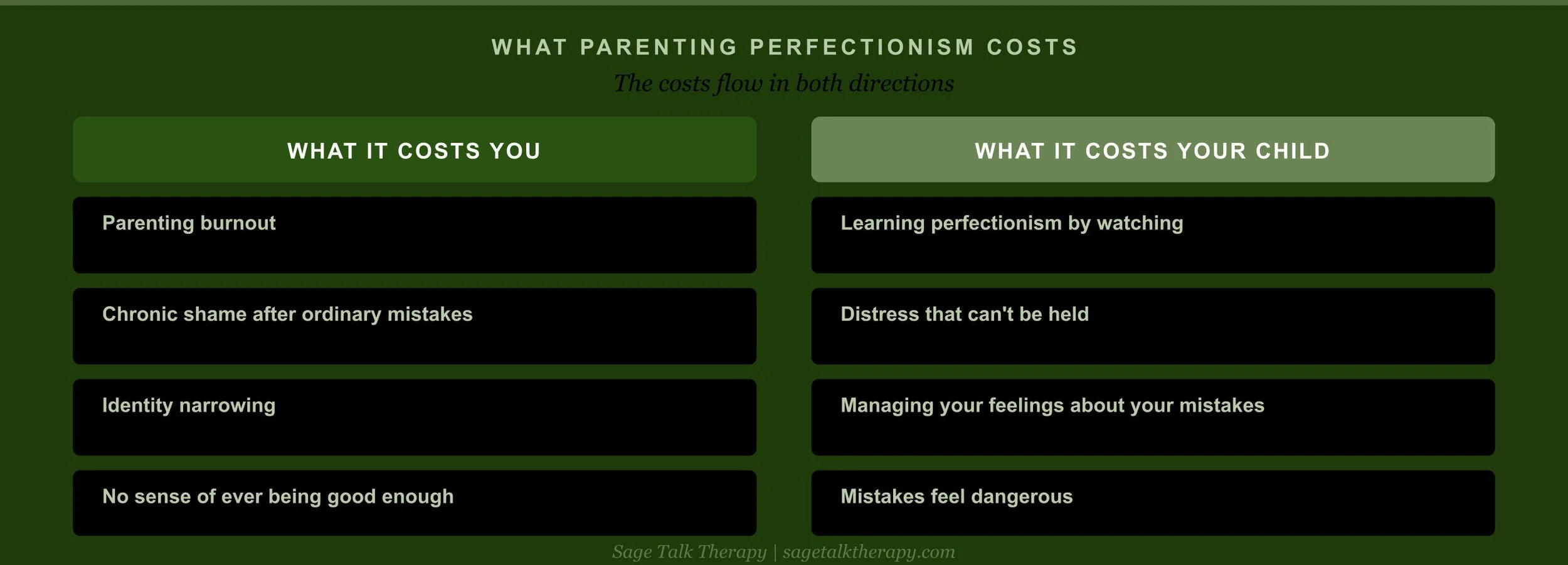
What it costs you
Perfectionist parents are at significant risk for parenting burnout: the particular exhaustion that comes from giving without limit to something that also has no limit. The constant monitoring and self-evaluation is exhausting. The shame after ordinary failures is depleting. And the inability to ever feel like you are doing it well enough means there is no real sense of accomplishment, only the relentless anxiety of not yet having gotten it right.
There is also the cost to your own identity. Parents who have organized their entire parenting self around not repeating their history sometimes find that their sense of themselves outside of parenting has narrowed. The vigilance required to parent differently than you were parented is consuming, and the result is often a person who has very little left over for themselves.
What it costs your child
Researchers have determined there is a genetic component to perfectionism, reinforced by behavior learned from perfectionistic parents. A greater influence comes from environmental factors. Children learn about perfectionism not primarily from explicit messages but from what they absorb about what is acceptable in their environment.
A child who lives with a parent in a constant state of vigilance about their own performance learns that ordinary failure is dangerous. A child who witnesses a parent's shame cascade after mistakes learns that mistakes produce shame. A child whose parent cannot tolerate their distress may learn that their distress is too much to express. Parents can help their child lessen internal high expectations by engaging in their own process of dismantling environmental factors.
The most powerful thing a perfectionist parent can do for their child is to address their own perfectionism. Not just to parent better, but because the child is watching how you relate to yourself — and what they see becomes part of how they relate to themselves.
wHY kNOWING bETTER dOESN’T fIX iT
Here is one of the most painful aspects of parenting perfectionism: it tends to be most intense in parents who know the most.
If you have done significant personal work, read widely about attachment and child development, and have a sophisticated understanding of what children need, you are fully equipped to see every way your parenting falls short of those needs. The knowledge, rather than producing confidence, produces a more refined instrument for self-criticism.
This is the same dynamic as perfectionism everywhere else: understanding what excellent looks like raises the bar for what is unacceptable. And because the fear underneath the perfectionism has not been addressed, the knowledge just gives the fear more specific ammunition.
The parent who doesn't know about attachment theory can dismiss a moment of mis-attunement. The parent who knows exactly what secure attachment requires and why it matters cannot. They see the gap and experience it as evidence of inadequacy rather than as ordinary human imperfection.
This is why information alone does not resolve parenting perfectionism. More parenting books are not the answer. Better frameworks are not the answer. The answer requires working at the level where the fear actually lives.
What actually helps
Addressing parenting perfectionism requires working at the same level as all perfectionism: the fear underneath the standard, not the standard itself.
The Internal Family Systems framework is particularly useful here. There is a part doing the parenting perfectly, working very hard to give this child what you didn't have. And there is usually a younger part underneath it, carrying the original wound: the child who was criticized, dismissed, or not seen clearly, who learned that falling short had real costs. The perfectionist parenting part is often protecting that younger part from re-experiencing the original injury through your own child's disappointment or pain.
Working with that dynamic, rather than simply trying to lower the parenting standard, tends to produce more durable change. The perfectionism has less to drive it when the fear it was organized around is addressed directly.
EMDR is useful for the specific experiences from your own history that are being activated in parenting contexts. The moments when your child's distress mirrors your own childhood distress. The particular situations that bring up your own unprocessed material. Processing those experiences directly, rather than managing their effects in the parenting relationship, changes the equation.
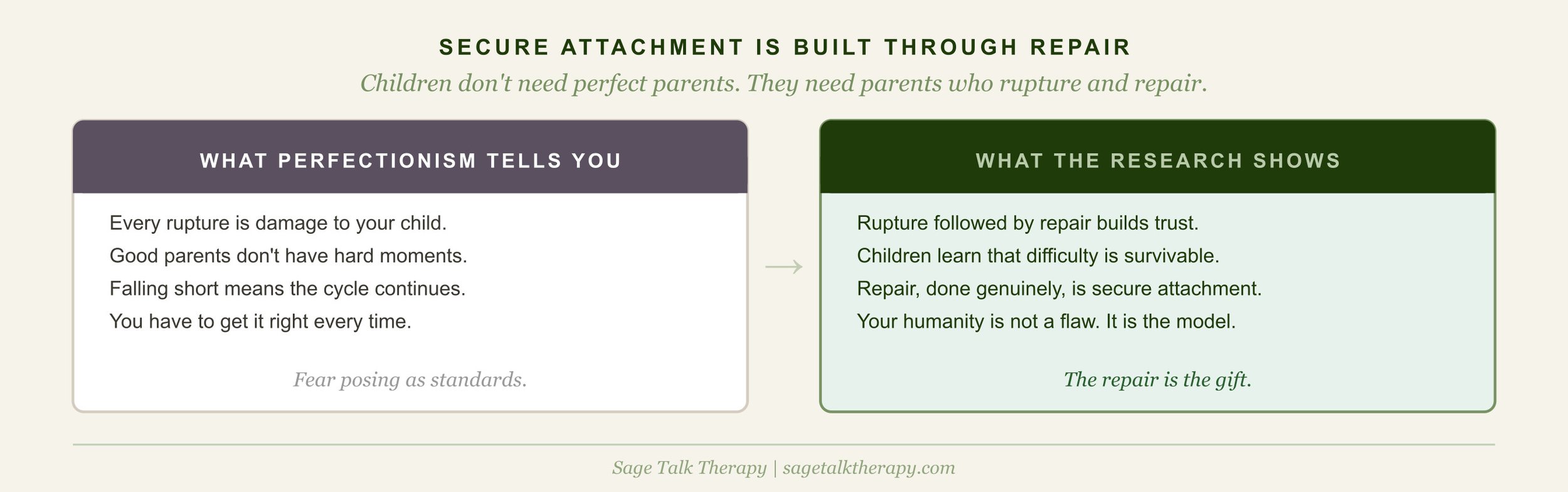
The repair relationship matters too. One of the genuinely important shifts for perfectionist parents is learning to experience repair as sufficient rather than rupture as catastrophic. The research on what children need does not show that children need perfect parents. It shows that they need parents who can rupture and repair. Breaking the cycle of perfectionism is a gift you give both yourself and your child. The repair, done consistently and genuinely, is itself a form of secure attachment. Not the absence of imperfection — the response to it.
A wORD tO tHE pARENT rEADING tHIS AT 11pm
If you are reading this late at night after a hard parenting day, cataloguing everything you got wrong, I want to say something directly.
Your child does not need a perfect parent. They need a parent who is present, who repairs, who models how to be human. They need to see that mistakes are survivable and that love is not conditional on performance.
The fact that you are this invested in getting it right is evidence of how much you care. That is real and it matters. But the investment can also become its own problem when it is organized around fear rather than love. When the drive to be a good parent is running on the same engine as every other perfectionist pattern in your life, the child experiences not a relaxed, present, loving parent, but a parent under enormous internal pressure.
Addressing that pressure is not self-indulgence. It is possibly the most direct thing you can do for your child.
if this resonates
I work with parents in Westchester, NY and online throughout New York and Connecticut who are navigating perfectionism, anxiety, and their own histories alongside the enormous work of raising a child. If what you have read here sounds familiar, I would welcome the conversation.
Learn more about Perfectionism Therapy.

Dadiana Lopez
LCSW · Anxiety & Trauma Therapist · EMDR Specialist
Dadiana Lopez is a Licensed Clinical Social Worker and EMDR therapist based in White Plains, NY. She specializes in anxiety, trauma, PTSD, and the patterns that form in the wake of both — including people-pleasing, perfectionism, and burnout. She sees clients in person in Westchester and online throughout New York and Connecticut.
Seeing clients in-person in White Plains, NY and online throughout New York and Connecticut.