
Is an EMDR Intensive Right for You? What to Know Before You Decide
If you have been reading about EMDR Intensives, something in you is already considering whether this might be the right next step. Maybe weekly therapy has felt too slow. Maybe your schedule makes consistent weekly appointments genuinely difficult. Maybe you have a specific experience you want to work through and the idea of getting it done in days rather than months feels like exactly what you need.
All of those are legitimate reasons to explore an intensive. And before you make the decision, there are things worth knowing that most practice websites do not tell you clearly.
This post is written for the person who is genuinely trying to figure out whether an intensive is the right choice for them right now. Not a sales pitch. A guide.
What an EMDR Intensive actually involves
An EMDR Intensive is not simply a longer version of a regular EMDR session. It is a different clinical structure entirely.
At Sage Talk Therapy, an intensive consists of extended processing blocks preceded by a preparation session. The preparation phase is not optional — it is what makes the intensive safe and productive. It is where treatment targets are identified, stabilization resources are built or strengthened, and readiness for extended processing is honestly assessed.
During the intensive itself, the extended time allows processing to move through natural completion points rather than stopping at an arbitrary fifty-minute boundary. What would take multiple weeks of weekly sessions to move through can often be addressed in a single intensive block.
After the intensive, the days immediately following typically require lighter scheduling and genuine rest. Integration is happening at the nervous system level, and honoring that with a quieter re-entry makes a meaningful difference in how thoroughly the work consolidates.
The total investment — preparation, intensive days, optional follow-up — represents months of weekly therapy work compressed into a much shorter calendar period. A week of intensive work gets about as much done as a year of hour-per-week therapy, with clients experiencing substantial relief and improved functioning that lasts.
Who tends to benefit most
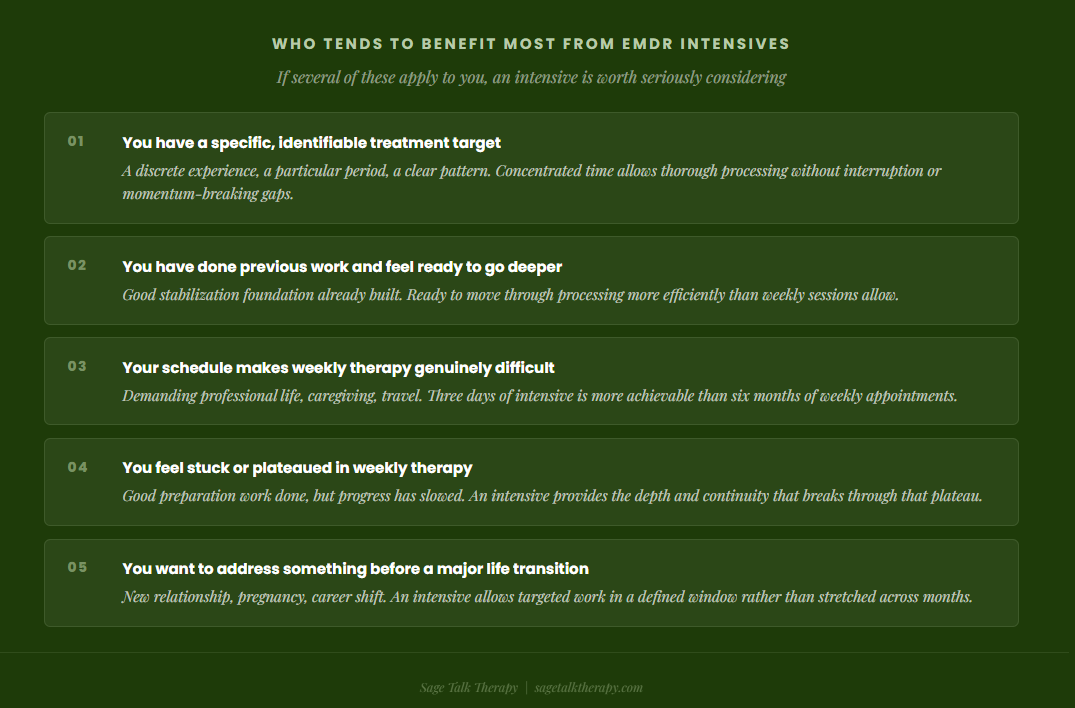
Certain situations tend to be particularly well-suited to the intensive format. If several of these apply to you, an intensive is likely worth seriously considering.
You have a specific, identifiable treatment target.
A discrete traumatic experience — an accident, an assault, a medical trauma, a specific loss, a particular period of your life — is one of the strongest indicators for the intensive format. The concentrated time allows thorough processing of that specific material without interruption or the momentum-breaking gap of a week between sessions. If you have experienced a single traumatic event, you may find EMDR intensives particularly effective. The concentrated format allows for thorough processing of specific memories without the start-stop nature of weekly sessions.
You have done previous trauma work and feel ready to go deeper.
If you have a foundation of stabilization, have worked with a therapist and built good resources, and feel like you have the preparation but want the depth and efficiency of extended processing, an intensive is often the right next step. The most common profile for intensive clients is someone who has done meaningful previous work and is ready to move through processing more efficiently.
Your schedule makes weekly therapy genuinely difficult.
Demanding professional life, caregiving responsibilities, business travel, geographical distance — for people whose lives make consistent weekly appointments hard to sustain, the intensive format concentrates the work into a defined period that fits real-world constraints. Three days of intensive processing may be more achievable than six months of weekly appointments.
You feel stuck or plateaued in weekly therapy.
If you have been doing weekly EMDR or trauma therapy, have built good stabilization, and feel like the work is moving slowly or not moving at all, an intensive can provide the depth and continuity that breaks through that plateau. The extended processing time allows the work to go places it simply cannot go in 50-minute increments.
You want to address something before a major life transition.
Upcoming changes — a new relationship, a pregnancy, a career shift, a return to a difficult environment — sometimes create genuine urgency around processing specific material. An intensive allows targeted work to be done in a defined window rather than stretched across months.
What the real contraindications are
This section matters. A therapist who is only trying to sell you on an intensive will not tell you this clearly. Here it is:
Active crisis or significant current instability: If your life is currently in significant upheaval — acute mental health crisis, active suicidality, major relationship or situational crisis — the nervous system needs stabilization before extended processing. An intensive during active crisis can intensify activation rather than resolve it. The intensive format works best when the client has adequate daily functioning and is using therapy primarily for targeted processing work, not crisis management.
Insufficient stabilization: Extended processing requires a nervous system that can hold activation for sustained periods without being overwhelmed. If your window of tolerance is currently very narrow, if you have significant dissociation, or if you do not yet have reliable grounding and stabilization tools, the preparation phase needs more time before an intensive is appropriate. This is not a permanent disqualification. It is a question of timing.
Significant unaddressed dissociation: Dissociation requires careful assessment and specific preparation before EMDR processing of any kind. In an intensive format, where processing runs for extended periods, adequate preparation around dissociation is especially important. This does not mean intensive EMDR is never appropriate for people with dissociative patterns — it means the preparation needs to account for it specifically.
No previous exposure to EMDR or trauma-focused work: While it is not impossible to do an intensive as a first exposure to EMDR, it is generally not the most appropriate starting point. The preparation phase is more thorough, the stabilization work takes longer, and the client has less familiarity with what processing feels like and how to work with it. For most people coming to EMDR for the first time, beginning with weekly sessions and transitioning to an intensive once the foundation is established is the better path.
A history that makes pacing especially important: For some trauma histories — particularly complex developmental trauma with significant relational wounding, early attachment disruption, or histories of severe or repeated abuse — the careful, gradual pacing of weekly therapy may serve the client better than intensive processing at this stage. This is assessed individually and is not a categorical contraindication, but it is something a responsible therapist will weigh honestly with you.
The questions worth asking yourself honestly
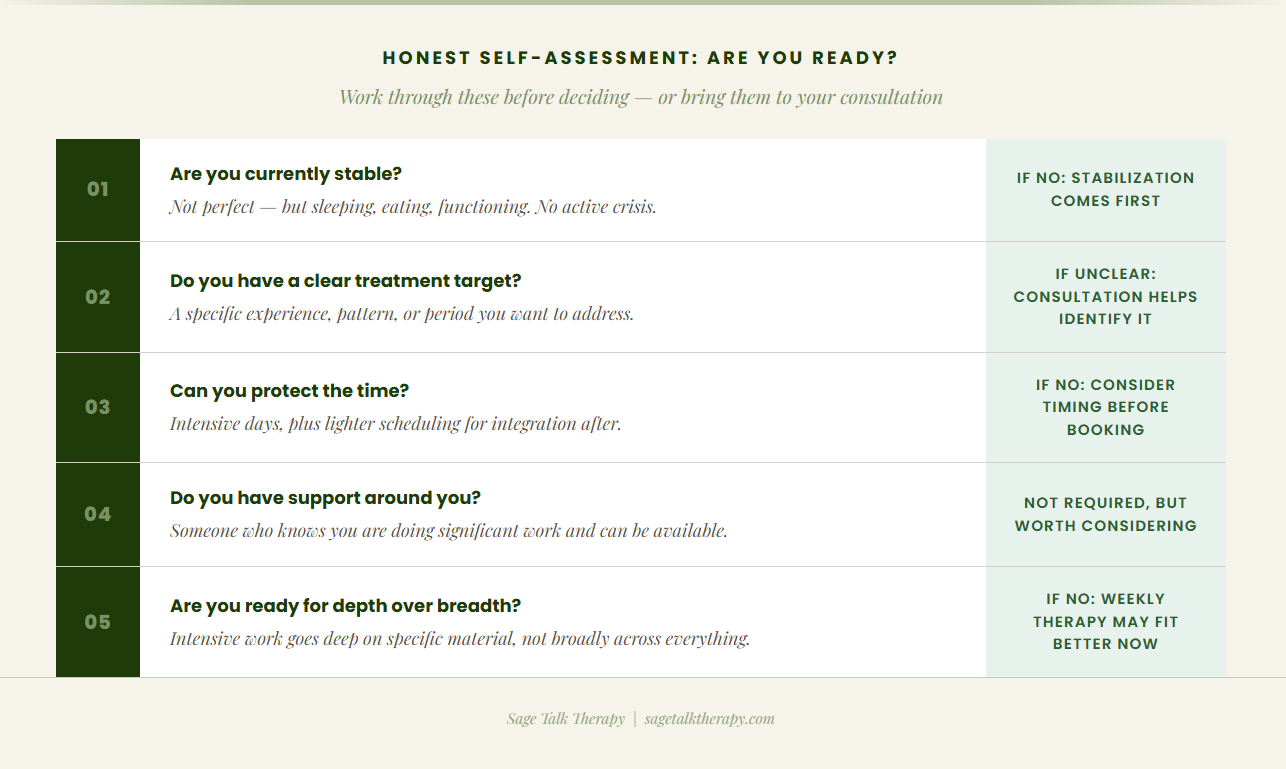
These are the questions I work through with prospective intensive clients during a consultation. You can use them to begin your own honest assessment.
Are you currently stable?
Not perfect — but stable enough. Are you sleeping, eating, maintaining basic daily functioning? Are you without active crisis? If yes, continue. If no, stabilization comes first.
Do you have a clear sense of what you want to work on?
An intensive works best with a defined target. This does not need to be a single memory — it can be a pattern, a relationship, a period of your life. But the more specifically you can identify what you want to address, the more efficiently the intensive can be structured.
Can you genuinely protect the time?
The days of the intensive require your full presence and energy. The days immediately following need lighter scheduling. Can your life accommodate that? If you are planning to return to a demanding work situation the day after an intensive, that is worth factoring into the timing.
Do you have adequate support around you?
This does not mean you need a therapist on call. It means having people in your life — a partner, a close friend, family — who know you are doing significant work and can be available if you need support during the integration period. Not everyone has this, and it is not a disqualifying factor, but it is something to consider.
Are you ready for depth rather than breadth?
Intensive processing goes deep on specific material. It is not a broad survey of everything you want to address. If you are at a stage where you need the ongoing support and flexibility of weekly therapy — where different things come up each week and you need space to address them — an intensive may not be what serves you right now.
Common fears and honest answers
"I'm worried it will be too overwhelming."
This is the most common concern and it deserves a direct answer. An intensive is designed with the same careful pacing principles as any EMDR work — it does not throw you into the deep end. The preparation phase builds the resources that allow extended processing to happen safely. Sessions have thorough closing phases so you never leave activated. The work is titrated to what your nervous system can hold.
That said, intensive work is substantive. It is not the same as a relaxing retreat. You will be doing real processing, and it will require real energy. The goal is depth without overwhelm — and a well-prepared intensive achieves that. The concern about overwhelm is a signal to ensure the preparation phase is thorough, not a reason to avoid intensive work entirely.
"I've tried EMDR before and it was too activating."
This comes up more often than you might expect. Many clients have tried EMDR in the past but found it too rigid or activating. An IFS-informed EMDR approach creates the safety, pacing, and personalization needed for real transformation.
If previous EMDR felt too intense, that is important clinical information. It suggests the preparation phase was insufficient, the pacing moved too fast, or the approach needed to be more titrated. It does not mean EMDR cannot work for you. It means the implementation needs to be different. During a consultation, I would want to understand specifically what happened and how to approach the work differently.
"I'm not sure I have anything traumatic enough to warrant an intensive."
EMDR Intensives are not only for severe or obvious trauma. They are effective for anxiety with identifiable roots, negative core beliefs, phobias, chronic patterns with specific origins, and any experience that has left a lasting imprint on the nervous system. The question is not whether your experience is traumatic enough. The question is whether it is affecting your life and whether EMDR processing could change that.
"I don't know if I'm ready."
The consultation is designed to answer that question. You do not need to know before you come in. Readiness is assessed together, based on your history, your current nervous system state, your stabilization resources, and what you are trying to accomplish. If you are not ready for an intensive, I will tell you that and tell you what would help you get ready. If you are, we will talk about how to structure it.

What the process looks like at Sage Talk Therapy
The consultation: A free 15-minute call to hear what you are carrying, where you are in your process, and whether an intensive is likely the right fit. This call is genuinely informational — not a sales conversation. If an intensive is not right for you right now, I will say so and tell you what would serve you better.
The preparation phase: One to two sessions to assess your current state in more depth, identify treatment targets, build or strengthen stabilization resources, and ensure you understand what processing will feel like and how to work with it. For some clients with good existing stabilization, this phase is brief. For others it takes more time. It is not skipped.
The intensive: A three-hour processing session. Each intensive has a clear opening, sustained processing, and a thorough closing phase. You will not leave a session activated. Between blocks, rest and light activity are encouraged — not more work.
Integration support: A follow-up session in the week or so after the intensive to consolidate what shifted and address anything that has continued to surface.
Intensives are available in person in White Plains, NY and online throughout New York and Connecticut.
The honest bottom line
An EMDR Intensive is not right for everyone. But for the right person at the right stage of their work, it is one of the most effective and efficient formats available for trauma processing.
The right person has done enough preparation to be genuinely ready for extended processing. They have a clear enough sense of what they want to address. They can protect the time around it. And they are ready to go deeper rather than broader.
If that describes you, an intensive can accomplish in days what might otherwise take months. If it does not describe you yet, there is a path to getting there — and a consultation is the right place to figure out what that path looks like.
if You Are Considering It
The clearest next step is a consultation. 15 minutes, no commitment, genuinely informational. I will hear what you are carrying, tell you honestly whether I think an intensive is the right fit, and if it is, walk you through what it would look like.

Dadiana Lopez
LCSW · Anxiety & Trauma Therapist · EMDR Specialist
Dadiana Lopez is a Licensed Clinical Social Worker and EMDR therapist based in White Plains, NY. She specializes in anxiety, trauma, PTSD, and the patterns that form in the wake of both — including people-pleasing, perfectionism, and burnout. She sees clients in person in Westchester and online throughout New York and Connecticut.
Seeing clients in-person in White Plains, NY and online throughout New York and Connecticut.