
Why People-Pleasing Is So Hard to Stop (And What's Actually Driving It)
You've told yourself a hundred times to stop. Stop over-apologizing. Stop saying yes when you mean no. Stop shrinking yourself to make other people comfortable.
And yet, here you are again, agreeing to something you didn't want to do, managing someone else's feelings before your own, and wondering why you can't just make it stop.
Here's what I want you to know: this isn't a willpower problem. It isn't a personality flaw. And it isn't something you can think or wish your way out of.
People-pleasing is one of the most common patterns I see in my therapy practice — and one of the most misunderstood. Most people who struggle with it know, intellectually, that they do it. They just can't figure out how to stop. This post is about why that is — and what it actually takes to change it.
You were. probably taught that your needs come last.
Before we talk about what keeps people-pleasing in place, it helps to understand where it usually comes from.
For most people who struggle with it, people-pleasing didn't start as a choice. It started as a survival strategy.
Maybe you grew up in a home where conflict felt dangerous — where someone's anger or disappointment had real consequences, and staying agreeable kept the peace. Maybe love in your family felt conditional — you received warmth when you were good, easy, compliant, and something colder when you weren't. Maybe you learned early that your job was to sense what other people needed and provide it, before they even asked.
In those environments, people-pleasing wasn't a character flaw. It was the most adaptive thing you could do. You learned how to read rooms, manage moods, and make yourself useful — because that's what kept you safe and connected.
The problem is that what once protected you tends to follow you out of the situations that created it. And it keeps running long after the original threat is gone.
THE FAWN RESPONSE: WHAT PEOPLE-PLEASING LOOKS LIKE IN THE NERVOUS SYSTEM
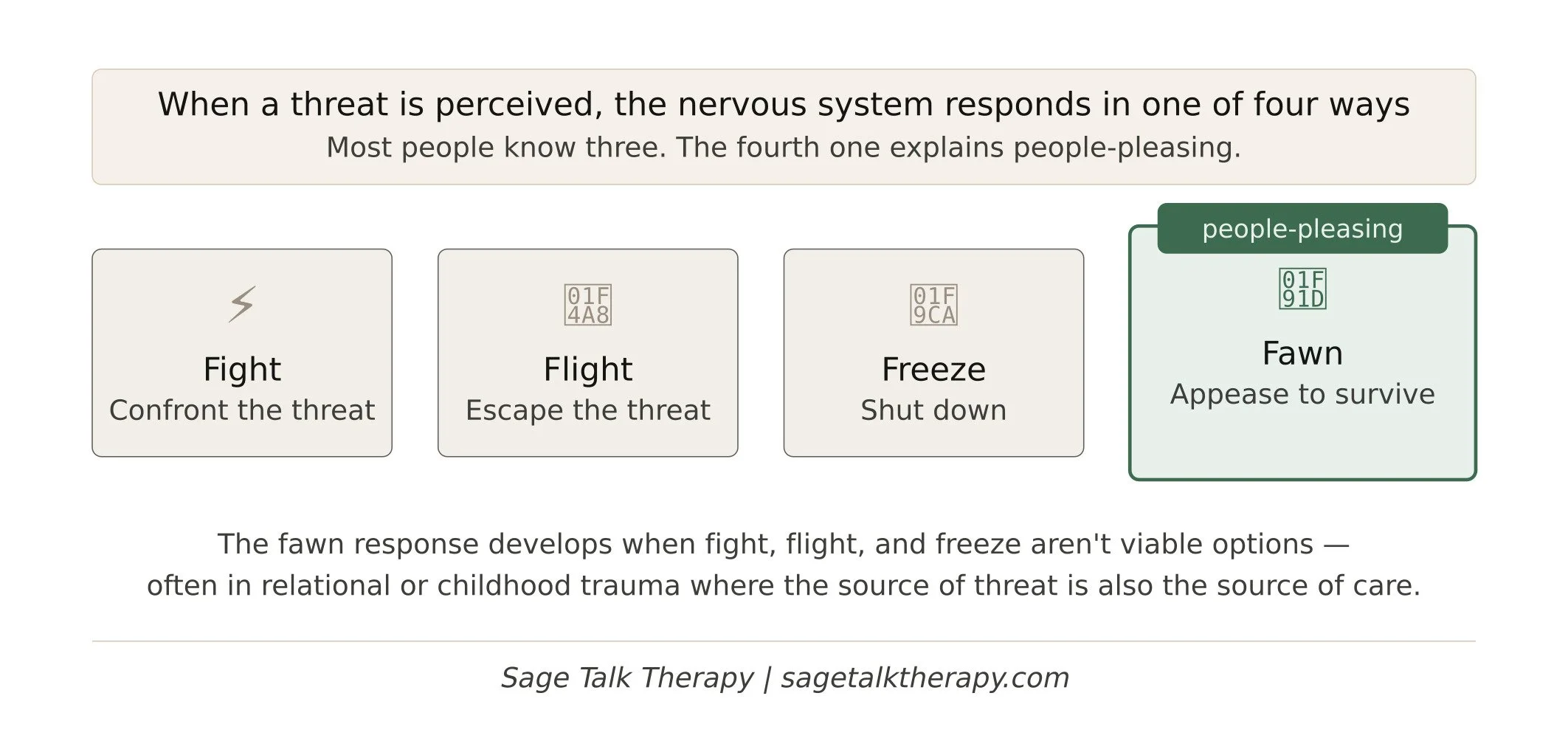
You've probably heard of fight, flight, and freeze — the three classic trauma responses. But there's a fourth one that doesn't get nearly enough attention: fawn.
The fawn response is what people-pleasing looks like at the nervous system level. When conflict, disapproval, or someone's anger feels threatening — even if only unconsciously — your system automatically moves toward appeasement. You become agreeable. You smooth things over. You manage the other person before you manage yourself.
This isn't a conscious decision. It's your nervous system doing what it was trained to do: keeping you safe by keeping everyone around you comfortable.
The fawn response was first described by therapist Pete Walker, who identified it as a trauma response that develops particularly in people who experienced relational trauma — where the threat came from the people who were supposed to keep you safe. When fighting back wasn't an option, when running wasn't possible, and freezing didn't help — appeasing did. And the nervous system remembered.
This is why so many people-pleasers feel like they can't stop even when they want to. You can know, in your thinking brain, that you want to say no. And still feel your mouth say yes — because your body has already responded to the perceived threat before your conscious mind caught up.
Understanding this changes the question. It's not "why can't I just stop?" It's "what is my nervous system still trying to protect me from?"
That's a much more answerable question. And it's the one therapy can actually work with.
WHAT PEOPLE-PLEASING ACTUALLY LOOKS LIKE DAY TO DAY
People-pleasing doesn't always look like weakness. From the outside, it often looks like being warm, capable, dependable, and easy to be around. That's part of what makes it so hard to name and so exhausting to carry.
Here's how it tends to show up beneath the surface:
You feel responsible for how other people feel, and work hard to manage it before they even ask. You say yes reflexively, before you've had a chance to check in with what you actually want. You over-explain your decisions, over-apologize for things that weren't your fault, and feel vaguely guilty even when you've done nothing wrong.
Conflict doesn't just feel uncomfortable. It feels threatening. The prospect of someone being disappointed in you or upset with you can trigger a level of anxiety that feels completely out of proportion to what's actually happening.
And underneath all of it: a quiet, creeping resentment. You give and give, and then feel unseen for it. You take care of everyone else and wonder when it will be your turn. You perform warmth and agreeableness and sometimes catch yourself wondering who you actually are when no one needs anything from you.
If that lands — you're not alone. And it can genuinely change.
WHY “JUST SAY NO” DOESN’T WORK
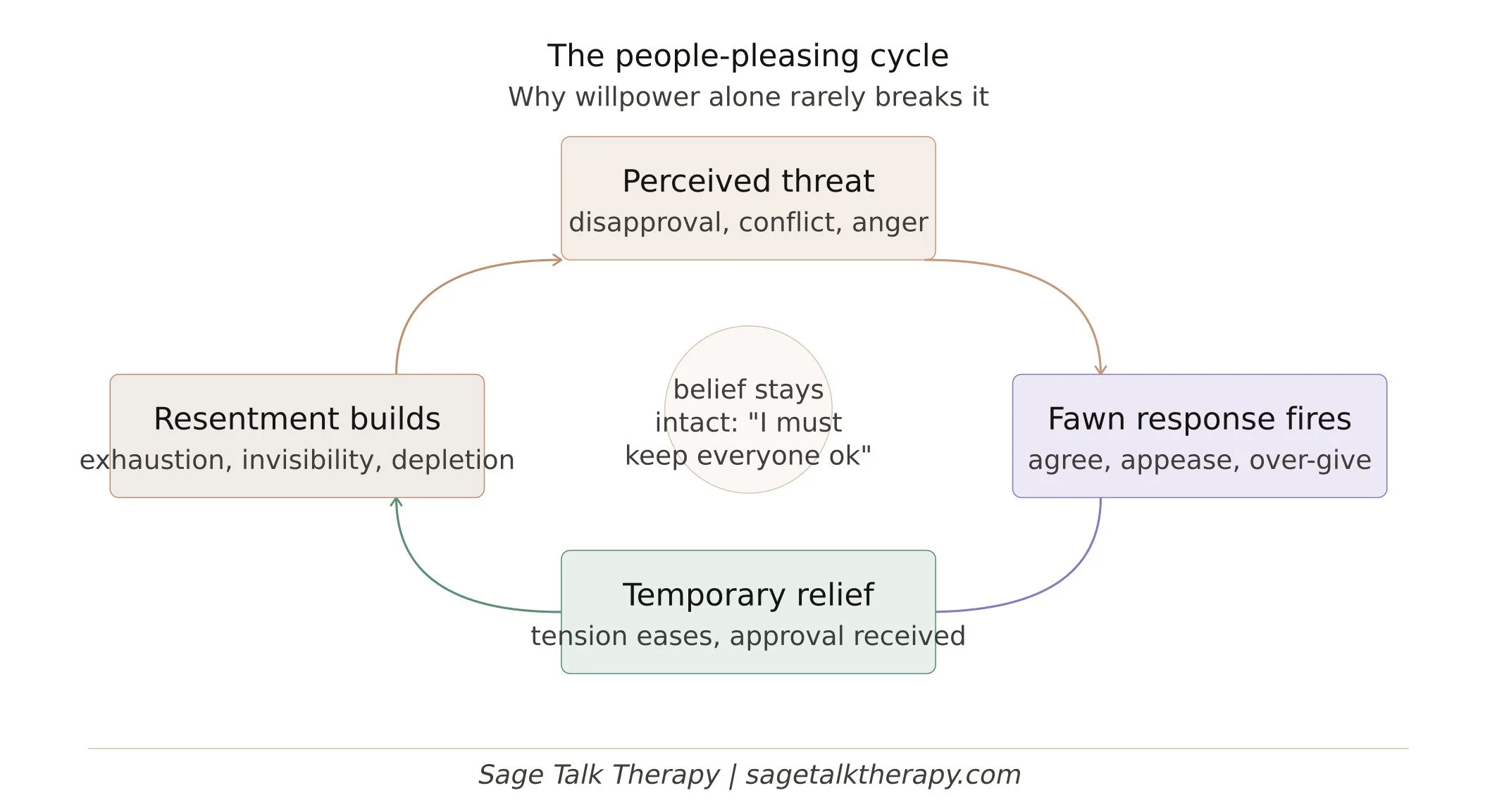
If you've ever tried to address people-pleasing through willpower alone, you've probably noticed that it doesn't work. Or it works momentarily and then snaps back. Or you manage to set one boundary and spend the next three days drowning in guilt and anxiety.
That's not because you're not trying hard enough. It's because the approach doesn't match the problem.
People-pleasing lives in the nervous system, not in your conscious decision-making. It's a body response, not just a thought pattern. So tools that work at the level of the thinking brain — reminding yourself that it's okay to say no, telling yourself you don't owe people your constant agreeableness — often don't reach it.
This is also why people-pleasing tends to be more stubborn than a lot of other habits. It's not just behavior. It's identity. For many people who struggle with it, being helpful and agreeable is core to how they see themselves and how they believe they're seen by others. The fear underneath isn't just "they'll be upset." It's "they'll leave. They won't love me. I'll be alone."
That level of fear requires more than a communication skill. It requires working at the level where it actually lives — the nervous system, the early relational experiences, the parts of you that are still trying to protect you from something that no longer poses the threat it once did.
What therapy for people-pleasing actually looks like
When I work with clients on people-pleasing patterns, we don't start with boundary scripts. We start much further back.
We start by understanding what's underneath: what your specific history looks like, what you learned about your worth and safety in early relationships, and what your nervous system has been trying to do all along. Not to assign blame, but to make sense of it. Because when you understand where a pattern came from, you can stop fighting it as if it's the enemy and start working with it.
From there, we use approaches that work at the body level as well as the cognitive one. EMDR to process the specific experiences that wired the fawn response in. Internal Family Systems to work with the part of you that people-pleases — to understand what it's been protecting and what it needs in order to stand down. Somatic approaches to build nervous system regulation that doesn't depend on managing everyone else's comfort first.
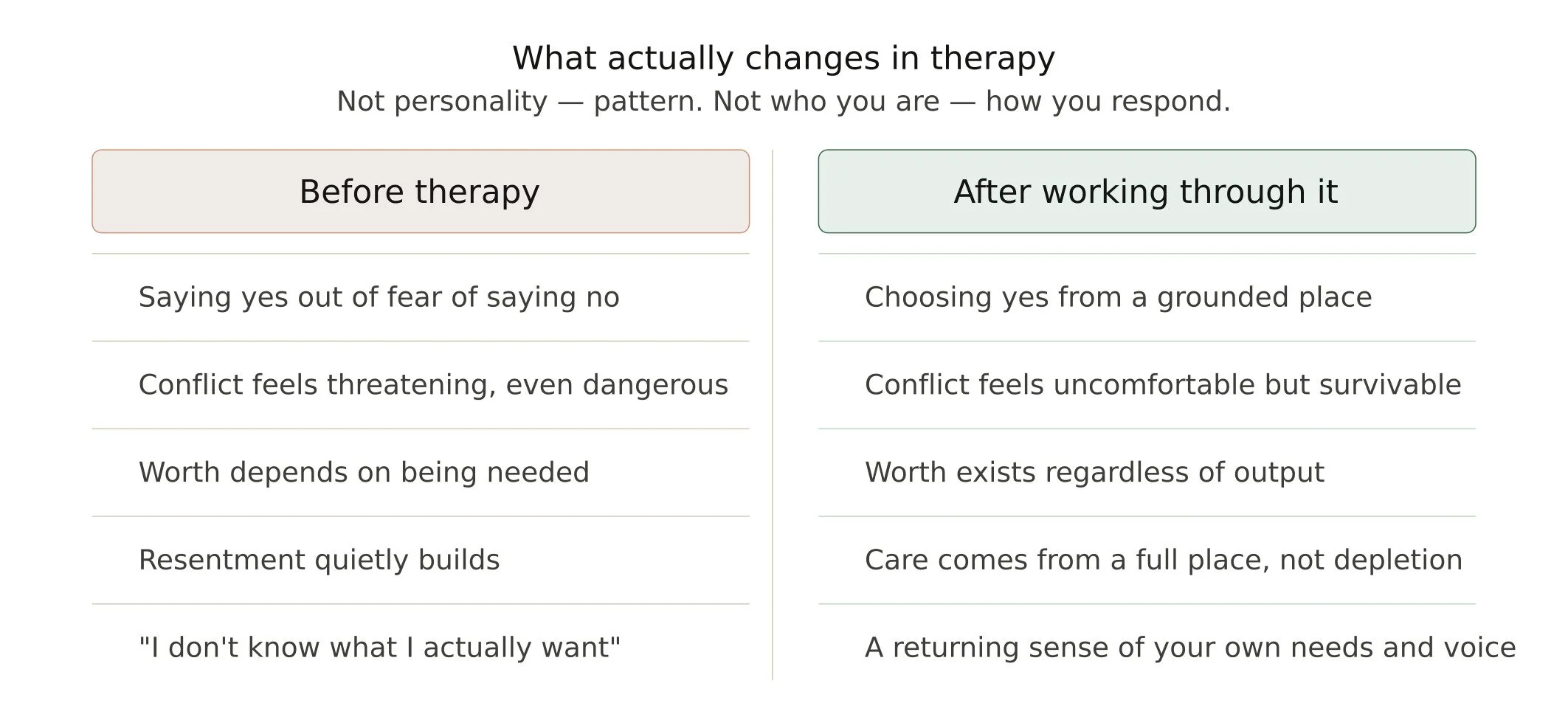
The goal isn't to turn you into someone who doesn't care about other people. It's to help you get to a place where you can genuinely choose. Where care comes from a full, grounded place, rather than from fear of what will happen if you don't give it.
That's a real difference. And people who experience it describe it as one of the most significant shifts in their lives.
A word on guilt
Almost everyone who starts working on people-pleasing patterns runs into the same wall: guilt.
When you start saying no, or taking up space, or prioritizing your own needs — the guilt can feel overwhelming. Like you're being selfish. Like you're becoming a different, worse person.
Here's what I want to offer: that guilt is part of the pattern, not evidence that you're doing something wrong. It's the old system responding to a new behavior. It makes sense that it's there. And it does get quieter over time, as your nervous system builds new evidence about what happens when you show up differently — and discovers that the catastrophe you feared doesn't come.
The people who genuinely love you will stay. The relationships that only worked because you were making yourself smaller will shift — and that's important information, even when it's painful.
You deserve to find out what's on the other side of that guilt. Most people who do describe it as feeling, for the first time in a long time, like themselves.
You've spent long enough putting everyone else first. Let's make sure you actually believe you're allowed to be next.
If you're reading this and recognizing yourself, know that this is workable. People-pleasing patterns — even deeply entrenched ones — change in therapy. Not overnight, and not without effort. But genuinely, lastingly, in ways that show up in your daily life.
If you're based in Westchester, NY or anywhere in New York or Connecticut, I'd love to connect. Learn more about how I work with people-pleasing and the fawn response, or book a free 15-minute consultation to talk through where you are and what might help.
You don't have to keep doing this alone.

Dadiana Lopez
LCSW · Anxiety & Trauma Therapist · EMDR Specialist
Dadiana Lopez is a Licensed Clinical Social Worker and EMDR therapist based in White Plains, NY. She specializes in anxiety, trauma, PTSD, and the patterns that form in the wake of both — including people-pleasing, perfectionism, and burnout. She sees clients in person in Westchester and online throughout New York and Connecticut.
Seeing clients in-person in White Plains, NY and online throughout New York and Connecticut.