
When Family Feels Impossible: A Therapist's Perspective on Estrangement
Family estrangement is one of the most painful and least talked-about experiences people carry into therapy.
It's painful because the loss is real and significant, regardless of which side of it you're on. And it's rarely talked about honestly because the cultural narrative around family is so rigid. Family is supposed to be everything. You're supposed to make it work. Choosing distance from a parent or a child carries a weight of shame that most people struggle to put down, even when the distance is the most self-protective decision they've ever made.
In my work as a trauma-informed therapist, I sit with both sides of this. Adult children who have made the agonizing decision to create distance from a parent. And parents who are living in the aftermath of that decision, trying to understand what happened and what, if anything, they can do.
What I've learned is that estrangement is almost never simple. It's rarely about one event. And it almost always has roots that go back much further than anyone realized at the time.
This post is for both. It doesn't take sides, because in my experience the truth of estrangement rarely lives entirely on one side.
what estrangement actually is
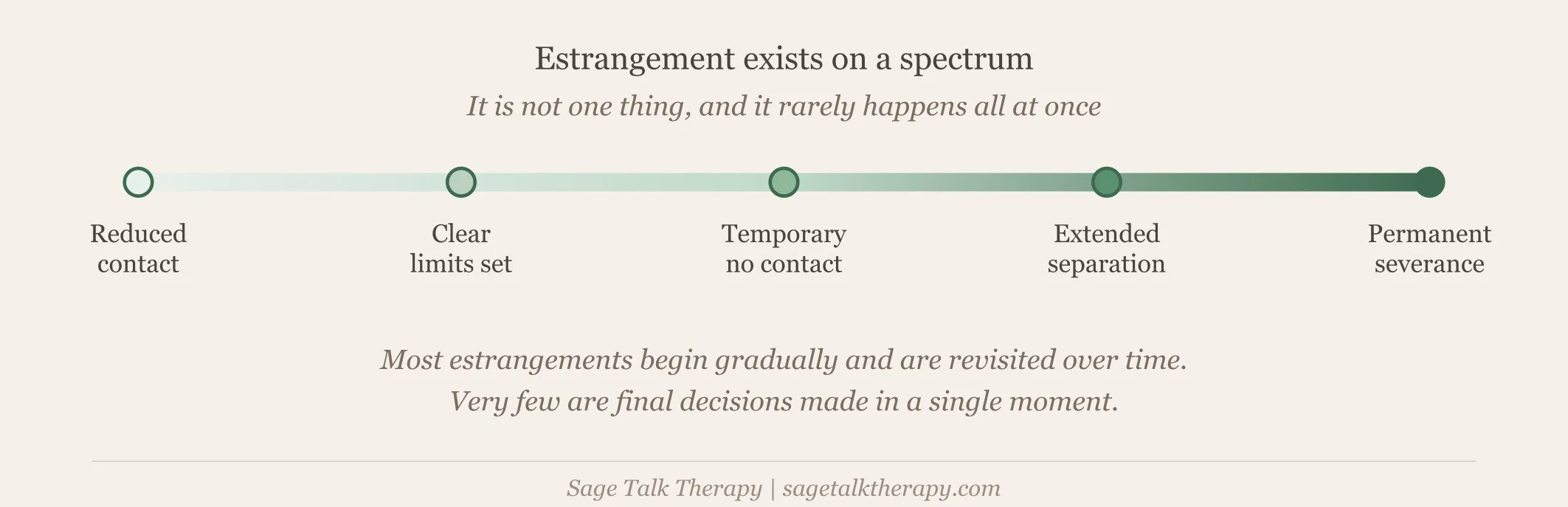
Estrangement refers to the breakdown or significant reduction of contact between family members, usually a parent and adult child, that is initiated by choice rather than circumstance. It exists on a spectrum from occasional contact with clear limits, to periods of no contact, to permanent severance of the relationship.
It's more common than most people realize. Research suggests that roughly one in four families experiences some form of estrangement. Yet because it carries so much shame, people often carry it in isolation, assuming their family is uniquely broken.
Estrangement is not the same as conflict. Most families have conflict. Estrangement is what happens when the relationship, as it currently exists, feels incompatible with one or both people's wellbeing. When the cost of maintaining contact consistently outweighs the benefit. When staying connected requires one person to consistently lose themselves in the process.
Understanding it that way doesn't make it hurt less. But it does make it more workable.
THE adult child’s experience
For adult children who choose estrangement, the decision is almost never made lightly.
Most people who reach this point have tried everything else first. They've had the conversations, set the limits, asked for change, and absorbed the fallout when change didn't come. They've given more chances than they can count. And at some point, usually after a long time and with enormous grief, they've made a decision that their own mental health and sense of self require some form of distance.
The cultural response to that decision is often unkind. "You only get one mother." "Family is family." "You'll regret it when they're gone." These messages, however well-intentioned, communicate that the adult child's experience doesn't merit the decision they've made. That their pain should be weighed against obligation and found insufficient.
What often gets missed in that narrative is the pattern underneath the decision.
Many adult children who estrange from a parent carry a long history of people-pleasing rooted in that relationship. They learned early that their needs came second, that speaking up had consequences, that love was conditional on compliance. The estrangement, when it finally comes, is often the first genuinely self-protective decision they've made in relation to that parent. It's the moment the fawn response finally gives way to something that says: I cannot keep doing this.
That's not a small thing. For someone whose nervous system has been trained toward appeasement since childhood, choosing their own wellbeing over a parent's comfort can feel like the most terrifying thing they've ever done. The guilt is enormous. The grief is real. And both of those things can coexist with the decision being the right one.
Estrangement is also frequently a response to intergenerational patterns that were never named or addressed. Criticism that was called honesty. Control that was called love. Emotional unavailability that was called stoicism. Enmeshment that was called closeness. When those patterns go unnamed across generations, the adult child who finally names them often gets cast as the problem, the one who is "too sensitive," who "can't take a joke," who is "breaking up the family."
What they're actually doing is interrupting a cycle. And that's important, even when it's painful for everyone involved.
The Parent’s Experience
Parents on the receiving end of estrangement often describe it as one of the worst experiences of their lives. And that deserves to be said directly, without qualification.
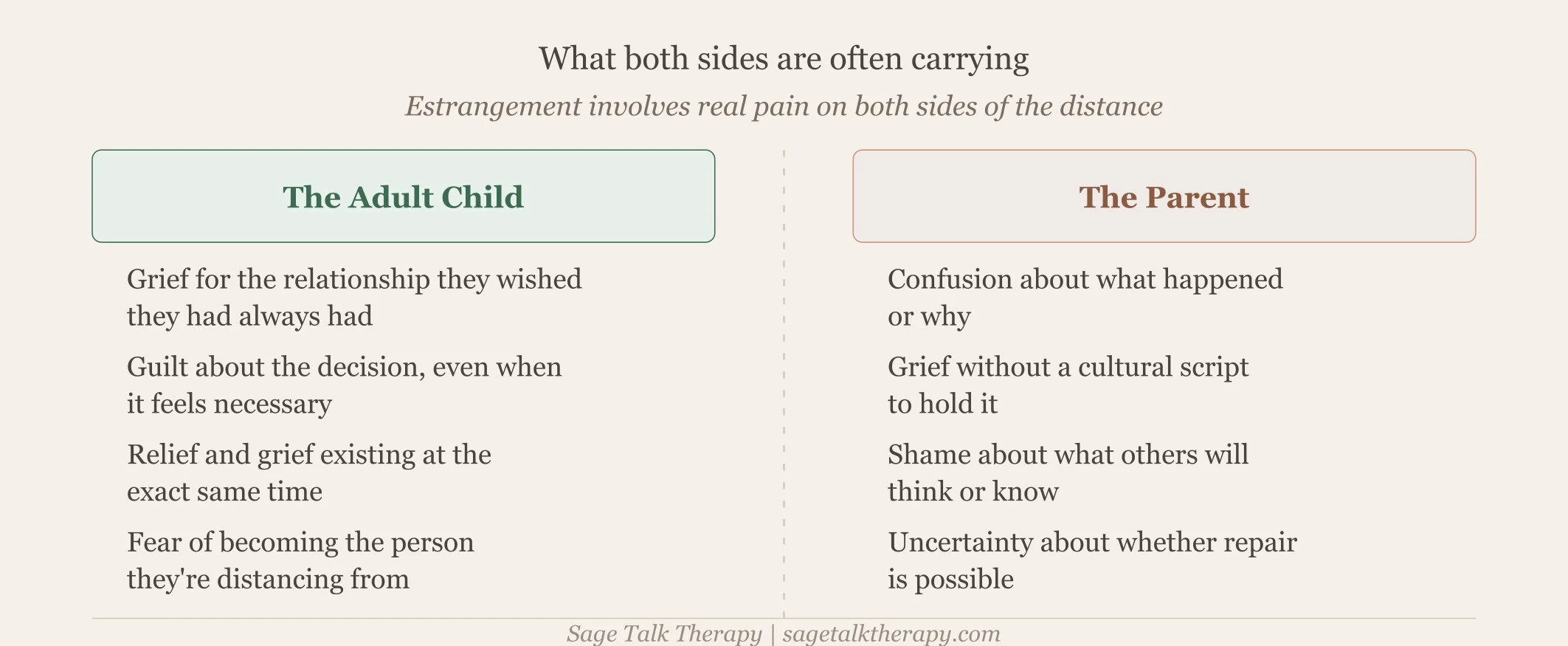
The loss is real. The confusion is real. The grief is real. Being cut off from a child, or having contact significantly reduced, without fully understanding why or being given a clear path toward repair, is a particular kind of pain that doesn't have many cultural containers. There's no script for it. There's no casserole from the neighbors.
Many estranged parents are genuinely bewildered. They look back and don't see what their child sees. They remember a different family than the one being described to them. That disconnection is disorienting, and it can make repair feel impossible because the two people aren't even working from the same account of what happened.
Some of that gap is genuine difference in perception. Memory is subjective and shaped by experience. A parent who was doing their best in genuinely difficult circumstances may have left wounds they didn't know they were leaving. A child who was more sensitive, more perceptive, or simply more affected than their siblings may have experienced the same family environment very differently.
Some of that gap, though, reflects something harder to sit with: the ways in which intergenerational patterns make it genuinely difficult to see what you've passed on. When you grew up in a home where criticism was love, where emotional unavailability was normal, where control was protection, it can be very hard to recognize those same patterns in yourself. Not because you're a bad person. Because water doesn't see itself as wet.
For parents willing to do the work of looking honestly at this, therapy can be a place to understand what happened without the defensive need to relitigate who was right. That work is hard and it asks a lot. It also tends to be the only thing that creates any genuine possibility of repair, whether or not reconciliation ultimately happens.
WHAT estrangement is not
Before going further, a few things worth naming directly.
Estrangement is not automatically the adult child's fault. The narrative that adult children who estrange are selfish, mentally ill, or manipulated by a partner or therapist is common and rarely accurate. Adults who choose estrangement are, in most cases, doing so after years of trying and with significant reluctance.
Estrangement is also not automatically the parent's fault. Some adult children estrange from parents who genuinely did their best and who carry real wounds of their own. The relationship may have been shaped by forces the parent didn't fully control. Pain flows in multiple directions in a family system, and most family systems have more than one person contributing to the dynamic.
And estrangement is not necessarily permanent. For some families, distance creates the space needed for genuine change to happen. Contact that was re-established after a period of estrangement is sometimes, paradoxically, more honest and sustainable than contact that was maintained out of obligation.
The Intergenerational Thread
What I see consistently in families navigating estrangement is that the rupture rarely started with this generation.
The parent who is critical and controlling often had a critical and controlling parent. The adult child who has been people-pleasing their whole life inherited that pattern from somewhere. The emotional unavailability, the conditional love, the enmeshment, the rigidity around family roles, the inability to tolerate a family member's individuation, which is the healthy process of becoming a separate person with a separate life: these patterns move through families across generations like a river finding its course.
Estrangement, when it happens, often represents the moment someone in the family system can no longer absorb the pattern. It's a signal that something needs to change. That signal is painful. It's also important.
For adult children, understanding the intergenerational thread can be a source of both compassion and clarity. Compassion, because understanding where your parent's patterns came from doesn't excuse them but it does make them more legible. And clarity, because seeing the full lineage of a pattern makes the work of interrupting it more possible.
For parents, understanding the intergenerational thread can be an invitation to look at what was passed to them before looking at what they passed on. That sequencing matters. It's much harder to genuinely reckon with your impact on your child when you haven't yet reckoned with what shaped you.
What helps, for both
There is no clean resolution to offer here, because estrangement rarely resolves cleanly. But there are things that help, for both adult children and parents, regardless of whether reconciliation is ultimately possible.
FOR ADULT CHILDREN:
Therapy that validates your experience without requiring you to minimize it is essential. So is therapy that also helps you understand the intergenerational roots of the dynamic, not to assign blame in the other direction, but to make meaning of what happened in a way that gives you more freedom going forward.
The people-pleasing patterns that often underlie estrangement don't disappear just because you've created distance. They tend to show up in other relationships, in other forms, until they're worked with directly. Understanding the fawn response and what your nervous system learned in that original relationship is some of the most important work you can do, not just for the family situation but for your entire life going forward.
Grief is also a necessary part of this. Estrangement involves the loss of the relationship you wished you'd had, alongside the loss of the relationship you're choosing to step back from. Both of those are real losses and they deserve to be mourned.
FOR PARENTS:
The most helpful thing a parent can do in the wake of estrangement, regardless of what they believe about who is right, is get into therapy and stay there long enough to genuinely look at themselves. Not to be blamed. Not to be told they're a bad parent. But to understand, with real honesty, what they may have contributed, what patterns they may have carried, and what a genuine repair would require.
That work is hard precisely because it asks you to hold your love for your child, which is probably real and significant, alongside the possibility that your love was sometimes expressed in ways that didn't land as love. Both things can be true. Holding both is what makes repair possible.
The adult child who estranged is, in many cases, watching to see whether change is genuinely possible. They're not always watching consciously. But the question underneath the estrangement is often: can you see me? Can you acknowledge what I experienced? Can you change? Those questions don't always get asked out loud. But they're usually there.
A word on RECONCILIATION
Not all estrangements end in reconciliation, and reconciliation is not always the goal.
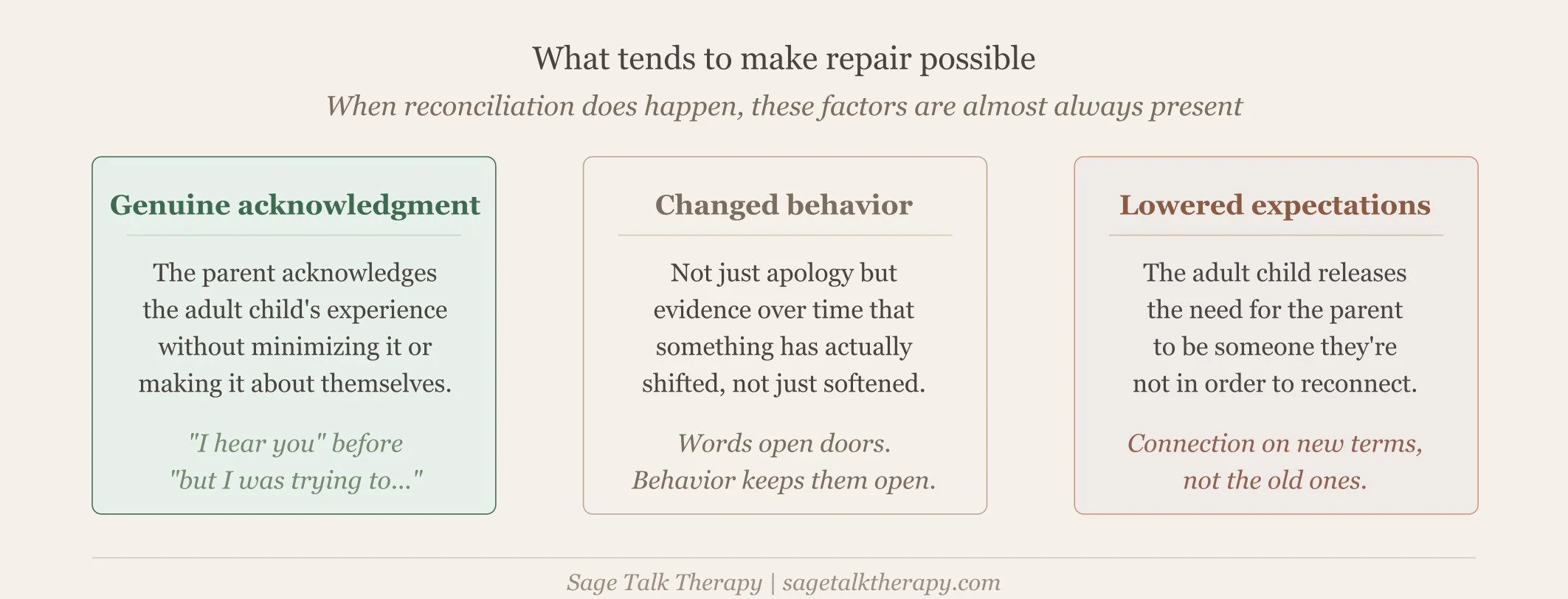
For some families, genuine reconnection becomes possible when both people have done enough of their own work that the relationship can exist on different terms. When the adult child no longer needs the parent to be someone they're not in order to be okay. When the parent has genuinely reckoned with their impact rather than just apologizing to restore the relationship. When there's enough safety and enough honesty to build something new.
For other families, the distance remains, and the work becomes about how each person builds a meaningful life alongside the loss. That's not a failure. It's sometimes the most realistic and self-respecting outcome available.
What therapy can offer, regardless of where the estrangement ends up, is the chance to understand it more fully. To grieve it more honestly. To make meaning of it that doesn't require you to either villainize the other person or minimize your own experience. And to carry whatever comes next with more clarity and less weight than you'd carry it alone.
IF THIS RESONATES
Family estrangement is one of those experiences that is very hard to navigate without support. The grief is complicated, the dynamics are layered, and the cultural shame around it tends to make people feel more isolated than they need to be.
If you're an adult child working through a decision about contact, or sitting with the aftermath of one, therapy can help you understand your own patterns, process the grief, and move forward with more clarity. The people-pleasing work we do here and the intergenerational trauma lens we bring are particularly relevant to this experience.
If you're a parent navigating estrangement from an adult child, therapy can offer a space to grieve, to look honestly at yourself, and to understand what genuine repair would require, whether or not it ultimately happens.
Either way, you don't have to carry this alone.
If you're based in Westchester or anywhere in New York or Connecticut, I'd welcome the chance to talk. Book a free 15-minute consultation here.

Dadiana Lopez
LCSW · Anxiety & Trauma Therapist · EMDR Specialist
Dadiana Lopez is a Licensed Clinical Social Worker and EMDR therapist based in White Plains, NY. She specializes in anxiety, trauma, PTSD, and the patterns that form in the wake of both — including people-pleasing, perfectionism, and burnout. She sees clients in person in Westchester and online throughout New York and Connecticut.
Seeing clients in-person in White Plains, NY and online throughout New York and Connecticut.