
How to Find the Right Therapist for Trauma in Westchester, NY
Searching for a trauma therapist in Westchester, NY sounds straightforward until you actually try it.
You open Psychology Today, type in your zip code, filter by trauma, and suddenly you're looking at forty profiles that all say roughly the same thing. Everyone is warm and compassionate. Everyone creates a safe space. Everyone works with trauma.
But here's what most of those profiles won't tell you: there is a significant difference between a therapist who is trauma-aware and a therapist who is genuinely trauma-trained. That difference matters enormously for whether the therapy you do actually helps — or whether you spend months in sessions that scratch the surface without ever reaching what's underneath.
This post is a practical guide to finding the right fit. Not just any therapist who lists trauma as a specialty, but the right therapist for the kind of trauma work that actually creates change.
FIRST: UNDERSTAND WHAT TRAUMA THERAPY ACTUALLY REQUIRES
Trauma is not like other presenting concerns in therapy. You cannot talk your way through it the way you might work through a difficult relationship dynamic or a career transition. Trauma lives in the nervous system — in the body's automatic responses, in the patterns that fire before your thinking brain has a chance to catch up.
This means that effective trauma therapy requires a therapist who understands how trauma is stored physiologically, not just psychologically. Someone who knows how to work with a nervous system that is still stuck in threat response, how to pace the work so it doesn't retraumatize, and how to use approaches that reach beyond the thinking brain to where the trauma actually lives.
Generic talk therapy — even skilled, empathic talk therapy — often isn't enough for this. Understanding what happened doesn't automatically change how it feels. That gap is where specialized trauma training comes in.
WHAT TO LOOK FOR IN A TRAUMA THERAPIST
1. SPECIFIC TRAUMA MODALITY TRAINING
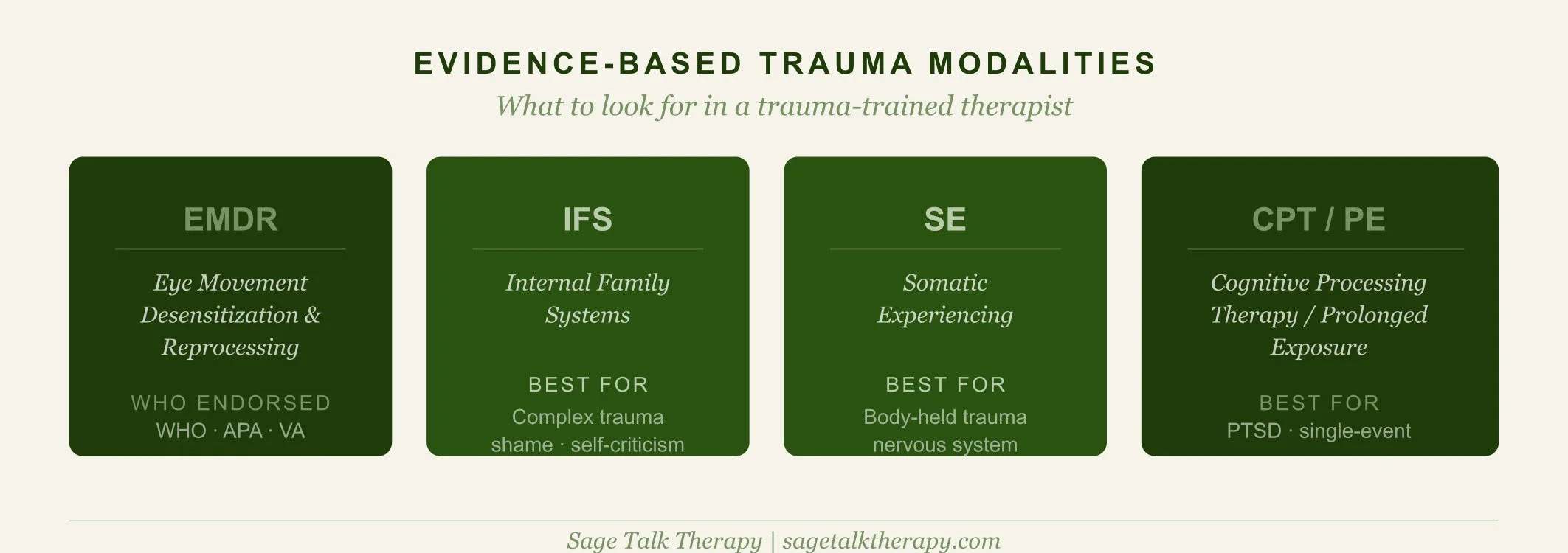
Eye Movement Desensitization and Reprocessing (EMDR): endorsed by the World Health Organization and the American Psychological Association as a gold-standard treatment for PTSD. EMDR works by helping the brain reprocess traumatic memories so they lose their emotional charge. Therapists should have completed formal EMDR training through an approved training program — not just attended a weekend workshop.
Internal Family Systems (IFS): a parts-based model that works with the internal protective structures trauma creates. Therapists can be IFS-informed through training programs of varying depth.
Somatic Experiencing (SE):a body-based approach developed by Peter Levine that works directly with the nervous system rather than the narrative of what happened. Practitioners complete a multi-year training program.
Cognitive Processing Therapy (CPT) and Prolonged Exposure (CP): two evidence-based CBT approaches specifically developed for PTSD.
When you're evaluating a therapist, look for specific modality training in their profile or website — not just "trauma-informed" as a general descriptor. Trauma-informed means someone understands that trauma affects the people they work with. Trauma-trained means they have specific skills for treating it.
2. Body-Based and Nervous System Awareness
Trauma lives in the body. A therapist who works exclusively at the cognitive level — identifying thoughts, challenging beliefs, building coping strategies — may help you understand your trauma without helping you heal it.
Look for therapists who mention somatic work, nervous system regulation, body-based approaches, or polyvagal theory in how they describe their practice. These are signals that they understand trauma as a physiological event, not just a psychological one.
3. Experience with your specific type of trauma
Trauma is not a monolith. Childhood and developmental trauma, relational trauma, single-event trauma, complex PTSD, racial trauma, sexual trauma — these have meaningfully different clinical presentations and require different pacing and approaches.
When you're reading profiles or speaking with a potential therapist, ask directly about their experience with your specific history. A therapist who primarily works with acute crisis situations may not be the best fit for someone doing deep developmental trauma work, and vice versa.
4. pacing and saety as explicit values
One of the most important markers of a genuinely trauma-trained therapist is how they talk about pacing and safety. Trauma work that moves too fast causes re-traumatization — the client gets flooded, destabilized, and often leaves therapy feeling worse than when they started.
A good trauma therapist will talk about building resources before processing, titrating the work carefully, and never pushing faster than the nervous system can handle. If a therapist's language around trauma work sounds intense, confrontational, or focused on getting to the trauma quickly — that's a red flag.
questions worth asking before you book
Most therapists offer a free consultation. Use it. Here are the questions that will tell you what you actually need to know:
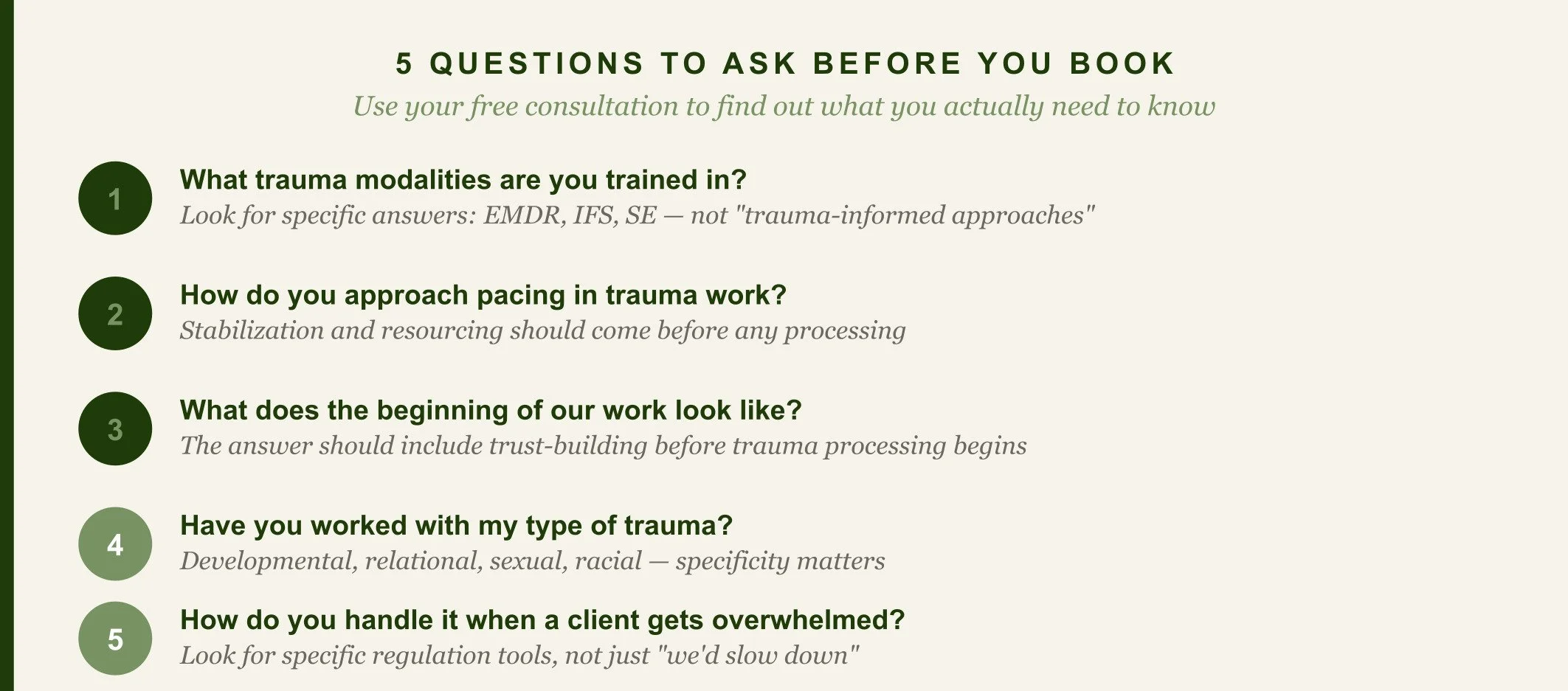
What trauma modalities are you trained in, and where did you receive that training? You're looking for specific answers — EMDR Level 1 and 2 training, SE training, IFS certification, and so on. Vague answers like "I use trauma-informed approaches" or "I draw from various modalities" are worth probing further.
How do you approach pacing in trauma work? A well-trained trauma therapist will talk about stabilization, resourcing, and titration. They will mention that processing doesn't happen in early sessions. If someone says they like to get into the trauma quickly or talks about catharsis as a goal, proceed carefully.
What does the beginning of our work together look like? The answer should include some version of getting to know you, building safety and trust, and developing grounding and stabilization tools before any trauma processing begins. This phase can take weeks or months depending on your history and nervous system.
Have you worked with clients whose history is similar to mine? This is a direct question and a good therapist will answer it directly. You're not asking for client details — you're asking whether they have experience with your specific type of trauma.
How do you handle it when a client gets overwhelmed in session? The answer should demonstrate that the therapist has a clear, practiced approach to regulation — not just empathy and reflection. You want to hear about specific tools and a clear philosophy around not letting sessions end while a client is destabilized.
RED FLAGS TO WATCH FOR
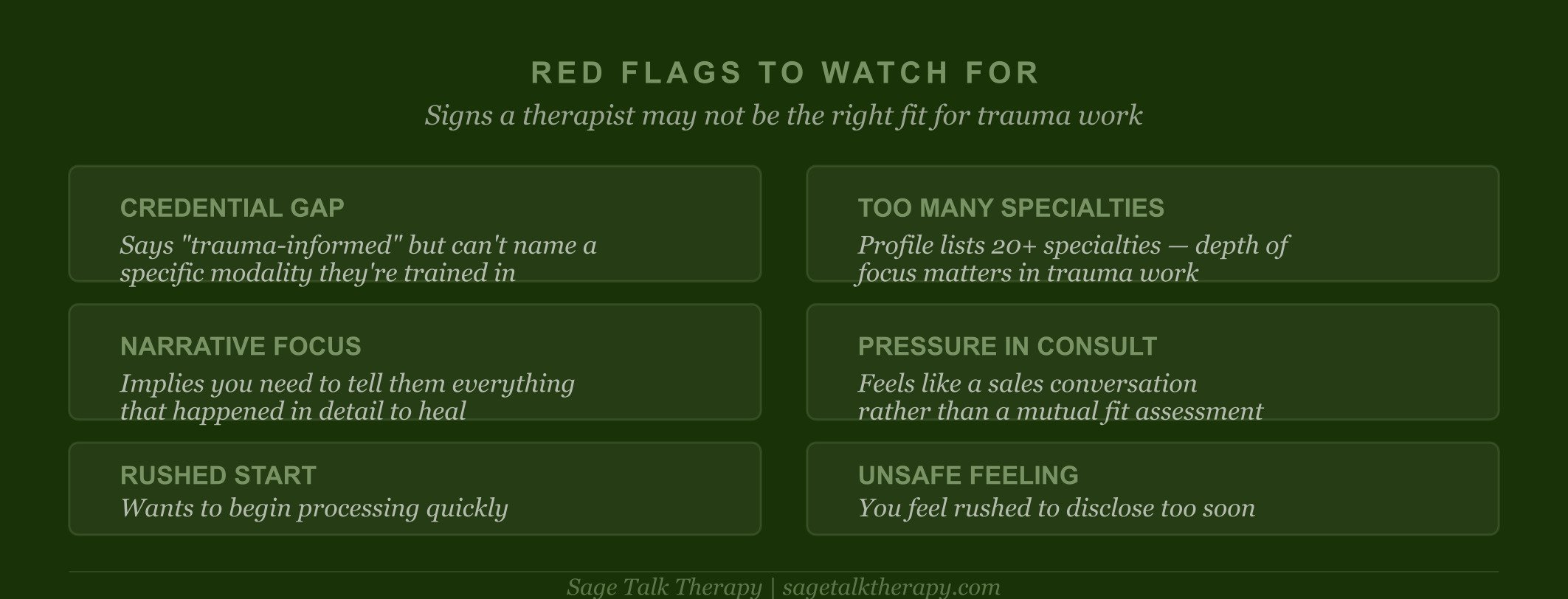
They describe themselves as trauma-informed but can't name a specific trauma modality they're trained in. Trauma-informed is a baseline orientation, not a treatment skill. It's necessary but not sufficient.
They suggest you'll need to tell them everything that happened in detail. Effective trauma treatment, particularly EMDR and somatic approaches, does not require a detailed verbal narrative of traumatic events. If a therapist implies that talking through everything is the primary mechanism of healing, their approach may not be appropriate for trauma.
The consultation feels like they're trying to sell you on starting quickly.A good trauma therapist is not in a rush. They want to assess fit carefully and they understand that starting with the wrong person can set trauma treatment back significantly.
Their profile lists twenty different specialties.Depth of specialization matters in trauma work. A therapist who lists trauma alongside thirty other areas of focus may not have the clinical depth that complex trauma requires.
You feel pressured to share more than you're ready to in a consultation.Your comfort and safety in the relationship is the foundation of trauma treatment. A consultation where you feel rushed, interrogated, or pushed to disclose is a meaningful signal.
what to expect when you find the right fit
Good trauma therapy takes time. That is not a flaw — it is the nature of the work.
Early sessions will focus on getting to know your history, understanding what you want from the work, and building the internal resources and relational safety that allow deeper processing to happen. You may not touch the trauma directly for weeks or months. That is appropriate and intentional.
When processing work does begin, it should feel challenging but manageable — not overwhelming. You should leave sessions feeling more settled than when you arrived, not more dysregulated. If you consistently leave sessions feeling worse, destabilized, or unable to function, that is worth raising with your therapist directly.
Progress in trauma therapy is not always linear. You may feel better, then go through a period of activation as deeper material surfaces. That is normal. What matters is the overall trajectory over time — and a good trauma therapist will check in regularly about how you're experiencing the work.
Finding a trauma therapist in Westchester specifically
Westchester County has a strong concentration of mental health providers, but the range in training and specialization is significant. A few practical notes for your search:
Psychology Todayis the most comprehensive directory but profiles vary widely in specificity. Filter by trauma, then read the full profiles carefully looking for specific modality training rather than general trauma language.
EMDR International Association (EMDRIA) has a therapist finder at emdria.org that lists only therapists with verified EMDR training. If EMDR is the modality you're specifically looking for, this is a more reliable starting point than a general directory.
Your insurancemay narrow the field significantly. If you have Aetna or UnitedHealthcare, verify in-network options before starting your search to avoid surprises. If you have out-of-network benefits, a broader range of specialists becomes accessible.
Telehealth has meaningfully expanded your options. Therapists licensed in New York can work with you virtually from anywhere in the state, which means you're not limited to providers physically located in Westchester. If you live in northern Westchester or want access to a more specific specialization, telehealth may open options that in-person alone wouldn't.
A note on fit beyond credentials
Credentials and training matter enormously. But so does the relational quality of the work.
Trauma treatment requires a level of trust and safety that goes beyond clinical competence. You need to feel genuinely comfortable with this person — not just intellectually assessed by them. The consultation is your chance to assess that as much as anything else.
If you leave a consultation feeling like the therapist really heard you, gave thoughtful and specific answers, and made you feel safe rather than scrutinized — that is meaningful clinical data. Follow it.
Working with a trauma therapist in White Plains, NY
I specialize in trauma and PTSD therapy for adults in White Plains, NY, with online sessions available throughout New York and Connecticut. My approach is EMDR-based, trauma-informed, and integrative — drawing from IFS, somatic work, and CBT depending on what each client needs and where we are in the work.
If you're in Westchester and looking for a therapist with specific trauma training, I'd welcome the chance to connect. A free 15-minute consultation is the lowest-stakes way to see whether we'd be a good fit.
Learn about why therapy may not have worked in the past.

Dadiana Lopez
LCSW · Anxiety & Trauma Therapist · EMDR Specialist
Dadiana Lopez is a Licensed Clinical Social Worker and EMDR therapist based in White Plains, NY. She specializes in anxiety, trauma, PTSD, and the patterns that form in the wake of both — including people-pleasing, perfectionism, and burnout. She sees clients in person in Westchester and online throughout New York and Connecticut.
Seeing clients in-person in White Plains, NY and online throughout New York and Connecticut.