
You have people. A group chat that never goes quiet, plans on the calendar, coworkers who like you, maybe a partner or kids who need you every hour of the day. And somehow you can be in the middle of all of it and still feel like nobody really knows you.
Then the second thought shows up. What is wrong with me? I have so much. I should be grateful.
Nothing is wrong with you. Feeling lonely around people is one of the most common things people bring into therapy, and it usually has little to do with how many people are in your life.
Lonely and alone are not the same thing
Being alone is about who is in the room. Loneliness is about whether anyone in the room knows you.
You can spend a whole weekend by yourself and feel settled. You can also sit at a table full of people you love and feel completely on the outside. What decides it isn’t the headcount. It’s whether any part of the real you feels seen.
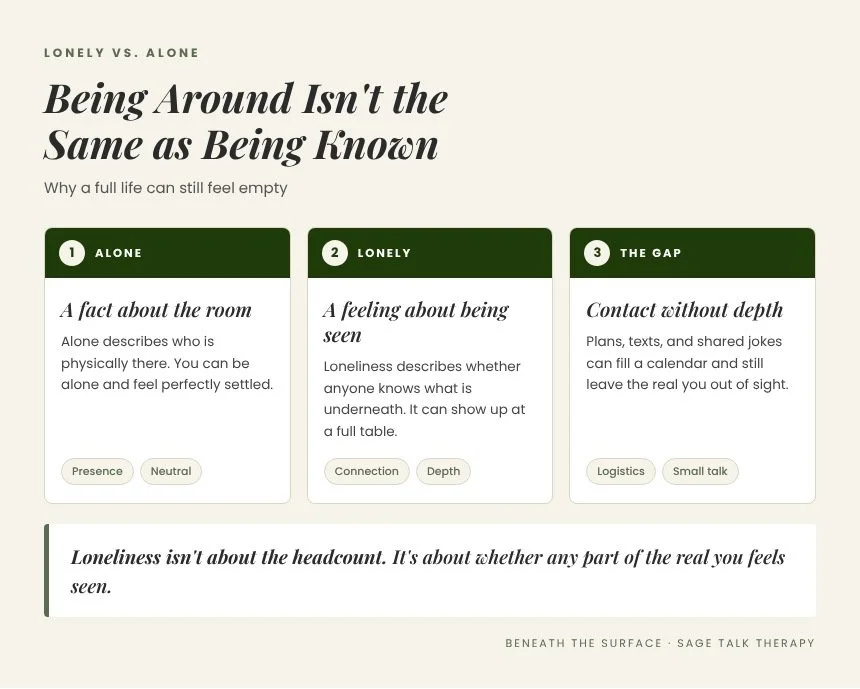
For many people, the missing piece isn’t more contact. It’s a different kind. Plenty of friendships run on logistics, humor, and keeping each other updated. Those matter. They just don’t always leave room for the harder stuff, like what you’re actually worried about, what you wish someone would ask, or how tired you are of being the one who has it together.
Why it happens: you may be showing only part of yourself
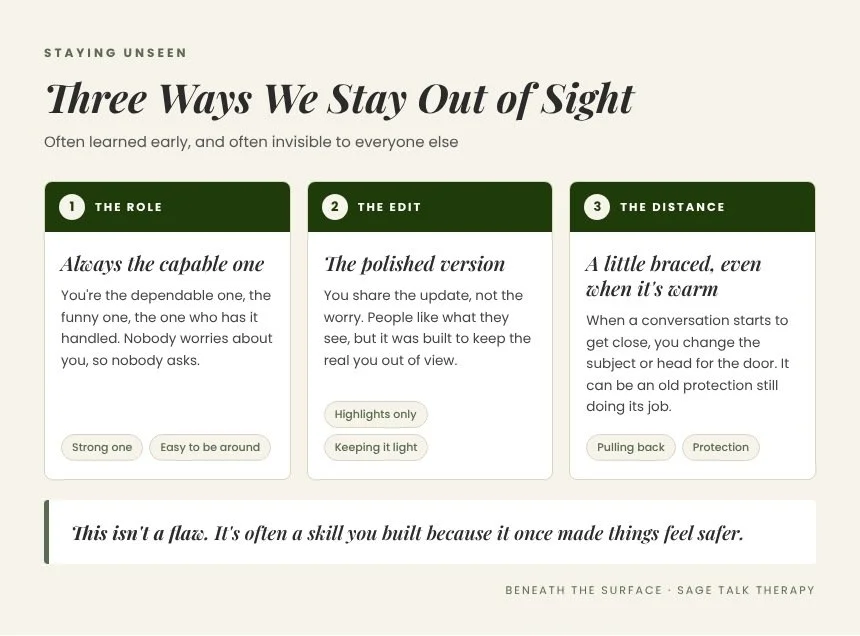
A lot of people who feel lonely in a crowd are very good with people. They’re the dependable one, the funny one, the one who remembers everyone’s birthday. They’re easy to be around, which is part of the problem.
If you learned early that your needs were a lot, or that being easy kept the peace, you may have gotten very good at showing a polished version of yourself. People like that version. It just can’t be the one that gets known, because it was built to keep the real one out of sight.
This pattern shows up often in people who were the strong one growing up, in first-generation families where you carried more than your share, and in people-pleasers who read every room before they say a word.
It isn’t true for everyone, and loneliness doesn’t always trace back to something from childhood. Sometimes it follows a move, a breakup, a new baby, or a long stretch of burnout. But when it keeps coming back no matter how full your life gets, it’s worth getting curious about what you’ve learned to hold back.
Why more plans don’t fix it
The usual advice is to join a club, say yes more, put yourself out there. That can help when the problem is a small circle. When the problem is depth, it can leave you more tired, because you’re spending more evenings performing the easy version of yourself with more people.
There can be a body piece too. If sharing something real ever felt risky, your body may stay a little braced even in a warm room. You might notice a tight chest, a quick change of subject, or a sudden urge to leave early right when a conversation starts to get close. That isn’t a flaw. It can be an old protection still doing its job.
What can start to shift it
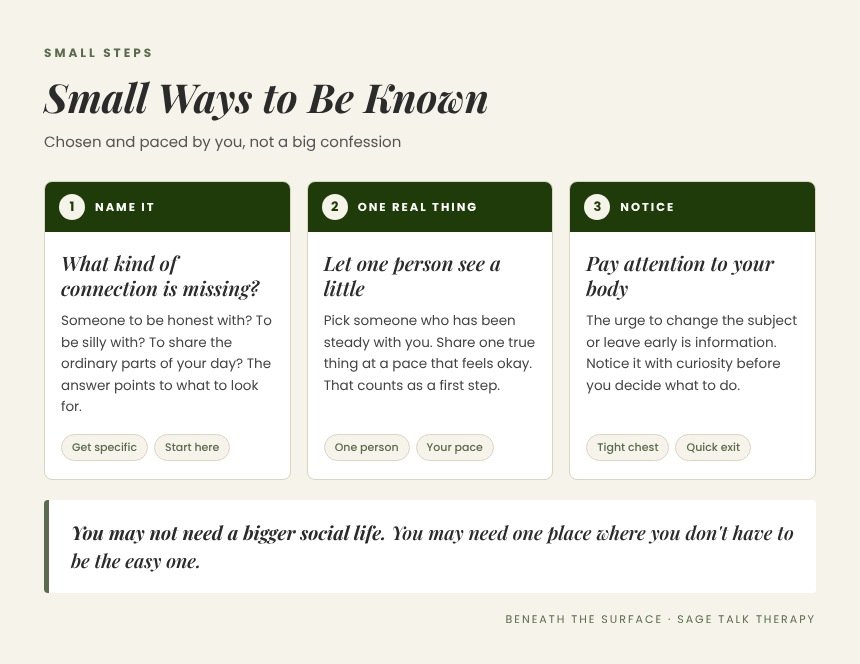
It usually isn’t a big confession. It’s small, and you choose the pace.
Start by getting specific about what’s missing. Someone to be honest with? Someone to be silly with? Someone who asks how your day actually went? Then, if it feels okay, let one person who has been steady with you see one real thing. That’s enough for a first step.
wHEN IT MIGHT BE MORE THAN loNELINESS
Loneliness and low mood often show up together. If you’ve also lost interest in things you used to enjoy, you’re sleeping much more or much less than usual, or the heaviness doesn’t lift, it’s worth talking with a mental health professional instead of waiting it out. You don’t have to be in crisis to ask for support.
if This Resonates
In my work, I use EMDR and IFS to help people examine the beliefs and protective patterns that make it hard to let others in, like “I’m too much” or “if I need something, I’ll be a burden.” Those beliefs usually made sense when they formed. Therapy is a place to look at them with someone who isn’t asking you to be easy.
If what you have read here describes something you have been living with, I would welcome the conversation.
Learn more about Internal Family Systems.

Dadiana Lopez
LCSW · Anxiety & Trauma Therapist · EMDR Specialist
Dadiana Lopez is a Licensed Clinical Social Worker and EMDR therapist based in White Plains, NY. She specializes in anxiety, trauma, PTSD, and the patterns that form in the wake of both — including people-pleasing, perfectionism, and burnout. She sees clients in person in Westchester and online throughout New York and Connecticut.
Seeing clients in-person in White Plains, NY and online throughout New York and Connecticut.