
If you have been in therapy recently — or reading about therapy — you may have come across the phrase "parts work" or heard a therapist mention IFS.
Internal Family Systems, or IFS, has moved from a relatively niche clinical approach to one of the most widely used and widely discussed frameworks in trauma-informed therapy. And the core concept at the center of it — the idea that the mind is made up of parts — is one of those ideas that, once you understand it, tends to make a lot of things about your own inner experience click into place.
But the language can be confusing at first. What does it mean to have parts? Is this about different personalities? Are parts real things or just a metaphor? And what does working with them actually involve?
This post is a plain-language guide to the basics. No jargon, no oversimplification. Just a clear explanation of what IFS is, what parts are, and why working with them tends to produce a different kind of change than other approaches.
The basic idea
The IFS model was developed by Dr. Richard Schwartz in the 1980s, originally as a framework for understanding family dynamics in therapy. What he noticed was that the same patterns that show up in family systems — certain members managing the household, others carrying pain, some protecting the family from what is seen as threatening — also show up inside individuals.
The core premise is straightforward: the mind is not a single, unified thing. It is a system made up of multiple parts, each with its own perspective, its own emotional experience, and its own set of strategies. These parts developed in response to experience. They have jobs. And they are all, at their core, trying to help.
Internal Family Systems views every human being as a system of protective and wounded inner parts guided by a core Self. It teaches that the mind is naturally multiple — and that this multiplicity is healthy — because, like members of a family, inner parts each play distinct roles within the internal system.
That last part matters: the multiplicity is healthy. Having different parts is not a problem to fix. It is how human beings are built. The goal of IFS is not to eliminate parts or get rid of the difficult ones. It is to develop a different relationship with them.
What parts actually are
Parts are not personalities in the clinical sense. They are not dissociated identities. They are more like internal voices, states, or perspectives — each carrying its own set of beliefs, feelings, and strategies.
You probably already know some of your parts, even if you have not called them that:
The voice that tells you everything you did wrong at the end of the day.
The part of you that works relentlessly and cannot rest.
The one that wants to say no but says yes anyway.
The part that shuts down in conflict.
The one that reaches for something numbing when the day gets hard.
The younger feeling that surfaces in certain relationships, the one that is less sure of itself than the adult version of you.
These are parts. They are not random. They developed in specific contexts, in response to specific experiences, because they served a specific protective purpose.
According to Schwartz, "each part is like a person with a true purpose" that can be uncovered. IFS therapy explores the idea that the mind is composed of multiple sub-personalities, or "parts," each with its own roles.
The most important thing to understand about parts is that none of them are bad. They are all doing something. The question IFS asks is not "how do I get rid of this part" but "what is this part afraid would happen if it stopped doing what it's doing?" The answer to that question is almost always more compassionate than people expect.
The three types of parts
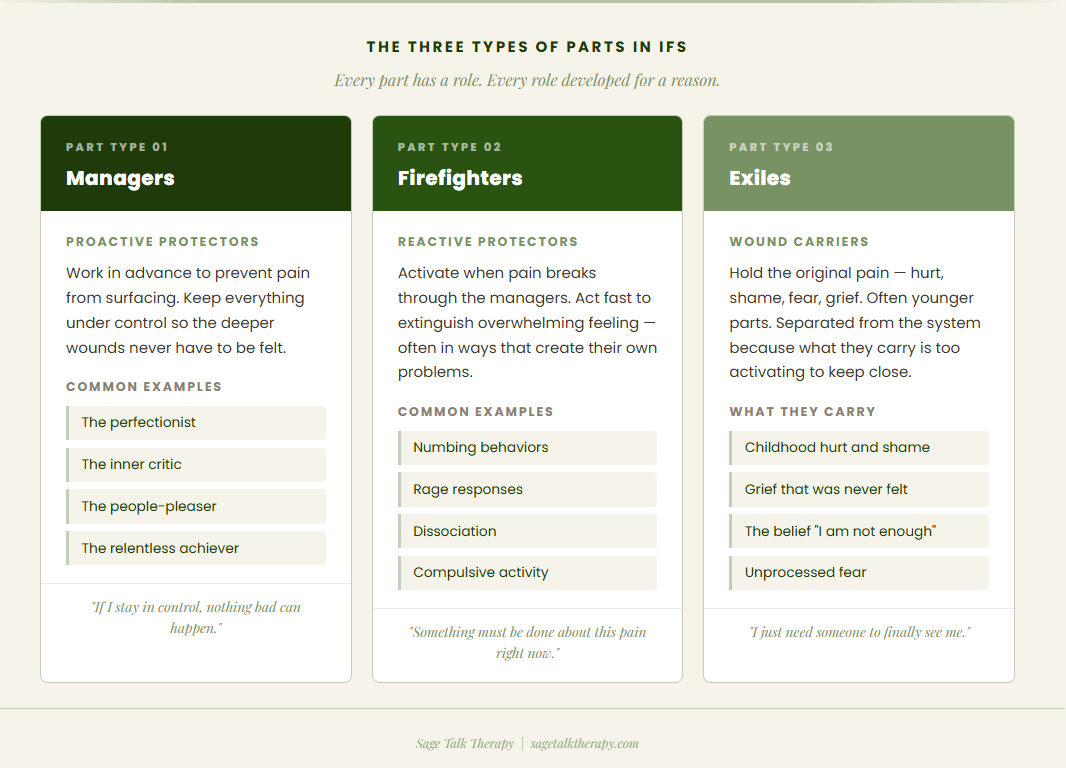
IFS organizes parts into three broad categories. These are not rigid boxes — parts can shift roles — but the framework is useful for understanding what you are working with.
1. MANAGERS
Managers are parts that try to keep things running and prevent pain from surfacing. They are often the most visible parts in daily life. The perfectionist is a manager. The people-pleaser is a manager. The inner critic that finds flaws before anyone else can is a manager. The workaholic who keeps everything in motion is a manager. These parts are working hard and they are proactive — they would rather manage the environment and maintain control than risk what happens when control is lost.
Managers often look like personality traits from the outside. The perfectionist gets called ambitious. The people-pleaser gets called kind. The workaholic gets called driven. What IFS helps illuminate is that these patterns are not simply who the person is — they are parts doing protective jobs. Which means they can change when the conditions that made the protection necessary change.
2. FIREFIGHTERS
Firefighters are parts that activate in response to pain that has already broken through. Where managers try to prevent overwhelming feeling, firefighters respond to it — fast, intensely, and often in ways that create their own problems. Substance use can be a firefighter response. Rage can be a firefighter. Dissociation, binge eating, compulsive behavior — these are often firefighter parts trying to extinguish pain that has become too intense to tolerate.
Firefighters are the parts most often pathologized — labeled as the problem, targeted for elimination. IFS understands them differently. Firefighters are not the enemy. They are responding to real pain, with the most effective tools they have available. The work is not to get rid of them but to understand what they are responding to — and address that.
3. EXILES
Exiles are the parts carrying the pain itself — the hurt, the shame, the grief, the fear. These are often younger parts, carrying experiences from earlier in life that were too overwhelming to process at the time. They have been separated from the rest of the system — exiled — because the experience they carry is too activating for the system to hold near the surface.
Exiles are what the managers and firefighters are working to protect. The managers prevent the exile's pain from surfacing. The firefighters respond when it breaks through anyway. Exiles are not accessed early in IFS work — the system needs to be stabilized and the protective parts need to trust the process before the deeper work can happen safely. But working with exiles is where the most significant and lasting change tends to occur.
The Self
Every explanation of IFS eventually arrives at the Self — and this concept is both the most important and the most commonly misunderstood.
In IFS, the Self is not a part. It is the core of who you are beneath the parts. It is the you that was there before the parts developed their strategies, and that is still there underneath them.
In Internal Family Systems Therapy, the Self represents your truest essence, a state of calm, clarity, compassion, and confidence — often referred to as Self-energy. It's the part of you that can respond to challenges with creativity.
The Self is characterized by qualities that Schwartz describes with the eight Cs:
Curiosity, Calm, Clarity, Compassion, Confidence, Creativity, Courage, and Connectedness.
When you notice yourself observing a difficult internal experience with genuine curiosity rather than judgment, that is Self-energy. When you can hold a part of yourself with compassion rather than trying to fight it, that is the Self at work.
The Self is not damaged by trauma. This is a central and genuinely important claim in IFS: no matter what happened, no matter how many parts developed in response to that experience, the Self is intact underneath them. The parts may have buried it under layers of protection, but it is there.
The overall goals of IFS therapy are to achieve balance and harmony within the internal system — to differentiate and elevate the Self so it can be an effective leader. When the Self is in the lead, the parts will provide input to the Self but will respect the leadership and ultimate decision-making of the Self.
The goal of IFS is not to get rid of parts. It is to help the Self step into its natural leadership role — so that parts no longer have to run the show out of fear, but can trust the Self to lead and step back when they are no longer needed.
Why "no bad parts" is not just a slogan
This phrase gets repeated in IFS contexts often enough to sound like a platitude. It is not. It is a clinical position that has real implications for how the work proceeds — and for how you relate to the most difficult aspects of your own inner experience.
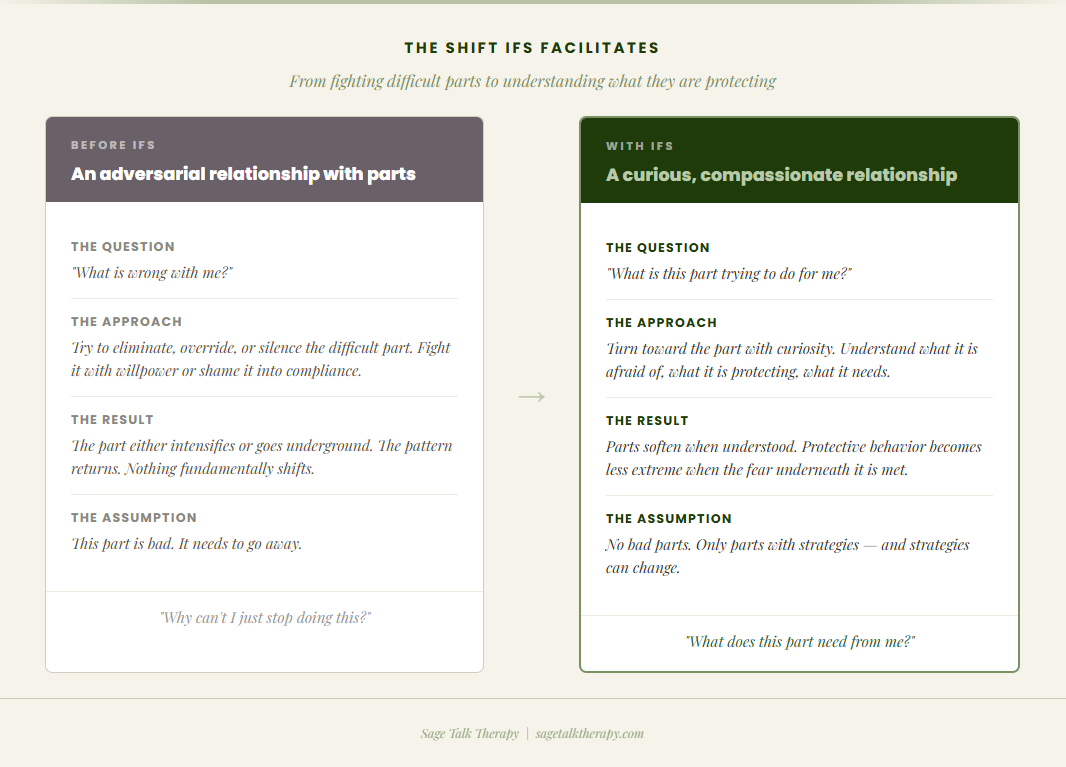
Most people arrive at therapy with a relationship to their difficult parts that is essentially adversarial. The inner critic is the enemy. The anxiety is the problem. The part that keeps self-sabotaging needs to be defeated. The part that is angry or scared or shut down needs to go away.
IFS proposes something different: what if instead of fighting those parts, you got curious about them? What are they afraid of? What are they protecting? What do they need? What would they do if they didn't have to work so hard?
The answer to those questions, consistently, is that even the most difficult parts are protecting something real. The inner critic is preventing rejection. The perfectionist is keeping the threat of failure at bay. The part that shuts down in conflict learned that conflict was dangerous. The part that can't rest is afraid of what happens when things stop.
These are not character flaws. They are strategies. And strategies, unlike character, can change — when the conditions that made them necessary change.
This reframe is particularly meaningful for high-functioning anxious people, who often have long histories of fighting their own patterns rather than understanding them. The shift from "what is wrong with me" to "what is this part of me trying to do" tends to produce a different quality of change than any amount of self-improvement effort.
What IFS work actually looks like
IFS therapy is not primarily about talking about parts in the abstract. It is experiential — meaning the work happens through direct internal engagement with the parts themselves.
In a session, a therapist working in the IFS model might ask you to notice where you feel a particular emotion or state in your body. To turn your attention toward it rather than away from it. To approach it with curiosity and ask what it wants you to know.
The experience of being in relationship with your own parts — approaching the inner critic with genuine curiosity instead of shame or irritation, sitting with the anxious part instead of trying to shut it down — tends to produce something unexpected: the parts often soften. The inner critic, approached with genuine curiosity rather than judgment, frequently reveals something much younger and more frightened underneath the criticism. The part that has been working relentlessly often turns out to be exhausted and grateful to be acknowledged.
This is the mechanism of IFS change. Not the elimination of parts but the transformation of their relationship to the Self — and through that, the transformation of their behavior. A manager part that trusts the Self to handle things can relax its vigilance. A firefighter that is met with understanding rather than shame tends to become less extreme. An exile that finally gets the attention and care it needed can release the burden it has been carrying.
This work also has a nervous system dimension that connects IFS closely to trauma-informed approaches. The activation that accompanies parts — the anxiety, the shame, the vigilance — is not just psychological. It is physiological. Parts work that engages the body as well as the mind tends to produce more complete and lasting change.
IFS and EMDR are often used together in trauma therapy precisely because they address complementary levels of the same material. IFS provides the relational framework for understanding which parts are carrying what, and building enough internal safety to approach difficult material. EMDR facilitates the processing of the experiences those parts are organized around. For clients doing EMDR Intensives, IFS preparation work can significantly deepen what the intensive is able to accomplish.
The parts you might recognize in yourself
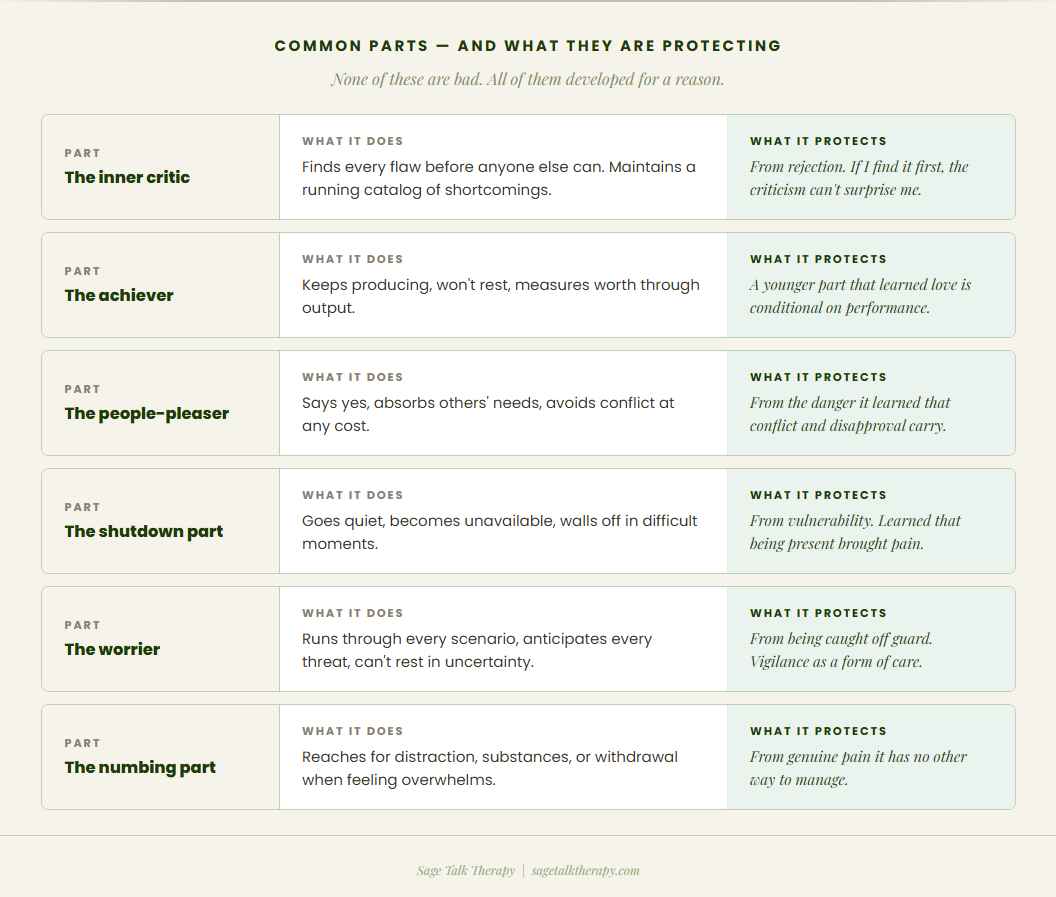
Here are some common parts and what they tend to be protecting. These are not diagnostic categories — they are patterns that show up frequently in clinical work with IFS.
The inner critic
Finds every flaw before anyone else can. The protection is preemptive: if I find it first, the rejection or humiliation can't surprise me. Often connected to experiences where being found wanting had real consequences.
The achiever
Keeps everything running, maintains output, won't rest. Protecting a younger part that learned that worth depends on performance. Terrified of what happens if the producing stops.
The people-pleaser
Says yes, absorbs others' needs, smooths every surface. Learned that conflict is dangerous, that other people's emotional states require management, that harmony is what keeps you safe.
The shutdown part
Goes quiet in conflict, becomes unavailable, walls off. Learned that expressing feeling produces bad outcomes — that being less present is safer than being fully there.
The worrier
Runs through scenarios, anticipates every possible problem, can't let things be uncertain. Trying to prepare you for threats before they arrive. The vigilance is love, in its way, even when it's exhausting.
The numbing part
Reaches for something — food, a screen, a drink, a distraction — when things become too much. A firefighter responding to genuine pain with the best tool it has available.
None of these are bad. All of them developed for reasons. The work is not to eliminate them but to understand what they are carrying — and to give them something better than the strategies they have been using.
if This Resonates
IFS is one of the approaches I draw on consistently in my clinical work — both as a standalone framework and in combination with EMDR for clients working on trauma. If what you have read here sounds like something you want to explore, I would welcome the conversation.

Dadiana Lopez
LCSW · Anxiety & Trauma Therapist · EMDR Specialist
Dadiana Lopez is a Licensed Clinical Social Worker and EMDR therapist based in White Plains, NY. She specializes in anxiety, trauma, PTSD, and the patterns that form in the wake of both — including people-pleasing, perfectionism, and burnout. She sees clients in person in Westchester and online throughout New York and Connecticut.
Seeing clients in-person in White Plains, NY and online throughout New York and Connecticut.