
EMDR for Anxiety: How It Reaches What Talk Therapy Often Can't
Most people who come to EMDR for anxiety have already tried something else.
They have done cognitive behavioral therapy. They have identified the thought patterns, challenged the distortions, built coping strategies. They understand their anxiety — where it comes from, what triggers it, what the underlying beliefs are. They can describe it fluently.
And it is still there. The understanding is real. The anxiety has not moved.
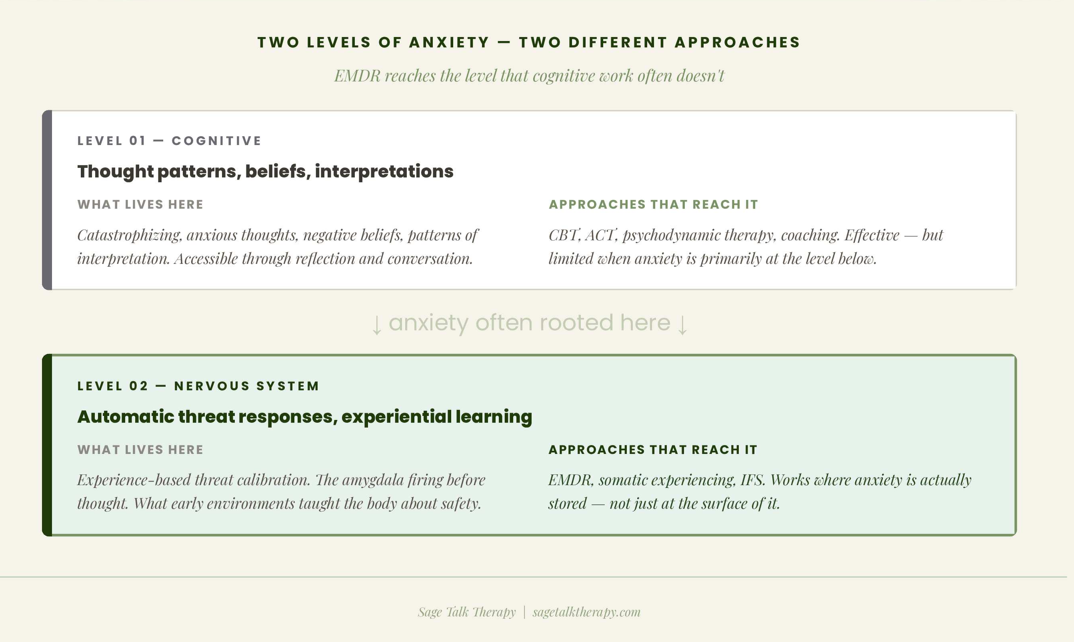
This is the experience that points most clearly toward EMDR. Not because EMDR is a last resort, but because it operates at a different level of the system than the approaches that came before — a level that cognitive work, however thorough, does not consistently reach.
Why anxiety doesn't always respond to cognitive approaches
Anxiety is widely understood as a thinking problem. Anxious thoughts, catastrophizing, cognitive distortions — the cognitive model of anxiety is influential and has generated genuinely effective treatments. CBT has strong evidence for anxiety disorders and has helped many people significantly.
The limitation is that this model does not fully account for where anxiety actually lives for a significant proportion of people who struggle with it chronically.
Anxiety is not only a thinking problem. It is a nervous system state. The racing heart, the shallow breathing, the muscle tension, the sense of threat that arrives before the thinking brain has had time to assess — these are expressions of a sympathetically activated nervous system, not just of anxious thought content.
EMDR creates lasting change because it addresses the root cause by changing how memories are stored and accessed in the brain. When memories shift from feeling like present threats to being recognized as past experiences, anxiety naturally decreases. This reprocessing creates fundamental shifts in how the brain processes situations rather than just temporary symptom relief.
When anxiety has roots in specific experiences, such as in early relational learning, or in experiences that taught the nervous system that threat is frequent and vigilance is necessary — then the anxiety is being generated by a nervous system that has learned something. And nervous system learning does not update through reasoning. It updates through processing.
The anxiety that has roots in experience
Not all anxiety is primarily experience-based. Some anxiety has a predominantly biological basis. Some is situational. Some is maintained primarily by avoidance patterns that behavioral approaches address effectively.
But a significant portion of chronic anxiety — particularly anxiety that has been present for years, that doesn't fully respond to cognitive work, that seems to have a quality older and deeper than current circumstances warrant — has roots in experience. In what the nervous system learned about the world in earlier contexts.
High-functioning anxiety is a particularly common version of this: the chronic low-level vigilance, the relentless internal monitoring, the inability to fully settle even when everything is objectively fine. This kind of anxiety is not primarily about current circumstances. It is the nervous system running a threat-management program it learned to run a long time ago, in an environment where that program made sense.
EMDR is specifically designed to work with experience-based nervous system learning. It helps the brain reprocess the experiences that trained the threat-detection system toward chronic activation — and when those experiences are processed, the threat response they were maintaining tends to quiet.
EMDR therapy for anxiety has shown significant results across seventeen clinical trials with 647 participants, demonstrating significant reduction in anxiety symptoms with a moderate to large effect size. It is particularly effective for trauma-related anxiety and generalized anxiety disorder.
What EMDR is actually doing when it addresses anxiety
When anxiety has roots in experience, there are usually identifiable experiences, relationships, or periods of life that trained the nervous system toward vigilance. They may be clearly traumatic — an abusive relationship, a medical event, a specific loss. Or they may be subtler — the texture of growing up in a home where emotional safety was inconsistent, the accumulated experience of having needs that were not reliably met, the early learning that staying on alert was what kept things manageable.
EMDR identifies those root experiences — the ones that are driving the current anxiety pattern — and facilitates their processing at the nervous system level. Here is what that achieves:
The threat response updates. The experiences that trained the nervous system toward hypervigilance are held, with bilateral stimulation running, until the brain reprocesses them as past rather than ongoing. When the memory no longer carries the quality of current threat, the threat response it was maintaining quiets. The amygdala, which has been firing at anxiety-related triggers, becomes less reactive. The prefrontal cortex, which has been offline during activation, can come back online. The nervous system's baseline threat level drops.
The negative beliefs that anxiety is organized around shift. Most chronic anxiety is associated with a negative belief about the self or the world: "I am not safe," "I cannot handle what happens," "Something bad is about to happen," "I am fundamentally at risk." These beliefs are not primarily cognitive. They are encoded in the nervous system through experience. EMDR processing works with those experiential roots, and as the root experiences are reprocessed, the beliefs they supported often shift without explicit cognitive work being done on them.
The anxiety that drives perfectionism and people-pleasing loses its fuel. For clients whose anxiety is expressed primarily through perfectionism, over-achieving, people-pleasing, or chronic over-functioning, EMDR addresses the fear-based experiences underlying those patterns. When the experiences that taught the nervous system that falling short was dangerous are processed, the urgency that drives the perfectionism quiets. The standards can stay. The dread underneath them doesn't have to.
What kinds of anxiety respond well to EMDR
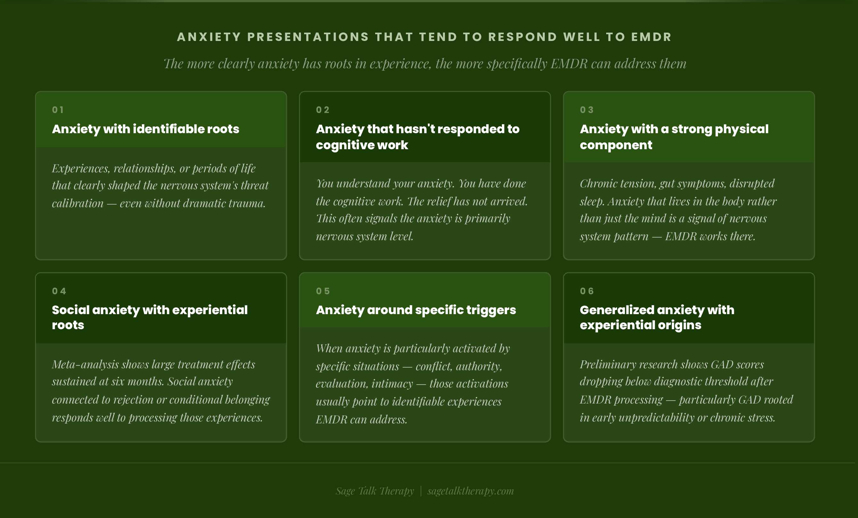
EMDR is not a universal solution for all anxiety presentations. But for the following, it is often particularly effective.
Anxiety with identifiable roots.
When you can point to experiences, periods of your life, or relational environments that clearly shaped your anxiety — even if those experiences were not dramatically traumatic — EMDR has clear targets to work with. The more identifiable the roots, the more specifically EMDR can address them.
Anxiety that has not fully responded to cognitive work.
If CBT or other cognitive approaches have helped you understand your anxiety but have not produced lasting relief, this is often a signal that the anxiety is primarily at the nervous system level rather than the cognitive level. EMDR is designed for exactly this presentation.
Anxiety with a strong physical component.
Chronic tension, digestive symptoms, disrupted sleep, the sense that anxiety lives in the body rather than just the mind — these are signals that the anxiety is being maintained by a nervous system pattern. EMDR works at that level.
Social anxiety with experiential roots.
Meta-analysis shows EMDR has a large treatment effect on social anxiety, sustained at six-month follow-up. The sustained benefits suggest EMDR creates fundamental shifts in how social situations are processed rather than just temporary symptom relief. Social anxiety that is connected to experiences of rejection, humiliation, or conditional belonging tends to respond well to EMDR processing of those experiences.
Anxiety around specific situations or triggers.
When anxiety is particularly activated by specific situations — confrontation, authority figures, being evaluated, intimacy, certain types of relationships — those specific activations usually point back to identifiable experiences. EMDR can process those experiences directly.
Generalized anxiety with a diffuse quality.
Preliminary research on EMDR for generalized anxiety disorder found that anxiety and worry scores dropped to below diagnostic threshold after fifteen EMDR sessions, with participants no longer presenting with GAD diagnosis at post-treatment and two-month follow-up. GAD that is rooted in early experiences of unpredictability or chronic stress can respond significantly to EMDR processing of those root experiences.
What EMDR for anxiety looks like in practice
EMDR for anxiety follows the same structure as EMDR for other presentations, with a few specifics worth knowing.
The preparation phase involves identifying the anxiety's roots as specifically as possible — the experiences, relationships, and early environments that trained the nervous system toward the current threat calibration. This is often genuinely clarifying work in itself. Many clients arrive understanding their anxiety as a present-tense problem and leave the preparation phase with a clear picture of where it actually comes from.
Treatment targets are identified from those roots. Sometimes the target is a specific experience. Sometimes it is a representative memory — a memory that captures the quality of a relational environment or a period of life. Sometimes it is the earliest memory associated with the anxiety pattern, worked forward through the network of connected experiences.
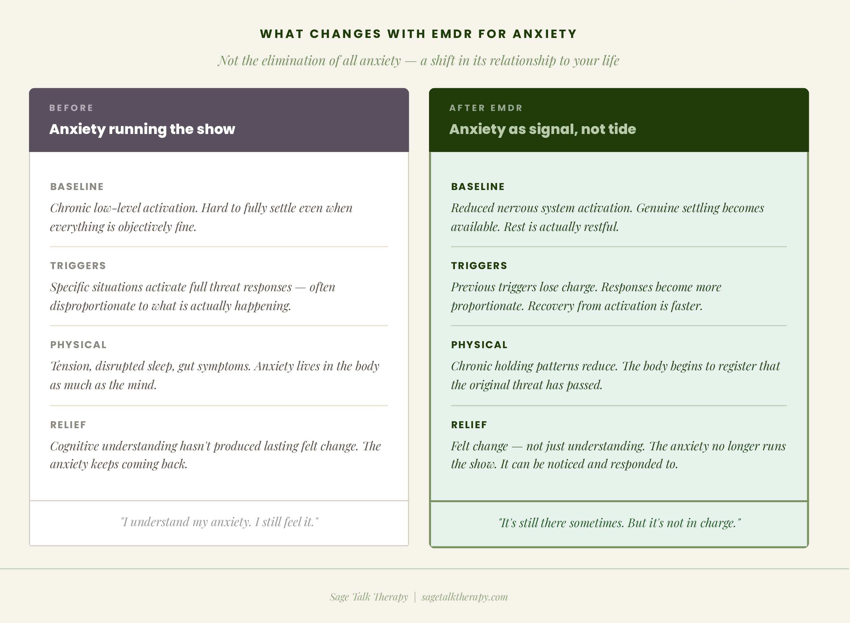
During processing, clients typically notice the anxiety shifting in quality rather than simply in intensity. The vigilance that felt constant may become intermittent. Situations that previously activated full threat responses may begin to feel manageable. The baseline nervous system state drops. The window of tolerance widens.
Most clients describe the change not as the elimination of all anxiety but as a shift in the anxiety's relationship to their lives. It is no longer running the show. It is a signal that can be noticed and responded to rather than a tide that takes over.
For clients who want to address anxiety efficiently — who have a clear sense of the roots and want to work through them without the interrupted pace of weekly sessions — EMDR Intensives offer extended processing time that allows the work to move more quickly. Many clients find that the concentrated depth of an intensive produces shifts that feel more complete than what weekly sessions achieve in the same total number of hours.
A NOTE on Nervousness Itself
It is worth being clear about this:
EMDR for anxiety is not relaxation training. It is not a calming experience.
The processing sessions involve real activation — the anxiety-related material needs to be present enough to process. Clients who expect EMDR to feel like a gentle, soothing experience are sometimes surprised by the intensity of the processing phase.
What the processing produces is not calm during the session but relief after it. The session requires engagement with difficult material. The nervous system does the reprocessing. The relief tends to arrive in the hours and days following rather than during the session itself.
If the idea of that activation makes you nervous, that is worth addressing directly before you start. The fears are real and deserve honest answers rather than dismissal.
EMDR for anxiety also requires adequate preparation. Clients who are in active crisis, who have very narrow windows of tolerance, or who do not yet have stabilization resources are not ready for processing. The preparation phase builds what is needed. This is not a delay — it is what makes the processing safe and effective.
if Your Anxiety Has Felt Unresponsive to What You Have Tried
The experience of understanding your anxiety deeply and still feeling it is one of the most frustrating things I hear from clients. The insight is real. The understanding is genuine. And the relief has not arrived.
EMDR is often the most direct path to that relief — not because it is more powerful than cognitive approaches, but because it is working at the level where the anxiety actually lives.
I offer EMDR therapy and EMDR Intensives in White Plains, NY and online throughout New York and Connecticut. If what you have read here describes your experience, I would welcome the conversation.
Learn more about Anxiety Therapy.

Dadiana Lopez
LCSW · Anxiety & Trauma Therapist · EMDR Specialist
Dadiana Lopez is a Licensed Clinical Social Worker and EMDR therapist based in White Plains, NY. She specializes in anxiety, trauma, PTSD, and the patterns that form in the wake of both — including people-pleasing, perfectionism, and burnout. She sees clients in person in Westchester and online throughout New York and Connecticut.
Seeing clients in-person in White Plains, NY and online throughout New York and Connecticut.