
Common Fears About EMDR — And What I Tell Clients Who Are Nervous to Try It
Most people who reach out about EMDR are at least a little nervous about it.
Sometimes it is the eye movements — the image is strange, the idea of following a therapist's finger or a light while thinking about something painful sounds both odd and uncomfortable. Sometimes it is the fear of being overwhelmed, of opening something that has been sealed shut for a long time and not being able to close it again. Sometimes it is the worry that it will not work, that nothing will, and that trying and failing will make the original pain worse. Sometimes it is the fear of what might surface — memories, emotions, physical sensations that have been carefully managed and never fully felt.
All of these fears make sense. They are not signs of avoidance or weakness. They are intelligent responses to the idea of doing something unfamiliar with your most difficult material.
What I want to do in this post is answer them honestly — not reassure you that everything will be fine, but actually address what the fears are responding to and tell you what is true. Because the fears deserve real answers. And real answers, I have found, are more settling than blanket reassurance.
"I'm afraid I'll be overwhelmed."
This is the most common fear, and it deserves the most thorough answer.
EMDR works by activating the nervous system's natural processing mechanism. That process requires you to hold something difficult in mind while the bilateral stimulation runs. It is not passive. It is real work. And yes, during processing, difficult material surfaces — emotions, physical sensations, memories, associations.
Here is what I tell clients who are afraid of being overwhelmed:
The entire structure of EMDR therapy is designed around preventing exactly that.
Effective EMDR operates within the window of tolerance. It is specifically designed to keep processing within the range of what the nervous system can hold — activating enough to move the material, never so much that the client is flooded and loses their footing. This is managed through preparation, through careful pacing, and through the therapist's continuous monitoring of how much activation the client is carrying at any given moment.
The preparation phase is not a formality. It is where the stabilization resources that allow the processing to be tolerable are built. Grounding techniques, resourcing, the internal sense of a safe place to return to — these are developed specifically so that when difficult material surfaces during processing, you have something to hold onto.
And sessions have a thorough closing phase. No well-run EMDR session ends with the client activated. The therapist ensures you are settled before you leave. Whatever was opened is carefully contained before the session ends.
What I tell clients:
You will feel things during processing. That is the point.
But feeling things within a carefully held container is very different from being overwhelmed. The fear of overwhelm is often about what uncontained activation felt like at the time of the original experience. EMDR processing is contained.
"I'm afraid of reliving the trauma."
There is a natural fear among clients about reliving trauma. Although EMDR is not about re-experiencing pain, the therapy does require addressing difficult memories, which can feel intimidating.
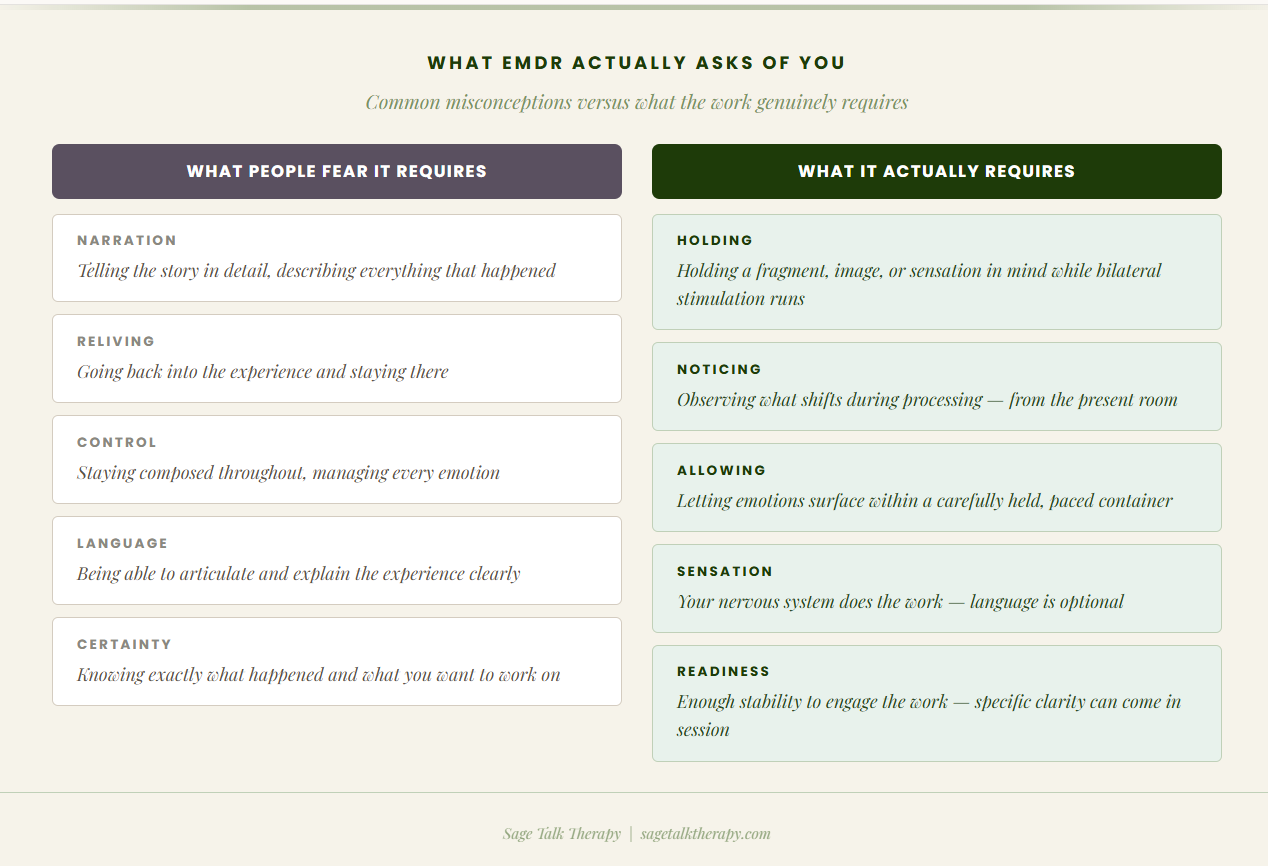
Here is the distinction that matters: EMDR is not exposure therapy. You are not asked to narrate what happened in detail, to describe the experience repeatedly, or to sustain prolonged contact with the memory. You hold it in mind — sometimes just a fragment, an image, a sensation — while the bilateral stimulation runs. The memory is present but not dwelt in.
What clients typically describe during processing is not reliving — it is more like the memory moving. Images shift. Emotions change. The material is alive and in motion rather than static and overwhelming. Clients are observing and noticing rather than immersed. The bilateral stimulation keeps part of the attention in the present room, which is what prevents the processing from becoming re-traumatization.
There is also something important to understand about the difference between current experience and past experience during EMDR. The memory is from the past. You are in the present. The bilateral stimulation is activating your brain's present-moment processing system while the memory is being held. The experience is dual — part of you is here, part of you is with the material — and that dual attention is what allows reprocessing rather than re-traumatization to happen.
What I tell clients:
You will be present in the room the entire time. I am with you. We are moving through the material together, not going back into it alone.
"I'm afraid of losing control."
This fear has several forms. The fear that emotions will surface that cannot be managed. The fear of crying and not being able to stop. The fear that something will open that cannot be closed. The fear of what will happen between sessions if the material is stirred up.
On emotions surfacing: they will. Grief, fear, anger, shame — these often surface during processing, sometimes with significant intensity. This is not loss of control. This is the processing happening. The emotion is the nervous system releasing what it has been holding. In my clinical experience, the relief that follows significant emotional release during processing is one of the most consistent things clients report. It is not destabilizing — it is integrating.
On not being able to close it: every EMDR session ends with a closing protocol. If processing is incomplete when the session ends — which is common and expected, particularly in early sessions — we close the material deliberately and carefully. You leave with whatever was opened contained rather than raw. Over time, you develop an increasing capacity to move in and out of the material without it spilling into the rest of your life.
Some clients report increased emotional sensitivity, vivid dreams, and temporary distress in the days following a session. These tend to arise because the therapy brings suppressed emotional content to the surface. They typically settle as the reprocessing completes. This is normal and worth knowing in advance. The days after a processing session can feel emotionally tender. Building in lighter scheduling after sessions is something I encourage all EMDR clients to do.
What I tell clients:
The control that gets temporarily loosened during processing is the control that has been holding the pain in place. Loosening it is the work. It is held, paced, and supported.

"I'm afraid it won't work."
This fear is different from the others. It is not about the process being too intense — it is about having tried things before that did not change the fundamental experience of carrying this, and not wanting to be disappointed again.
If previous therapy produced insight without felt change, that experience is clinically meaningful. It points toward the gap between cognitive understanding and nervous system-level processing — the gap EMDR is specifically designed to bridge.
Here is what the research shows. EMDR is endorsed by the World Health Organization, the American Psychological Association, and the Department of Veterans Affairs as an evidence-based treatment for PTSD. Multiple meta-analyses confirm its effectiveness across trauma types. It is one of the most thoroughly researched trauma treatments available.
But research averages are not individual predictions. What I tell clients about the fear that it will not work is this: the most common reason EMDR does not produce the expected result is that it was not implemented in a way that matched what the client actually needed. Too fast. Insufficient preparation. Wrong target. Approach not calibrated to the client's specific nervous system. Not inadequate as a modality — inadequate as an implementation.
A thorough preparation phase, honest ongoing communication about what is and is not shifting, and an approach calibrated to your specific history and nervous system are what I build into the work. If something is not moving the way it should, that is clinical information that changes the approach — not evidence that change is impossible.
What I tell clients:
The fear that it won't work is often the fear that you are beyond help. You are not. The question is whether the approach has been right for you — and that is worth finding out.
"I'm afraid of what might surface that I don't remember."
The concern here is about repressed or forgotten memories — the fear that EMDR will excavate something that has been buried for a reason and that knowing it will make things worse rather than better.
There are two things worth separating here:
First, EMDR does not excavate hidden memories in the way this fear imagines. Processing works with what the nervous system is already carrying — the sensations, beliefs, and emotional responses that are already affecting your life. It does not force material that is genuinely inaccessible into consciousness.
What sometimes happens is that during processing, associated memories surface — things that are connected to the target experience in ways the client was not consciously aware of. This is the brain reprocessing a network of connected experiences, not suppressed material being forced to the surface. And when it happens, it happens in the context of the processing session, with the therapist present.
Second, even when material surfaces that the client was not expecting, it surfaces in a context designed to process it rather than simply expose it. The session is structured to work with whatever emerges. If something significant comes up, we work with it. The client does not leave with raw, unprocessed material and no support.
What I tell clients:
EMDR will not show you things that are going to destabilize you without support. If something significant surfaces, it surfaces into the work.
"The eye movements seem strange. Is this actually science?"
A reasonable concern, and one worth addressing directly.
EMDR looks unusual because it is unusual. Following a therapist's moving finger or a light bar while holding a distressing memory in mind is not what most people associate with therapy, and the strangeness of it can feel like a reason for skepticism.
The skepticism is understandable, but the evidence is robust. Bilateral stimulation is thought to mimic the processing that occurs during REM sleep, when the brain consolidates and integrates difficult experiences. When EMDR activates this mechanism during a session, emotions, physical sensations, and memories can surface intensely — and this is not the therapy going wrong.
The exact mechanism by which bilateral stimulation facilitates processing is still being studied. There are multiple competing theories, and the research has not definitively resolved which one is correct. What has been established definitively is that it works — across populations, across trauma types, across multiple independent research programs. The mechanism is debated among researchers; the efficacy is not.
Eye movements are the most common form of bilateral stimulation but not the only one. Tapping and audio tones are also used, with equivalent effects. If the eye movements feel distracting rather than helpful, other forms can be used.
What I tell clients:
The strangeness of it is real. The evidence is real too. Most clients find that after the first processing set, the eye movements fade into the background and the processing takes over. The strangeness stops registering.

"What if I feel worse between sessions?"
After an EMDR session, clients may notice increased emotional sensitivity, vivid dreams, and surfacing memories. These side effects tend to arise because the therapy brings suppressed emotional content to the surface. They typically resolve within a day or two as reprocessing completes.
The days after a processing session can be tender. Sometimes more material is available to consciousness. Dreams can be more vivid as the brain continues integrating at night. There can be a sense of emotional proximity to things that were previously more distant.
This is normal. It is not the therapy going wrong — it is the nervous system continuing to process what was activated in session. The container of the session starts the work. The nervous system completes it over the following hours and days.
What helps in this window: lighter scheduling where possible, gentle physical activity, spending time outdoors, staying connected to the grounding resources developed in the preparation phase. Avoiding high-stakes situations, important decisions, or demanding social obligations in the days immediately after a processing session is something I actively encourage clients to build into their planning.
For clients who want the most supported integration experience, EMDR Intensives offer the advantage of extended processing time with built-in closure and integration support, rather than leaving after fifty minutes with processing still in motion.
What I tell clients:
Plan the days after processing. Give yourself space. The tenderness is temporary and it means the work is happening.
"I don't know if I can talk about it."
This one comes up more often than people might expect, and it carries particular weight.
EMDR does not require a detailed verbal narrative of what happened. You do not need to tell the story. You do not need to describe the experience in explicit detail, relive it in words, or explain it to me before we can work with it.
You hold it. I run the bilateral stimulation. The processing happens at the nervous system level — in physical sensation, in the emotional experience, in the shifts that occur during the set — and most of that is internal rather than verbal.
Clients process experiences in EMDR that they have never been able to put into words. The absence of language around what happened is not a barrier. In some ways, the non-verbal nature of EMDR processing is exactly what makes it accessible to experiences that language has never been able to reach.
What I tell clients:
You do not need to be able to talk about it. Your nervous system knows what it is carrying. We are working with that — not with the story of it.
A NOTE on Nervousness Itself
Here is something I notice consistently: the clients who are most nervous about EMDR are often the ones for whom it produces the most significant shifts.
The nervousness is not random. It is the nervous system's response to the prospect of approaching material that has been carefully kept at a distance. The anxiety around starting is often the same anxiety that has been organized around the original experience — and the fact that it is activated by the idea of approaching it is, in its own way, evidence that there is something real there to work with.
Being nervous is not a contraindication. It is not a sign you are not ready. It is a sign you are taking the prospect seriously. That seriousness is something to work with, not through.
The consultation is the right place to bring the fears. Not to be reassured away from them — to have them met honestly, so you can make a real decision about whether this is the right step for you right now.
if You Are Nervous and Considering It
Bring the fears to a consultation. That is what the consultation is for — to hear where you are, address what is making you hesitant, and give you an honest read on whether EMDR is likely to be a good fit for what you are carrying.
No commitment required. Just a conversation.

Dadiana Lopez
LCSW · Anxiety & Trauma Therapist · EMDR Specialist
Dadiana Lopez is a Licensed Clinical Social Worker and EMDR therapist based in White Plains, NY. She specializes in anxiety, trauma, PTSD, and the patterns that form in the wake of both — including people-pleasing, perfectionism, and burnout. She sees clients in person in Westchester and online throughout New York and Connecticut.
Seeing clients in-person in White Plains, NY and online throughout New York and Connecticut.