
The holidays are built around a table you may not be sitting at this year.
Every commercial, every card, every "what are your plans" question assumes a version of family that may not be true for you anymore. If you're estranged from a parent, sibling, or someone else close, this time of year can bring a specific kind of dread that doesn't show up the rest of the year.
This isn't about talking you into reconciliation, and it isn't about talking you out of it either. It's about getting through the season on your own terms.
Why this grief feels so different
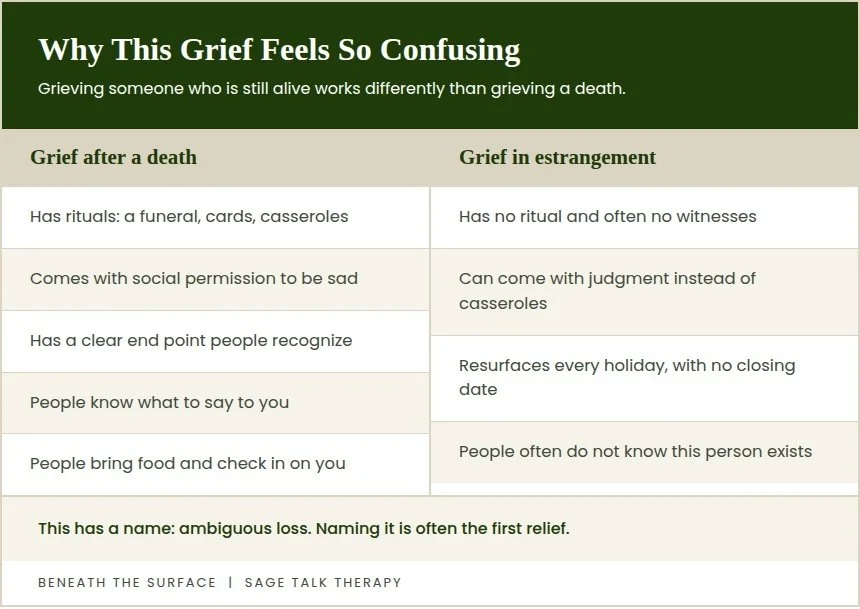
When someone dies, grief comes with structure. There's a funeral, people bring food, and everyone around you knows the shape of what happened. Estrangement grief doesn't work that way. The person is still alive, maybe posting on social media, maybe still showing up at gatherings you're not at. There's no ritual for this, and often no one around you who even knows there's something to grieve.
This has a name. It's called ambiguous loss, and naming it is often the first relief people describe. You are not doing grief wrong. You're doing a harder version of it, one your culture never gave you a script for. If you've wondered whether what you went through even counts as something worth grieving, that question is worth its own look.
The dread that starts before the day does
If you've noticed the heaviness creeping in weeks before the holiday, that's a familiar pattern for a lot of people who've been through this. Your body may be bracing based on what these days have meant before. That's a form of nervous system dysregulation, and it's worth understanding rather than fighting.
Naming that pattern to yourself can take some of its power away. You're not walking into the unknown. You're walking into something your body already knows, and this time you get to decide how to meet it.
You don't owe anyone a holiday truce
There's a specific pressure that shows up this time of year: the idea that November and December are when old fights are supposed to get set aside. You don't owe anyone that. Estrangement that made sense in July doesn't stop making sense in December just because there's a tree up.
At the same time, some people do choose to open the door a little during the holidays, a short call, a card, a single visit. That's not a step backward either. There's no single right way to do this, and the choice can look different every year.
If people ask questions, you get to decide how much of your story they receive. A short, closed answer is enough: "We're doing our own thing this year, but thank you for asking." That closes the question without opening a conversation you didn't sign up for. You don't need to justify your situation to people who are only asking to make small talk.
Build your plan before the day arrives
The best time to make these decisions is now, while you're calm and thinking clearly, not in the moment when someone corners you at a party or a text catches you off guard and you're scrambling for a response. A plan you've already made is something you can lean on. A plan you're inventing on the spot is just another thing to manage on top of everything else the day is asking of you.
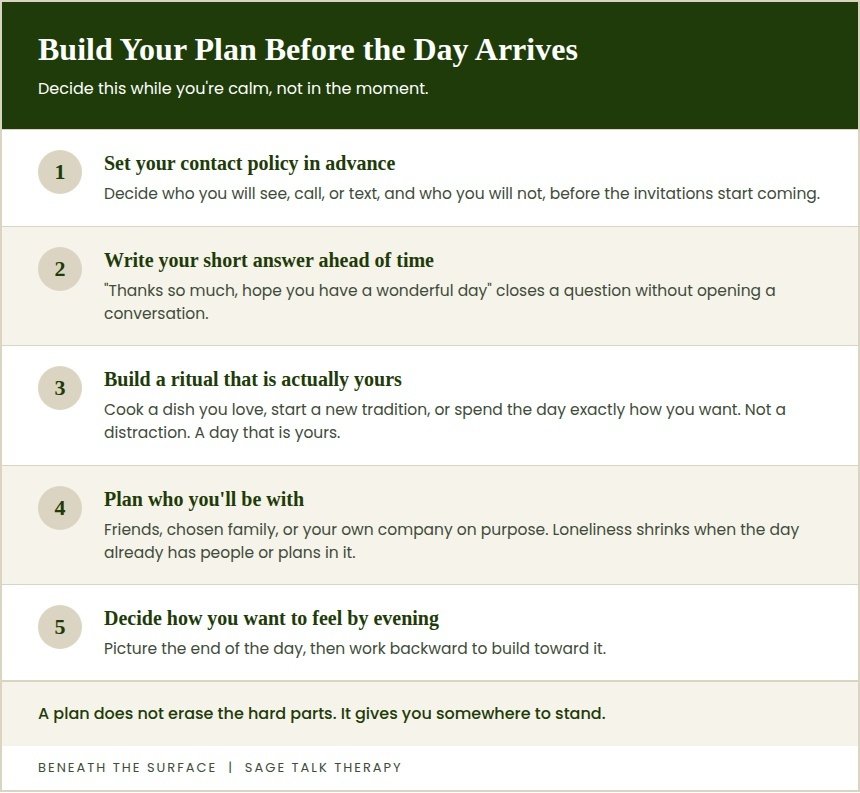
None of this makes the day easy. What it does is give you something steadier to stand on than reacting to whatever comes at you. Start from how you want to feel by the time the evening winds down, then work backward from there. Deciding the shape of the day ahead of time tends to carry people through it far better than trying to survive it moment by moment.
Guilt is not the same as wrongdoing
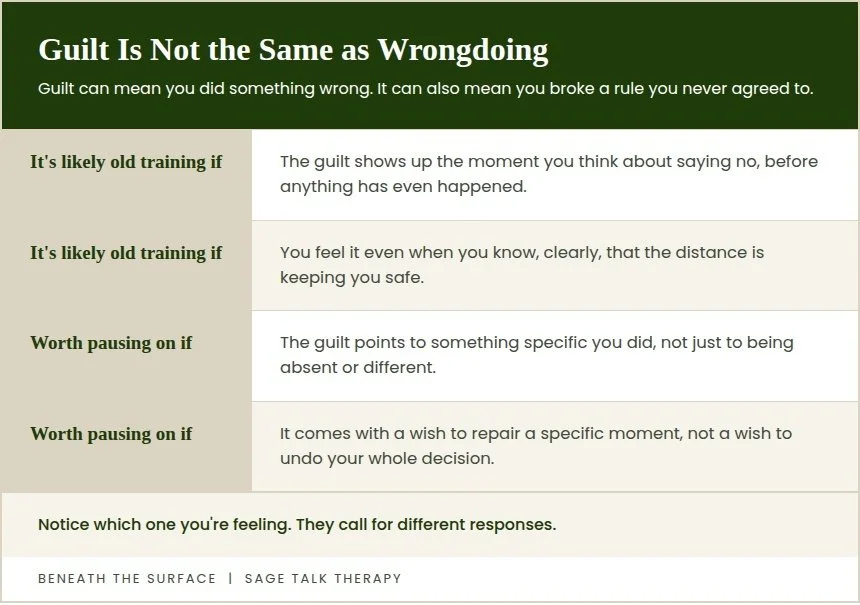
Guilt has a way of getting loud around the holidays, especially if you were raised to believe family comes first no matter what. If saying no has always felt dangerous, not just uncomfortable, that pattern likely didn't start with this holiday.
It helps to ask what the guilt is actually pointing at. Sometimes it's pointing at something real, a specific moment you'd want to repair. More often, especially around estrangement, it's pointing at an old rule: family gatherings are mandatory, saying no is a betrayal, distance means you did something wrong. That's not guilt about wrongdoing. That's guilt as training, and it deserves a different response.
Build a day that's actually yours
This isn't about filling the day with distractions so you don't have to feel anything. It's about building something real, and it can take a lot of different shapes.
For the day itself:
Cook a dish that's yours, not one inherited from the family gathering you're not at
Start a tradition from scratch: a specific movie, a hike, a project you've been meaning to start
Host a small gathering with friends or chosen family, even if it's just one or two people
Spend the day fully alone on purpose: a long walk, music you love, a book, a slow morning with no agenda
Volunteer or spend part of the day doing something for someone else, if that feels like it fits you
For loneliness:
Isolation tends to grow in unstructured hours. Give the day some bookends: a call with a friend in the morning, plans with someone in the evening, even if the middle of the day is quiet. You don't need the whole day filled, just enough connection that you're not alone with it start to finish.
For guilt:
When it spikes, name it out loud or in writing: "this is the old rule talking, not something I actually did wrong." That doesn't make the guilt disappear, but it stops it from running the day.
For the feeling of being left out or left behind:
Even when estrangement was the right call, there can be a real ache of feeling like everyone else has a family gathering and you don't. That feeling is grief, not a sign you made the wrong choice. Let it be there without needing to fix it or argue yourself out of it. It tends to move through faster when it's allowed to exist than when it's pushed away.
If you grew up in a first-generation household, this can carry extra weight, since the holidays are often tied closely to cultural identity, food, language, and community, not just to one family. Building something of your own doesn't mean giving that up. It can mean choosing which parts you keep.
Whatever you build, let it be something you'd choose again, not just something that fills the hours until the day is over.
if the grief is bigger than the day
Some years this is manageable.
Other years it isn't.
That's not a sign you're handling it wrong. If the ambiguous loss, the guilt, or the old patterns feel like more than you can carry through the season, that's worth bringing to a therapist rather than carrying alone. In my work, I use EMDR and IFS to help people process the grief and old family roles that estrangement often stirs up, especially this time of year.
if YOU’RE READY TO TALK
I work with individuals and couples in Westchester, NY and online throughout New York and Connecticut. If the holidays bring up more than you want to carry alone, you're welcome to reach out for a consultation.
Learn more about Internal Family Systems.

Dadiana Lopez
LCSW · Anxiety & Trauma Therapist · EMDR Specialist
Dadiana Lopez is a Licensed Clinical Social Worker and EMDR therapist based in White Plains, NY. She specializes in anxiety, trauma, PTSD, and the patterns that form in the wake of both — including people-pleasing, perfectionism, and burnout. She sees clients in person in Westchester and online throughout New York and Connecticut.
Seeing clients in-person in White Plains, NY and online throughout New York and Connecticut.