
The question comes up in almost every intake I do with a new client.
Sometimes it is asked directly: "Do you think what I experienced was actually traumatic?" Sometimes it arrives sideways: "I know other people have been through much worse." Sometimes it is just present in the room — the slightly apologetic quality to how someone describes what happened to them, the qualification that arrives before every difficult thing they share.
The question of whether something counts as trauma stops a significant number of people from getting help they genuinely need. They minimize what happened. They compare it to something more dramatic and find their own experience lacking. They decide it wasn't bad enough. And they continue carrying something that has been affecting them for years, sometimes decades, because they have not been able to give themselves permission to call it what it is.
This post is an attempt to answer that question honestly — what trauma actually is, why the clinical definition is narrower than the lived reality, and how to assess your own experience without the comparison trap that keeps so many people stuck.
What the clinical definition gets right and what it misses
Trauma, as defined by the DSM-5-TR, involves exposure to actual or potential situations such as death, severe injury, or sexual violation. This exposure can occur through directly experiencing traumatic events, witnessing them firsthand, learning about trauma experienced by family or friends, or repeatedly being exposed to distressing details of traumatic events.
This definition has value. It establishes that trauma is not limited to direct personal experience — witnessing something, or learning about something that happened to someone close to you, can be traumatic. It also acknowledges that repeated exposure to others' traumatic material, as happens with first responders and medical professionals, can produce a trauma response.
But it is a narrow definition, built primarily around the most severe and categorical forms of threat. And it misses a significant range of experience that produces the same physiological and psychological effects.
The American Psychological Association defines trauma more broadly as any disturbing experience that results in significant fear, helplessness, dissociation, confusion, or other disruptive feelings intense enough to have a long-lasting negative effect on a person's attitudes, behavior, and other aspects of functioning.
This broader definition is more clinically useful — and more accurate to the lived experience of the people I see in practice. The criterion is not the objective severity of what happened. It is the impact on the person's functioning. And that impact depends not only on what happened but on when it happened, what resources were available, how the person was supported, what else was happening at the time, and what the nervous system learned as a result.
The question that actually matters
Here is the reframe that changes the most for people who are stuck on whether their experience counts.
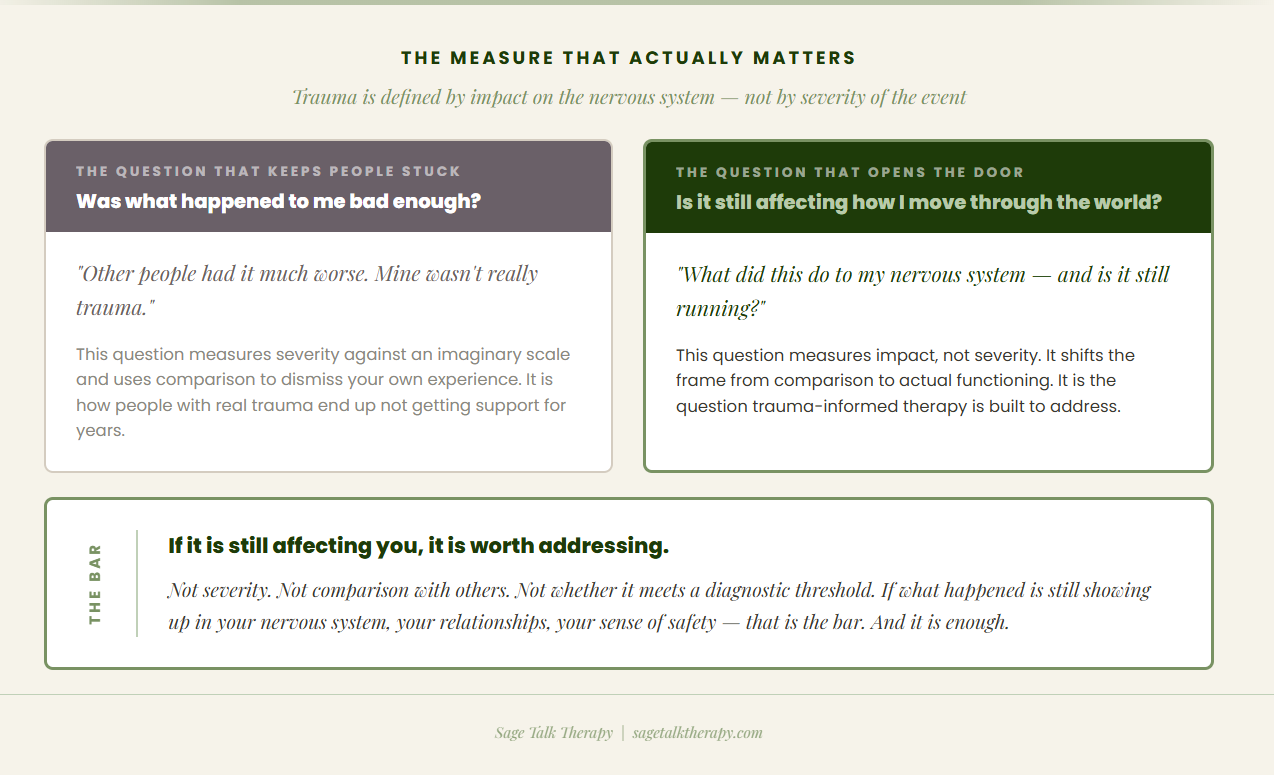
The question is not: was what happened to me bad enough?
The question is: what did it do to my nervous system — and is it still affecting how I move through the world today?
Trauma is not defined by the event. It is defined by the response. Two people can experience the same thing and one will be significantly affected while the other is not. This is not about strength or weakness. It is about the specific conditions under which the experience happened — the person's age, their existing resources, whether they had support, whether they had any control over the situation, and what their nervous system was already carrying at the time.
Trauma lives in the body as a physiological state — a nervous system that was overwhelmed at the time of the experience and never fully completed the processing. What makes an experience traumatic is not its severity on some objective scale. It is the degree to which it overwhelmed the nervous system's capacity to integrate what was happening.
A car accident that lasts thirty seconds can be more traumatic than a year of chronic stress — or less. A parent's emotional unavailability across an entire childhood can produce more lasting nervous system dysregulation than a single acute frightening event — or less. The variables are not fully predictable. What is consistent is the mechanism: when the nervous system is overwhelmed beyond its capacity to process, the experience leaves a mark that keeps affecting functioning long after the event is over.
Big-T and small-t trauma
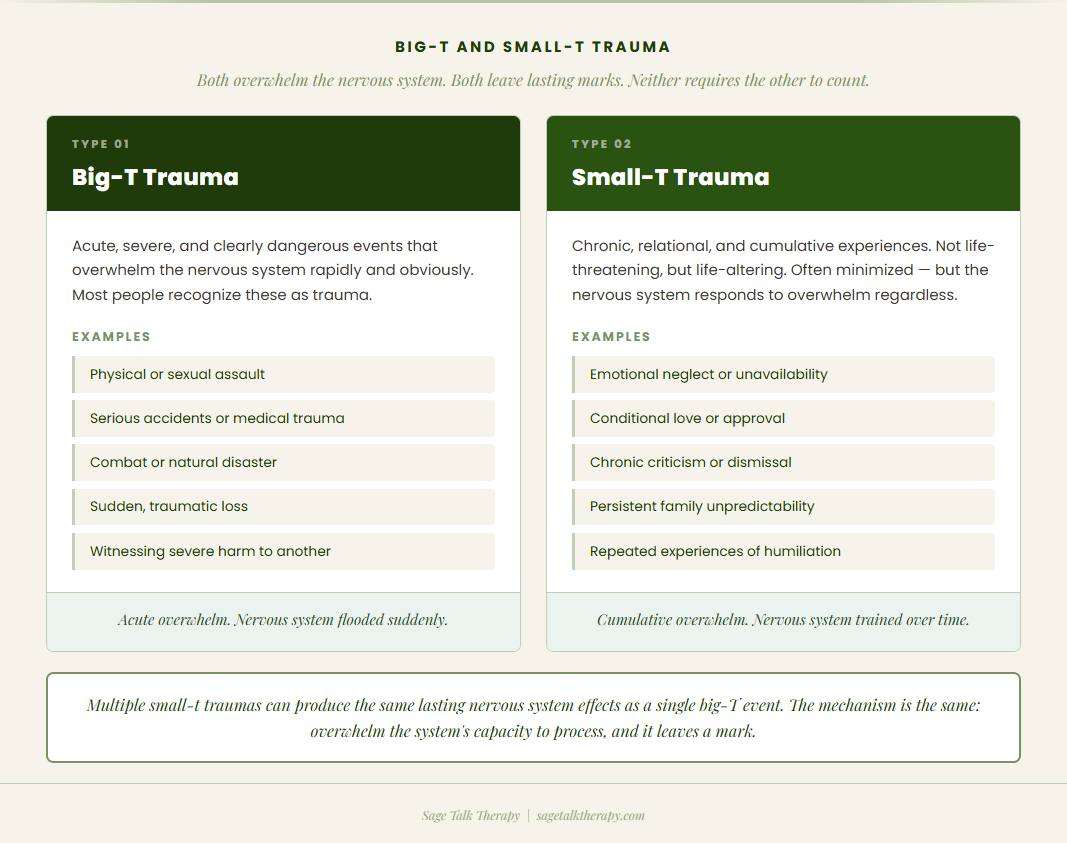
Therapists often use the ideas of "big-T" trauma and "little-t" trauma to help us understand how seemingly small things can traumatize us.
Big-T trauma refers to the clearly dangerous and extreme events we already associate with the word "trauma."
Little-t trauma refers to events and circumstances that are life-altering but not life-threatening.
These situations may seem ordinary, but they can still produce a trauma response and damage mental health. Multiple little-t traumas can build up over time and cause the kinds of severe symptoms that usually come from big-T traumas.
This distinction is clinically useful — not because the categories are rigid, but because it names something real about how trauma works. Big-T trauma is the kind most people recognize: assault, accidents, disasters, combat, abuse, sudden loss. The nervous system is overwhelmed acutely and severely. These experiences leave obvious marks.
Little-t trauma is subtler and far more common — and it is where most of the minimization happens. Persistent emotional neglect. Growing up in a home where conflict was constant or where expressing need was unsafe. A childhood defined by unpredictability or by conditional love. A relationship characterized by chronic criticism, control, or dismissal. Repeated experiences of humiliation, exclusion, or not being believed.
These experiences do not look like trauma in the way that phrase is commonly understood. But they produce the same physiological effects: a nervous system that learned to stay on alert, that calibrated its threat-detection system to an environment of chronic stress, that developed strategies to manage what it could not resolve.
The childhood experiences that most shape adult anxiety and relational patterns are frequently little-t experiences — not single catastrophic events but the accumulated texture of what it was like to grow up in a particular environment. The nervous system does not distinguish between types of overwhelming experience. It responds to overwhelm.
The comparison trap
One of the most consistent things I see in clients who have experienced trauma and are struggling to name it is what I think of as the comparison trap: the belief that what they experienced doesn't count because someone else had it worse.
This reasoning sounds logical but it does not hold up clinically.
Trauma is not a competition. The fact that someone else experienced something more severe does not diminish the impact of your own experience. A person whose nervous system was overwhelmed by persistent emotional neglect has not been helped by the existence of someone else whose trauma was more dramatic. Their nervous system still learned what it learned. The patterns are still operating.
The comparison trap is particularly common in people who grew up in environments where their experiences were minimized or dismissed. When a child's distress is consistently met with "you're overreacting" or "other kids have it much worse" or "you don't know how good you have it," they learn to evaluate their own experience through that dismissive lens. The self-minimization in adulthood is often a direct continuation of the minimization they received as children.
There is also a specific version of this that comes up around family-of-origin experiences: "My parents did their best. It wasn't that bad. They weren't abusive." These things can all be true simultaneously with the fact that the environment shaped the nervous system in ways that are still affecting the person today. A parent can love a child genuinely and still be emotionally unavailable in ways that cause lasting harm. Acknowledging the impact is not an accusation.
Signs that what you experienced may be trauma
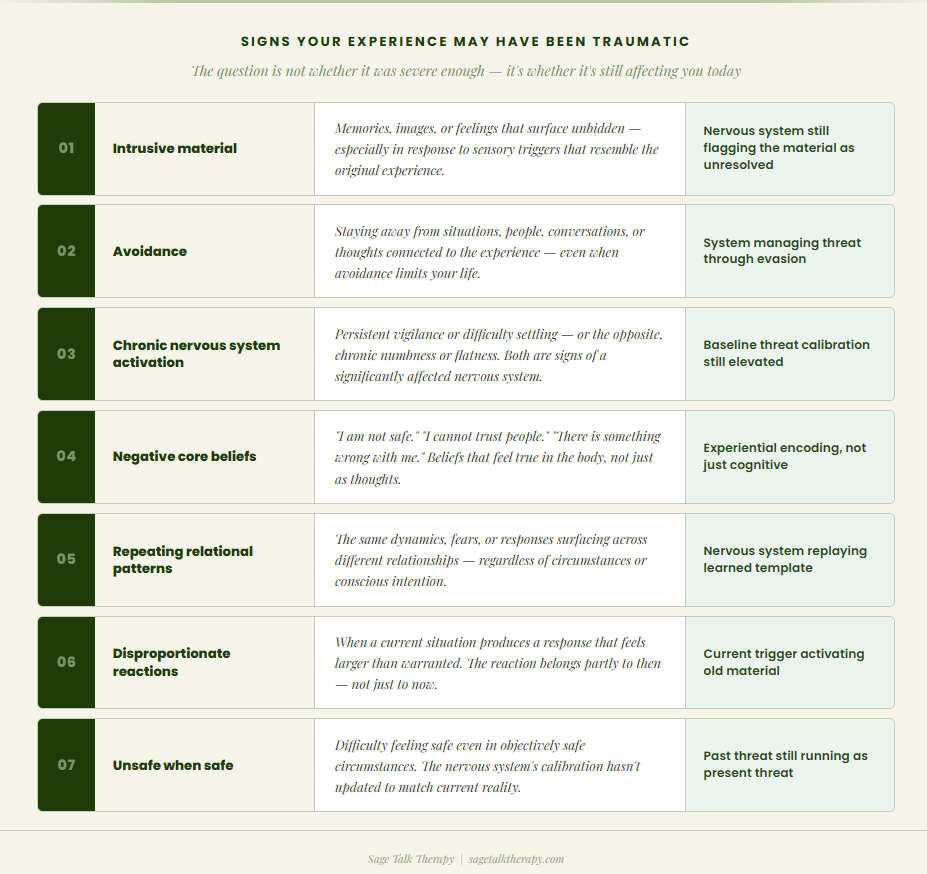
Rather than asking whether the event was severe enough, a more useful question is whether the experience left an imprint that is still affecting your functioning. Here are signs that it may have:
Intrusive material: Memories, images, or feelings that surface unbidden — particularly in response to sensory triggers that resemble something about the original experience. The intrusion can be vivid or subtle. It doesn't have to look like a flashback to be a trauma response.
Avoidance: Staying away from situations, conversations, people, or even thoughts that are connected to the experience. Avoidance is one of the clearest signals that the nervous system has flagged something as threatening and is managing that threat through evasion.
Chronic nervous system dysregulation: Persistent hypervigilance, difficulty settling, a baseline level of alertness that doesn't respond to objectively safe circumstances. Or, on the other end, chronic numbness, flatness, difficulty accessing feeling. Both are signs of a nervous system that has been significantly affected.
Negative beliefs about yourself or the world: "I am fundamentally unsafe." "I cannot trust people." "There is something wrong with me." "I am not enough." These beliefs tend to be encoded not just cognitively but experientially — they feel true in a way that doesn't respond to argument. That quality often indicates a traumatic origin.
Relational patterns that repeat: Patterns in relationships — the same dynamics surfacing regardless of different partners or circumstances, the same fears activating, the same responses appearing — often trace back to what the nervous system learned about relationships in early experience.
Reactions that feel disproportionate: When a current experience produces a response that feels larger than what the situation warrants, that gap often indicates that the current experience is activating something older. The reaction belongs partly to then, not just to now.
Difficulty feeling safe even when safe: When the nervous system has been trained by experience to treat the world as threatening, it does not automatically update that calibration when circumstances change. The experience of not feeling safe even in objectively safe situations is a direct expression of trauma's effect on the nervous system.
What this means for treatment
If what you experienced was trauma — of any kind, big-T or small-t, acute or cumulative — then treatment that addresses it at the level where it is stored is more likely to produce lasting change than treatment that works primarily at the cognitive level. Understanding what happened and why it affected you the way it did has genuine value. It doesn't resolve the physiological imprint.
This is also true for intergenerational trauma — patterns passed down through family systems that may show up as chronic anxiety, hypervigilance, or relational patterns without any specific personal memory that seems to explain them. The body carries what was transmitted before there were words for it.
EMDR is effective across the range of traumatic experience — not only for big-T trauma but for the accumulated experience of chronic little-t trauma, for childhood environments that shaped the nervous system in lasting ways, for the relational experiences that produced the negative beliefs and patterns that are still operating today. For clients who want to address a specific experience or pattern efficiently, EMDR Intensives provide the extended processing time that allows the work to move more thoroughly than weekly sessions often allow.
The starting point is giving yourself permission to take seriously what you have been carrying. Not because naming it as trauma provides a label or an excuse, but because accurate understanding of what is happening in your nervous system is what points toward the right treatment.
Permission to name it
If you have been carrying something for a long time and have been telling yourself it wasn't bad enough to warrant real attention — this is the post's central invitation: you have permission to take it seriously.
Not because everything is trauma. Not because the bar for what counts should be so low that the word loses meaning. But because the mechanism that produces lasting distress is not the objective severity of what happened. It is whether the nervous system was overwhelmed, and whether it has ever had the support it needed to complete the processing.
You do not have to have survived a disaster to carry a wound. You do not have to have experienced the worst possible version of something for your experience to matter. The fact that someone else had it worse does not mean your nervous system is fine.
If it is still affecting you, it is worth addressing. That is the bar. Not severity. Impact.
if This Resonates
I work with clients in Westchester, NY and online throughout New York and Connecticut who are carrying experiences of all kinds — acute and chronic, dramatic and quiet, named and unnamed. If you have been wondering whether what you experienced counts, the most direct thing I can offer is a conversation.
Learn more about Trauma Therapy.

Dadiana Lopez
LCSW · Anxiety & Trauma Therapist · EMDR Specialist
Dadiana Lopez is a Licensed Clinical Social Worker and EMDR therapist based in White Plains, NY. She specializes in anxiety, trauma, PTSD, and the patterns that form in the wake of both — including people-pleasing, perfectionism, and burnout. She sees clients in person in Westchester and online throughout New York and Connecticut.
Seeing clients in-person in White Plains, NY and online throughout New York and Connecticut.