
If you have worked with a trauma-informed therapist, you have probably heard the phrase "window of tolerance." It comes up in EMDR preparation, in somatic work, in conversations about pacing and readiness for deeper processing.
But the concept is useful far beyond the therapy room. Understanding your own window of tolerance — what it is, how trauma narrows it, and what expanding it actually requires — changes how you understand your own responses to stress. And it explains something that a lot of people with trauma histories find genuinely relieving to finally have language for: why you either spiral or shut down, and why trying harder does not fix it.
What the window of tolerance actually is
The window of tolerance is a concept developed by psychiatrist Daniel Siegel. It describes the optimal zone of nervous system arousal within which a person can function effectively — the range in which you can feel emotions without being overwhelmed by them, think clearly while also staying connected to your body, and engage with difficulty without losing your footing.
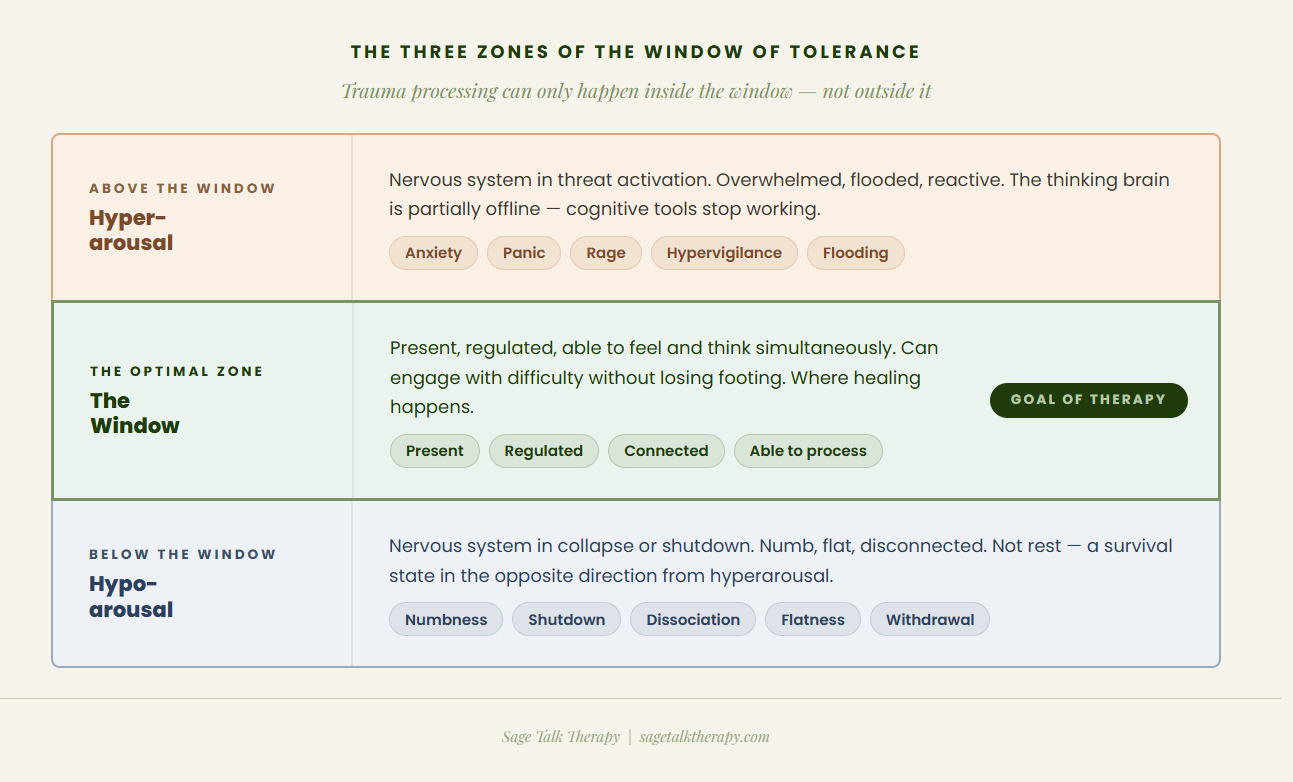
The window of tolerance is the optimal zone of nervous system arousal within which a person can function effectively, process information, and stay present. Outside this window, in either direction, effective functioning and trauma processing become very difficult or impossible.
That last phrase matters: outside the window, in either direction. The window has two edges — and exceeding either one produces a state that looks and feels very different but is equally a sign that the nervous system has left its functional range.
The window of tolerance is the zone where you can handle stress, feel emotions, and stay connected to yourself. When you're pushed outside it, your nervous system shifts into survival mode — and the tools that normally work stop working.
This is worth sitting with: the tools that normally work stop working. When someone outside their window is told to take a deep breath or challenge their anxious thoughts or use a coping skill, those instructions frequently fail — not because the person is resistant, but because the nervous system state they are in makes those cognitive and behavioral tools genuinely inaccessible. The window is a physiological reality, not a frame of mind.
The three zones
Understanding the window requires understanding what sits on either side of it.
The window — optimal arousal zone.
Inside the window, you have access to the full range of your capacities: emotion, thought, body sensation, connection to other people. You can feel something difficult and stay present. You can engage with a challenging problem and think it through. You can be in a hard conversation and remain connected to the other person and to yourself. This is not the absence of feeling. It is the capacity to feel and function simultaneously.
Hyperarousal — above the window.
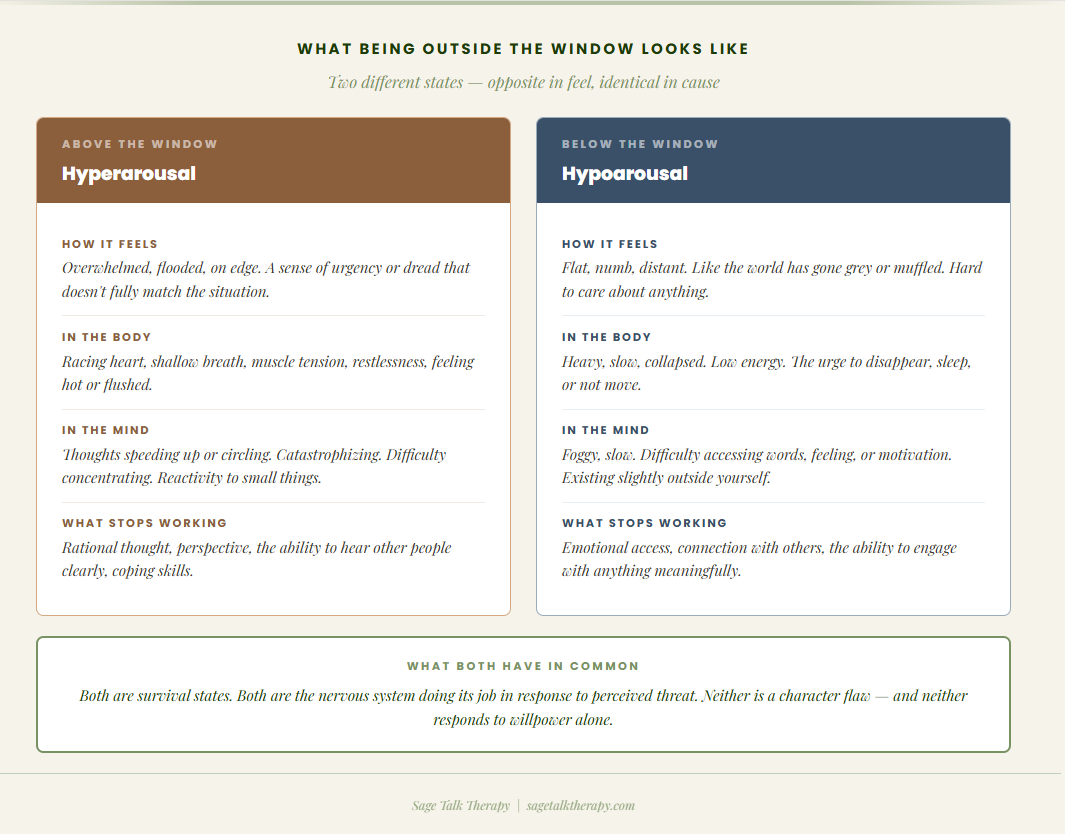
When the nervous system moves above the upper limit of the window, it enters a state of threat activation. Hyperarousal involves an overactivation of the body's stress response system. When someone is in a state of hyperarousal, they may feel constantly on edge, anxious, or overwhelmed. The heart rate increases. Breathing becomes shallow. Muscles tense. The thinking brain partially goes offline. From the inside this can feel like anxiety, panic, rage, hypervigilance, the sense that something terrible is about to happen. It is the fight or flight state — the nervous system mobilized for threat.
Hypoarousal — below the window.
When the nervous system moves below the lower limit of the window, it enters a state of collapse or shutdown. This is the freeze response — the nervous system's last resort when fight or flight is not available or has not worked. From the inside this can feel like numbness, disconnection, emotional flatness, the inability to access feeling, exhaustion that rest doesn't touch, or the strange sense of being slightly outside your own experience. Many people with chronic hypoarousal don't recognize it as a nervous system state because it doesn't feel like activation — it feels like the absence of feeling.
Both hyperarousal and hypoarousal are survival states. Neither is a character flaw. Both are the nervous system doing its job — responding to what it perceives as threat, with the most effective tools available.
How Trauma Narrows the Window
A person who has not experienced significant trauma tends to have a relatively wide window. They can tolerate a significant range of emotional and physiological activation without leaving their functional zone. Stress moves them closer to the edges, but it takes considerable intensity to push them out.
Trauma shrinks the window of tolerance. The nervous system learns that the world is dangerous and becomes quicker to shift into hyperarousal or hypoarousal.
This is the physiological mechanism through which trauma affects daily functioning. The nervous system, shaped by overwhelming experience, recalibrates its threat threshold downward. Things that a wider-windowed person can manage without leaving their functional range will push a narrowed-window person outside it. Not because they are weaker or less capable, but because their nervous system has genuinely learned something different about how much activation is safe.
This narrowing happens across the full range of traumatic experience — not only through acute single-event trauma but through the accumulated weight of chronic stress, emotional neglect, relational unpredictability, and any experience that repeatedly overwhelmed the nervous system's capacity to process. Childhood environments that were chronically unsafe, unpredictable, or emotionally unavailable produce significant window narrowing — often without any single identifiable traumatic event.
The narrowed window also means that the distance between regulated and dysregulated is much shorter. Small triggers produce large responses. Situations that seem manageable from the outside produce genuine overwhelm from the inside. The person is not overreacting. They are accurately responding to how close they already are to the edge of their window.
Why this explains so much
The window of tolerance framework explains several things that people with trauma histories often find confusing or shameful about their own responses.
Why you can't just calm down
When you are outside your window in hyperarousal — truly flooded — the instruction to calm down is asking a physiologically activated nervous system to do something it is not currently capable of. The prefrontal cortex, which would execute calm-down strategies, is partially offline. This is not a choice. It is a state. Moving back into the window requires physiological intervention — breath, movement, grounding, sensory input — not just a decision.
Why numbness isn't rest
Many people with chronic hypoarousal assume they are simply not emotional or not reactive. They may have been told they seem calm or detached. The window of tolerance framework names what is actually happening: the nervous system has collapsed below the functional zone into shutdown. This is not regulation. It is the absence of accessible feeling — and it is as much a dysregulation state as hyperarousal, just in the opposite direction.
Why coping skills stop working under stress
Breathing exercises, grounding techniques, cognitive reframing — these work inside the window. When someone is significantly outside their window, these tools become inaccessible. The instructions make sense cognitively but cannot be implemented. This is not failure. It is the window.
Why some people swing between both extremes
Many trauma survivors experience both ends — periods of hyperactivation alternating with periods of shutdown. This is the nervous system oscillating between its two survival states, never finding a stable landing in the functional zone in between. Understanding this as a window issue rather than a mood or character issue changes both how the person relates to it and what they do about it.
What expanding the window actually requires
The goal of trauma therapy is to help people expand the window so that more can be experienced without leaving it, and develop the capacity to recognize when they are outside it and return.
This is worth being precise about, because there is a common misunderstanding here. The goal is not to feel calm all the time. It is not to eliminate emotional intensity. It is not even to prevent being pushed outside the window — that will happen regardless. The goal is a wider window and a faster return.
A wider window means more can happen without the nervous system leaving its functional range. More stress can be tolerated before flooding. More emotional intensity can be felt without shutdown. More difficult material can be engaged with before it becomes overwhelming. The same events that previously knocked a person outside their window become manageable from inside it.
Here is what that expansion actually requires — and this is where most tip-list posts on this topic stop short:
Stabilization before processing.
You cannot expand the window by going directly into the most difficult material. Attempting to process trauma before the window is wide enough to hold the activation produces flooding or shutdown — neither of which is processing. This is why the preparation phase of EMDR involves explicit window-building work before any processing begins. The window needs to be wide enough to hold the activation that processing generates. This is not a delay. It is what makes processing safe and effective.
Titrated activation — small doses.
The window expands through repeated experience of moving toward activation and returning to regulation — not through avoidance, and not through flooding. Somatic and trauma-informed approaches work with small, carefully titrated doses of activation: just enough to engage the edge of the window, then supported return to the functional zone. Over time, with repetition, the edge moves. The window widens.
Co-regulation.
Engagement with another person — the social engagement system — is one of the most effective means of moving out of shutdown. The nervous system is a relational organ. It regulates itself partly through contact with other regulated nervous systems. A calm, attuned therapeutic relationship is not just emotionally supportive — it is physiologically regulating. This is one of the reasons trauma therapy requires more than just technique.
Body-based work.
Because the window is a physiological reality, expanding it requires physiological work — not just insight. Movement, breath, attention to body sensation, and somatic practices all contribute to window expansion in ways that purely cognitive work does not. The body is where the window lives, and the body is where the expansion happens.
Working with the parts that guard the window.
In IFS terms, many people have parts that are invested in keeping the nervous system in a particular state — managers that keep hyperarousal going as vigilance, or parts that maintain shutdown as protection. Working with those parts directly, understanding what they are afraid of and what they need, is often necessary for genuine window expansion rather than temporary regulation.
Recognizing your own window
One of the most immediately useful things this framework offers is a way to track your own state in real time.
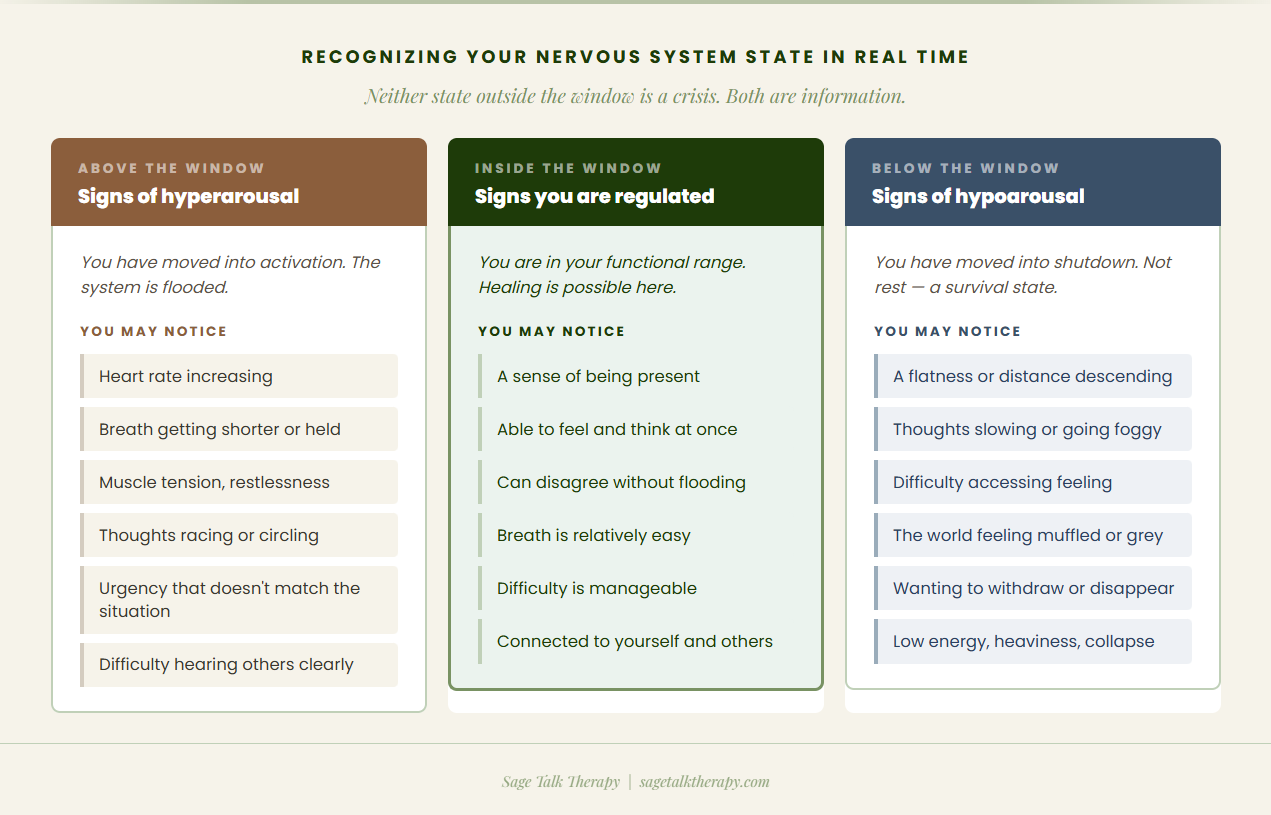
Inside the window, you can probably notice: a sense of being present, some capacity to think and feel simultaneously, the ability to engage with difficulty without being overwhelmed by it. You can disagree without flooding. You can feel sad without collapsing. You can be uncertain without spiraling.
Signs you have moved into hyperarousal: heart rate increasing, breath getting shallow or held, muscle tension, a sense of urgency or threat that doesn't quite match the situation, thoughts speeding up or circling, the sense that something is very wrong.
Signs you have moved into hypoarousal: a kind of flatness or distance descending, thoughts becoming slow or foggy, difficulty accessing feeling, a sense of the world becoming grey or muffled, wanting to disappear or withdraw.
Neither of these states is a crisis. They are information. The window of tolerance framework converts those states from something shameful or confusing into something legible: your nervous system has left its functional range, and it needs support to return.
That shift — from "what is wrong with me" to "I have left my window and I know what that means" — is itself a small but real form of regulation. Understanding what is happening is one of the first steps toward being able to do something about it.
if This Resonates
The window of tolerance framework is one I return to consistently in clinical work — both as a psychoeducation tool and as an active clinical target. If you recognize yourself in what you have read here — particularly if you swing between overwhelm and shutdown and have not had language for what that means — I would welcome the conversation.
Learn more about Trauma Therapy.

Dadiana Lopez
LCSW · Anxiety & Trauma Therapist · EMDR Specialist
Dadiana Lopez is a Licensed Clinical Social Worker and EMDR therapist based in White Plains, NY. She specializes in anxiety, trauma, PTSD, and the patterns that form in the wake of both — including people-pleasing, perfectionism, and burnout. She sees clients in person in Westchester and online throughout New York and Connecticut.
Seeing clients in-person in White Plains, NY and online throughout New York and Connecticut.