
Every January, the same thought shows up for a lot of people: this is the year I finally talk to someone. Then comes the second thought: but I should wait until the holidays are over, until work calms down, until I feel ready. And before you know it, it’s March.
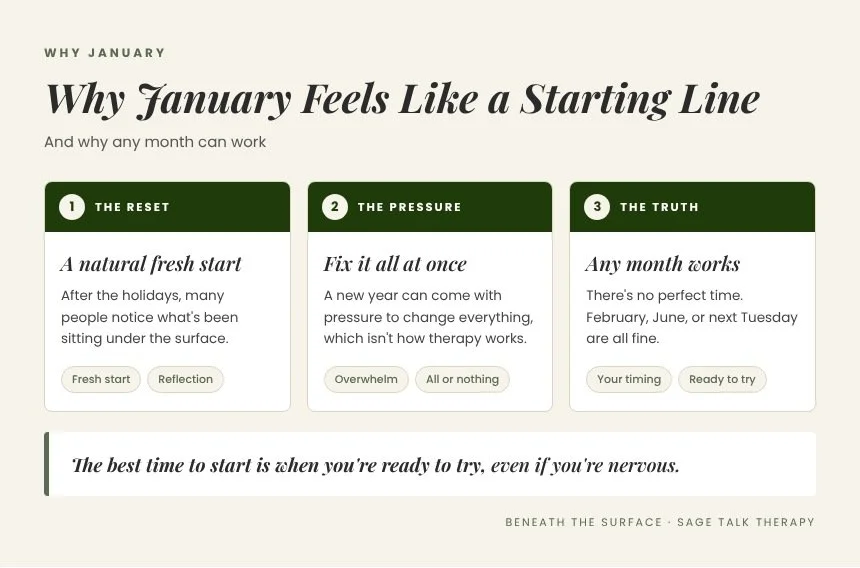
If you’ve been going back and forth, here’s the honest answer. January can be a good time to start therapy. So can February, June, or next Tuesday.
Is January a good time to start therapy?
It can be. A new year gives many people a natural starting line, and the holidays often bring up what’s been sitting under the surface, like family dynamics, loneliness, or the sense that you’re running on empty. If that’s where you are, starting in January makes sense.
But the best time to start therapy isn’t a month. It’s when you’re ready to try, even if you’re nervous about it. Waiting for a perfectly calm moment usually means waiting a long time, because the pressure that makes you want help rarely disappears on its own. If you’re wondering whether what you’ve been through counts, how to know if what you experienced was trauma may help you decide.
Do I have to wait for the new year?
No. A new-year start can feel motivating, but it can also come with pressure to fix everything at once, and that’s not how therapy works. You don’t need a resolution, a plan, or the right words. You can start with “I’m not sure what’s wrong, but something isn’t working.” It’s also fine if you’ve tried therapy before and it didn’t help. Why therapy didn’t work before is often about fit and approach, not about you.
What does the first month of therapy look like?
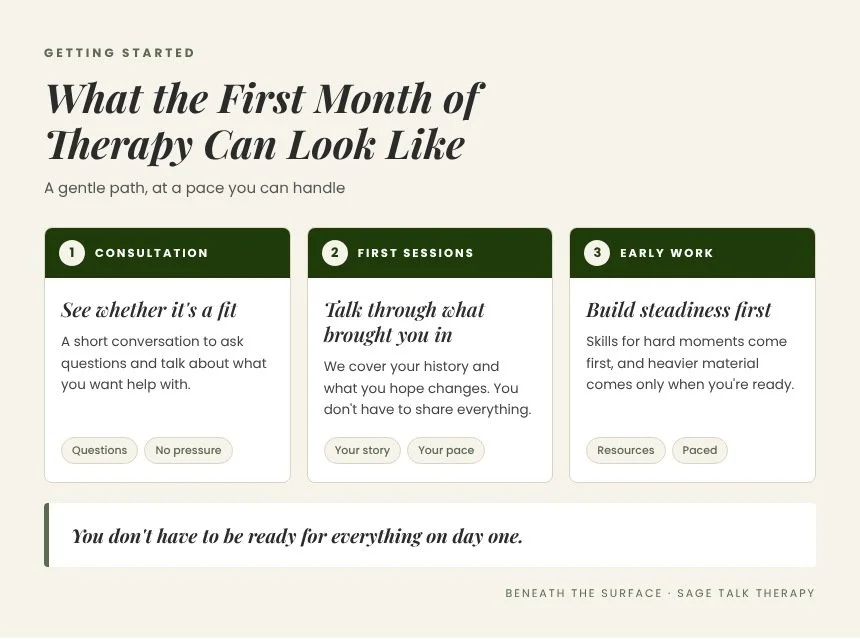
Starting is often the scariest part, partly because people don’t know what happens. Here’s the usual path:
A consultation. A short conversation to see whether we’re a fit, answer your questions, and talk about what you want help with.
The first session. We go over what brought you in, your history, and what you’re hoping changes. You don’t have to share everything.
The next one to three sessions. We get to know each other, I may use short assessments to understand how intense things feel, and we talk about a plan for the work.
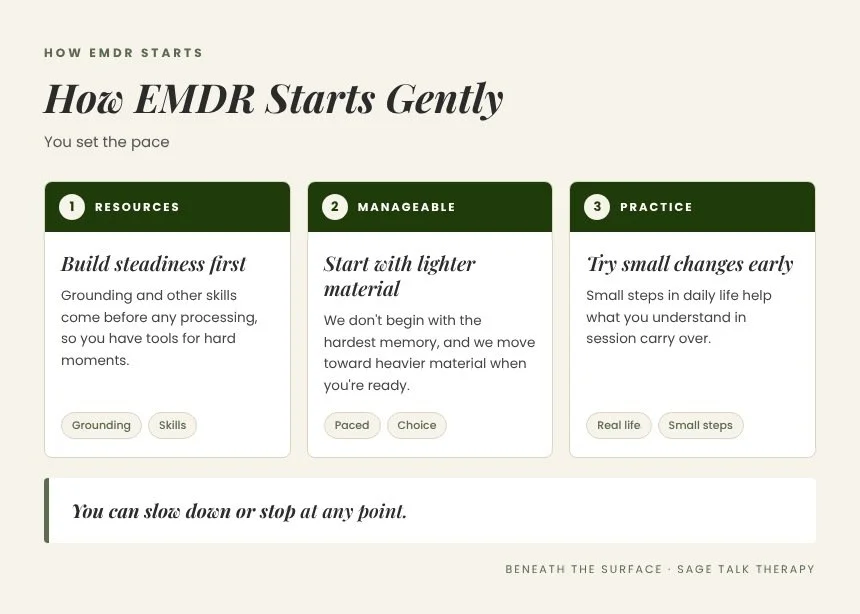
Early work. We build skills for staying steady and begin with material that feels more manageable. If EMDR is part of the plan, we don’t start with the hardest memory.
What if I’m not ready to talk about everything?
You don’t have to be. Therapy done well moves at a pace you can handle. Good therapists don’t push you into your hardest memories in the first week. Early sessions are about building steadiness, so you have resources before you do deeper work. I explain how that works in what happens in your brain during EMDR and in common fears about EMDR, including the worry that it will make things worse before it gets better.
What might start to change in the first few weeks?
Everyone’s pace is different, and I can’t promise a particular outcome. But there are a few early shifts people often describe:
You feel less alone with it. Saying it out loud to someone steady can lighten the load.
You get clearer on what you’re working on. The vague “something’s off” starts to have words.
You have a few tools for the hard moments. Even small ones, like grounding, can change how a stressful day feels.
What can I do before the first session?
You don’t need to prepare much, but a few small things help:
Jot down two or three things you’d like to feel differently. Rough notes are fine.
Think about a day and time you can protect, so sessions don’t get squeezed out by work.
Write down any questions about the process, the pace, or how I work.
Notice what you hope for and what you’re worried about. Both are useful to bring in.
Can I move faster if I want to?
If you want to build momentum, an EMDR Intensive can be an option. It’s a different format, not a different goal: you prepare beforehand, you get longer uninterrupted time to work on one focus, and you follow up afterward to practice what shifted. Some people start with weekly sessions, and others start with an intensive, so it’s worth a conversation. I explain how the two compare in EMDR Intensives vs. weekly sessions, and if you’ve felt stuck in weekly therapy, it might not be you. I’m happy to talk through timing for an EMDR Intensive in early 2027 if that interests you. It isn’t the right fit for everyone, and we work that out together.
It doesn’t have to stay this way
You don’t have to wait for a new year to deserve support, and you don’t have to have it figured out to ask. Picture a few weeks from now, after a couple of sessions: you’ve said the thing out loud, you have a little more steadiness on a hard day, and the thing you’ve been carrying feels less like a secret. Small shifts like that add up.
Many people who start nervous find that the first step was the hardest part, and that it gets easier with support and a pace that fits.
If this resonates
If you’ve been thinking about it for a while, reaching out can be the first step. I work with adults in White Plains, Westchester, and across New York and Connecticut, in person and online. I’d be glad to hear what’s been on your mind. Schedule a consultation at sagetalktherapy.com, and we’ll talk about whether weekly therapy, an EMDR Intensive, or both makes sense for you.

Dadiana Lopez
LCSW · Anxiety & Trauma Therapist · EMDR Specialist
Dadiana Lopez is a Licensed Clinical Social Worker and EMDR therapist based in White Plains, NY. She specializes in anxiety, trauma, PTSD, and the patterns that form in the wake of both — including people-pleasing, perfectionism, and burnout. She sees clients in person in Westchester and online throughout New York and Connecticut.
Seeing clients in-person in White Plains, NY and online throughout New York and Connecticut.