
Most of the advice for low self-esteem treats it as a thinking problem.
List your accomplishments. Challenge the negative self-talk. Replace the thought "I am not enough" with a more accurate assessment of your actual worth. Write down three things you like about yourself each morning. The premise underneath all of it is that low self-esteem is primarily a cognitive error — a distorted way of thinking about yourself that can be corrected with better evidence and more accurate thoughts.
There is a reason this approach helps some people and leaves others untouched. Low self-esteem is not primarily a thinking problem. It is a relational wound — a belief about your worth that was formed in specific relational contexts, encoded in the nervous system, and that carries the weight of experience rather than the weight of logic.
You can know intellectually that you are valuable, capable, and worthy of care while still feeling, in your body and in your gut, that you are not quite enough. That gap — between what you know and what you feel — is the sign that the belief lives somewhere other than conscious thought. And reaching it requires working at the level where it actually lives.
This post is about where low self-esteem actually comes from. Not the version that lends itself to tip lists, but the version that explains why the tip lists haven't worked.
What low self-esteem actually is
Low self-esteem is a pervasive, negative evaluation of oneself — a deep-seated belief, rather than a passing mood, that one is fundamentally not good enough, not worthy of love, not acceptable as one actually is.
Being understood, respected, and taken seriously is basic to the development of self-esteem. If you experienced neglect or trauma, this impacted your self-esteem negatively.
The key word there is development. Self-esteem is not something you are born with or without. It develops in relationship. Specifically, it develops in the earliest relationships — with caregivers, family, and the social environments of childhood — through the accumulated experience of being seen, valued, and responded to. Or not.
When those early relational environments communicated, explicitly or implicitly, that you were not quite enough — that love was conditional on performance, that certain parts of you were not welcome, that your needs were too much or not worth attending to, that you were a disappointment or a burden or simply not very important — the belief formed in the body, not just the mind. It became part of the architecture of how you experience yourself.
The root cause of low self-esteem is early relational environments where authenticity threatened attachment or safety.
That framing is precise and important. When being yourself — expressing needs, feeling emotions, making mistakes, being imperfect — produced negative responses from the people whose approval was necessary for survival, the nervous system learned to treat authenticity as threatening. The self that was not acceptable got hidden. And the belief that there is something wrong with the real you — something that needs to be managed, improved, or kept out of sight — took root.
The specific experiences that form it
Low self-esteem rarely comes from a single event. It accumulates — through the texture of an environment, through what was said and not said, through what was welcomed and what was turned away.
Here are the specific relational experiences that most consistently produce lasting low self-esteem:
1. Conditional love and approval
When love or approval was explicitly or implicitly tied to performance — to achievement, behavior, compliance, or emotional presentation — the child learns that who they actually are is not quite the right answer. The love is available, but it is contingent. The child's response is to manage themselves toward what earns the approval, and to experience the parts of themselves that don't earn it as flawed or shameful.
This is one of the most consistent origins of the high-functioning person who cannot feel their own worth despite significant external evidence of it.The performance was always sufficient to earn approval — which means the person never found out whether the self underneath the performance was acceptable. That uncertainty doesn't resolve through achievement. It requires a different kind of experience entirely.
2. Chronic criticism or dismissal
When a child's ideas, feelings, efforts, or way of being were consistently criticized, dismissed, or mocked — by a parent, a sibling, a peer environment — the evaluation of the critic becomes incorporated into the self. The inner critic that many adults live with is not a random voice. It is the internalized voice of an environment that found them wanting. The criticism is now internal, which makes it feel like truth rather than someone else's opinion.
3. Emotional neglect
This is the form of relational wounding that produces the most minimization in adulthood — precisely because there was no single identifiable event, no obvious harm. Just the persistent absence of something necessary. A child who has experienced trauma has a high chance of developing low self-esteem, particularly in family systems where adults are unable to nurture and support the emotional, mental, physical, and spiritual needs of children.
When a child's emotional experience is consistently not responded to — when distress is dismissed, needs are invisible, feelings are met with silence or irritation — the child learns that their inner life does not matter. Not in an explicit way. Just in the lived experience of repeatedly reaching for attunement and finding no one there. The conclusion the child draws, without words, is that they are not worth attending to.
4. Abuse — physical, sexual, or emotional
The most direct form of the wound. When the people responsible for a child's safety and worth communicate, through action, that the child's body or feelings or dignity are not worthy of protection — the damage to self-worth is profound and often long-lasting. Both PTSD and CPTSD were associated with low self-esteem — thus, trauma therapy for both should include improvements in self-esteem.
5. The family role that required self-erasure
The parentified child who was responsible for managing the emotional states of adults. The scapegoat in a family that needed someone to carry its dysfunction. The child who learned to be invisible, to take up less space, to smooth things over. These roles require the child to suppress their own experience in service of the system — and the cumulative effect is a self that has been trained to believe its own needs, feelings, and presence are secondary.
6. Intergenerational transmission
Low self-esteem can also be inherited — not genetically but relationally. A parent who carries deep shame and low self-worth transmits those patterns implicitly, through the quality of their attunement, through the beliefs they enact about worth and acceptability, through what they model about how people treat themselves and expect to be treated. The child absorbs it without language for what they have absorbed.
Why affirmations and evidence don’t reach it
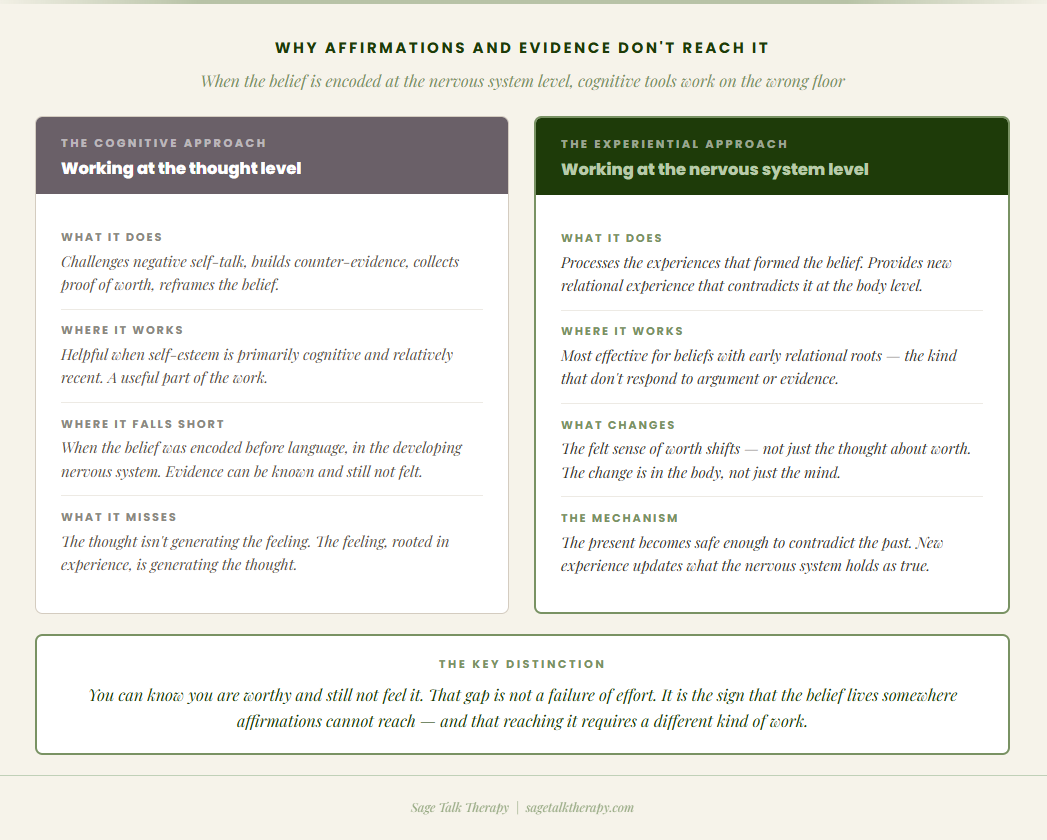
The cognitive model of low self-esteem suggests that negative self-beliefs are maintained by selective attention — focusing on evidence that confirms them and discounting evidence that contradicts them. The treatment implication is to consciously build a more balanced evidence base: notice the positive feedback, challenge the negative self-evaluation, collect proof of your worth.
This approach is not wrong. For low self-esteem that is primarily cognitive and relatively recent, it can be genuinely helpful. The limitation appears when the self-belief is not primarily cognitive — when it is encoded in the nervous system as experiential learning rather than held as a conscious thought.
When a belief about your worth was formed through repeated relational experience in early childhood — when it was encoded in the developing brain and nervous system at a time before language and explicit reasoning — it does not reside primarily in the conscious thought system. It resides at a deeper level, in the body, in the automatic responses that fire before deliberate thought.
You can challenge the thought "I am not enough" with all the counter-evidence available and still feel, in your gut, that you are not enough. Because the feeling is not generated by the thought. The thought is generated by the feeling — and the feeling has a source that predates the thought by years or decades.
This is why positive feedback lands differently for people with deep low self-esteem. Criticism lands and sticks. Praise passes through without leaving a mark. The asymmetry is not random — it reflects a nervous system calibrated to expect and register evidence of inadequacy, and to discount evidence to the contrary. Changing that calibration requires working at the level where it was set.
It also explains why building self-esteem can feel actively threatening — why being praised or cared for can produce anxiety rather than comfort. The nervous system that learned to associate worth with performance may experience genuine positive regard as disorienting, as something it doesn't know how to hold. Widening the capacity to receive care is itself a part of the work.
What low self-esteem looks like in adult life
Low self-esteem rarely presents as someone who simply says "I don't like myself." More often it shows up in patterns — in how the person relates, what they tolerate, what they cannot let themselves have.
Difficulty receiving care, compliments, or help: When worth is not felt as solid, being cared for can feel suspicious, undeserved, or uncomfortable. The compliment is deflected. The offer of help produces guilt. Being loved feels contingent in a way that creates anxiety rather than security.
Chronic apologizing and over-explaining: The sense of taking up too much space, of being too much, of needing to justify one's existence or preferences. Every request comes wrapped in apology. Every boundary is accompanied by extensive explanation.
Staying in relationships or situations that confirm the belief: One of the most consistent and painful features of low self-esteem is that it tends to reproduce the conditions of its formation. The person who learned they were not worth much tends to end up in relationships and environments that reinforce that belief — not because they are drawn to pain but because those environments feel familiar, and familiar feels true.
Difficulty advocating for their own needs: When you fundamentally believe your needs are less important, less valid, or less worthy of attention than other people's, advocating for them requires overcoming a deeply held conviction every time. This is exhausting, and it is why people with low self-esteem often give far more than they receive and call it normal.
Perfectionism as proof of worth: When worth is not felt as inherent, it must be earned. The perfectionism that organizes around low self-esteem is not primarily about high standards — it is about the belief that sufficient performance might eventually produce the feeling of being enough. It never does, because the bar keeps moving. The performance can never be sufficient to settle a question about fundamental worth.
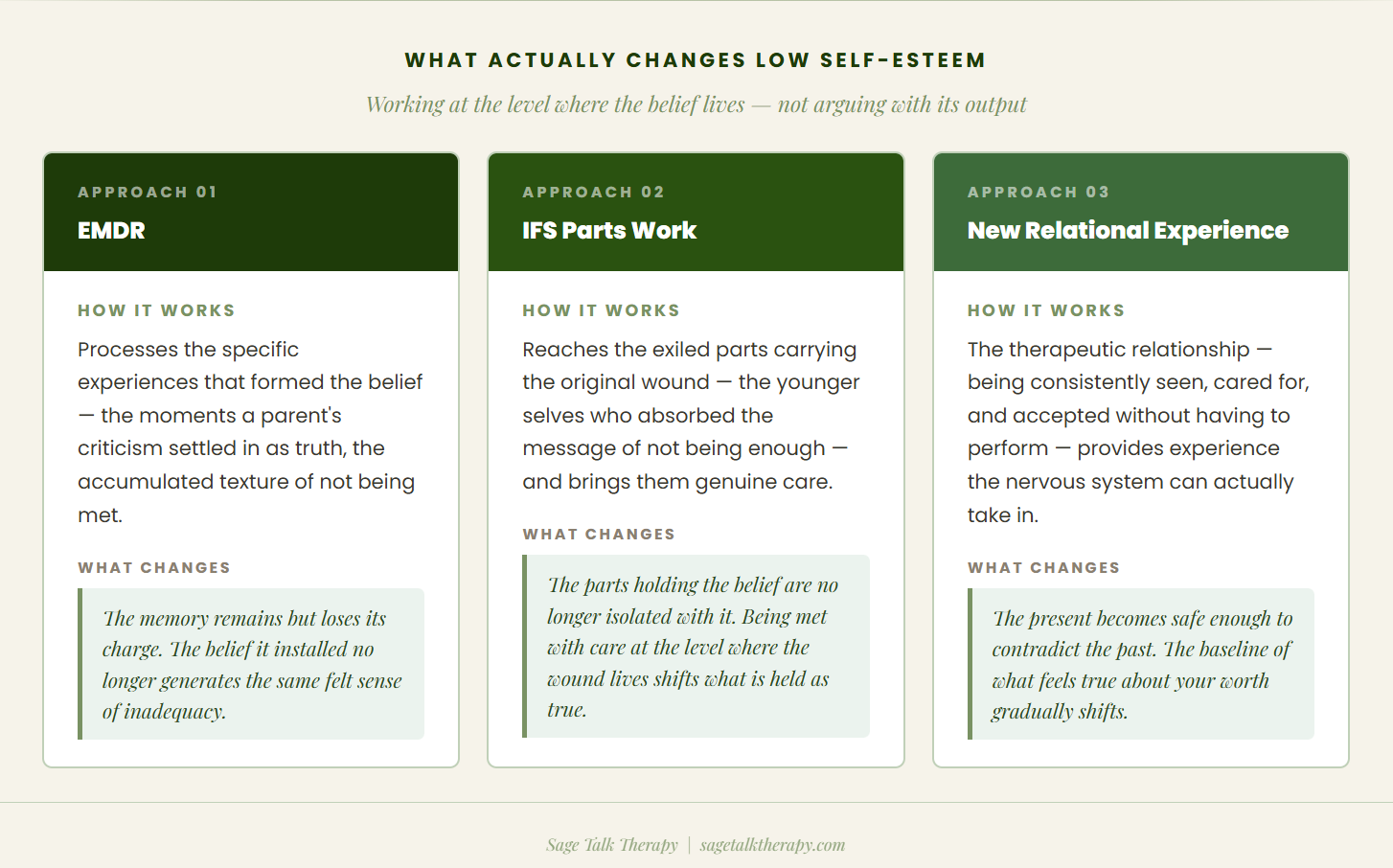
A note on what you deserve
If you have carried low self-esteem for a long time, the idea that you deserve care and genuine regard may itself feel suspicious. That suspicion is part of the wound, not evidence of truth.
The belief that you are not enough was not a neutral observation about your actual worth. It was a response to a specific environment that was not able to meet you adequately. That environment's failure was not a verdict on your value. It was a limitation of the environment.
You are worth addressing this. Not because you need to perform differently or achieve more or be easier to love. Because you are a person, and that is sufficient.
If this resonates
I work with adults in Westchester, NY and online throughout New York and Connecticut whose low self-esteem has roots in early relational experience. If what you have read here describes something you have been carrying, I would welcome the conversation.
Learn more about Low Self-Esteem therapy.

Dadiana Lopez
LCSW · Anxiety & Trauma Therapist · EMDR Specialist
Dadiana Lopez is a Licensed Clinical Social Worker and EMDR therapist based in White Plains, NY. She specializes in anxiety, trauma, PTSD, and the patterns that form in the wake of both — including people-pleasing, perfectionism, and burnout. She sees clients in person in Westchester and online throughout New York and Connecticut.
Seeing clients in-person in White Plains, NY and online throughout New York and Connecticut.